“In Russia, they say I'm a Pole, in Poland they call me Russian”
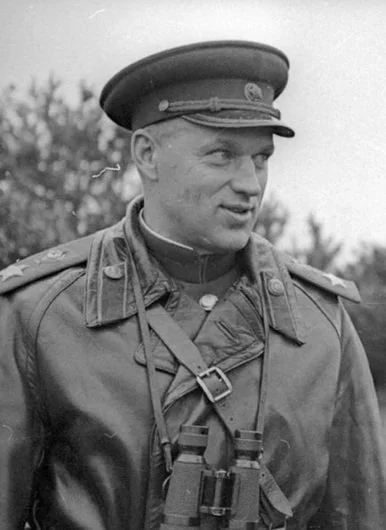
Born in Velikiye Luki in Imperial Russian on 21 December 1896, Konstantin Konstantinovich Rokossovsky was born to a Polish nobleman and his Russian wife. His father was director of railways in Warsaw, and although scion of a line of cavalry officers was himself a civil servant. His father, Ksawery, would die in 1902 after a railway accident, and his mother died a decade later, leaving the orphaned Konstantin to take a job as a laborer.
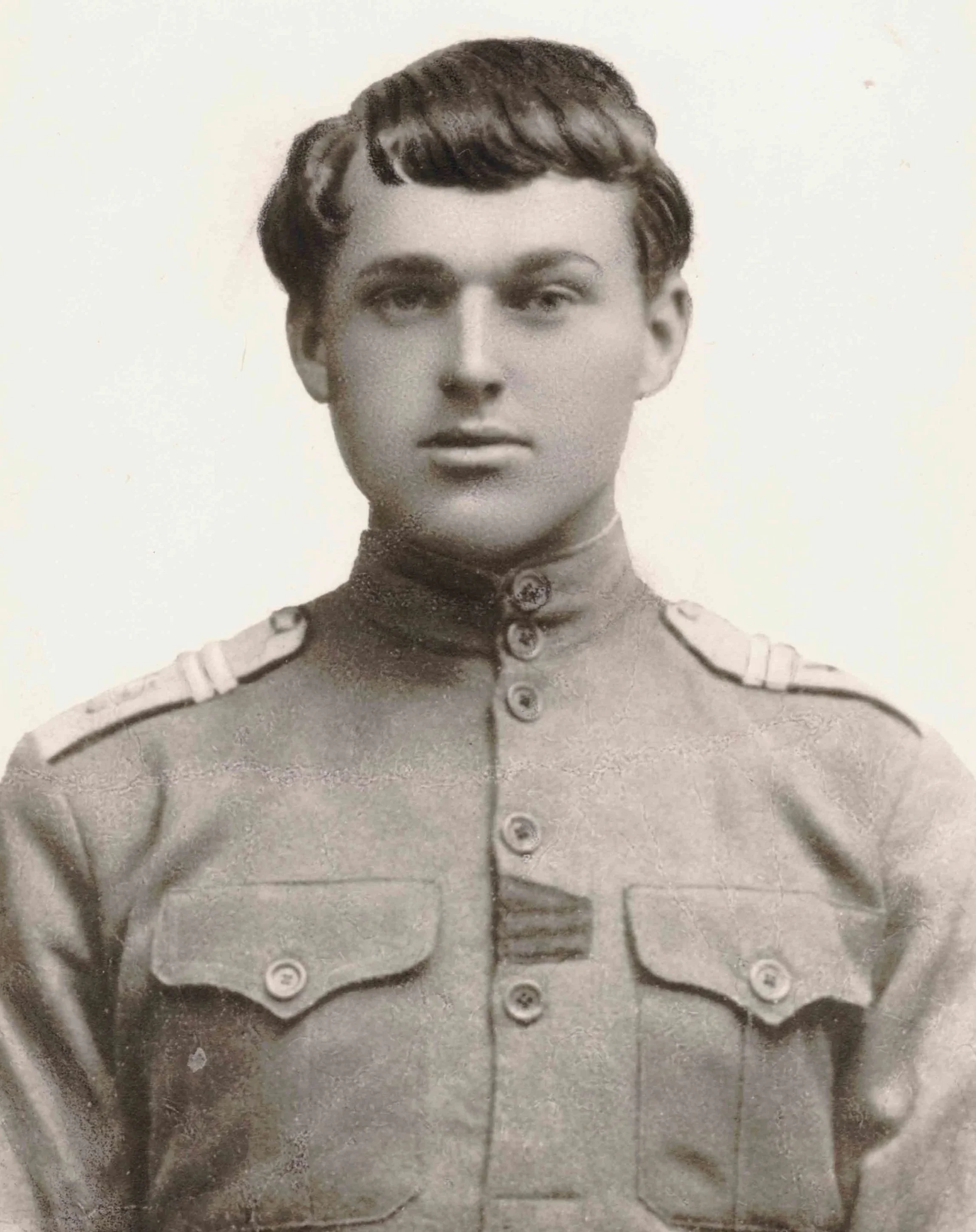
Jr. Sgt. Rokossovsky in the Imperial Russian Army, 1917
In 1914, after rising tensions exploded into the First World War, Rokossovsky enlisted in Tsar Nicholas II’s Imperial Army, assigned to the Kargopol Dragoon Regiment, stationed in Galicia to face Austro-Hungarian forces. During his service with them, Rokossovsky would twice be decorated with the Cross of St. George for bravery, and by 1917 was serving along the Dvina River when he heard of the abdication of Tsar Nicholas II. Rokossovsky and the Kargopol Regiment swore loyalty to the new Provisional Government, and went back into the lines against German troops pushing through Latvia in the summer of 1917.
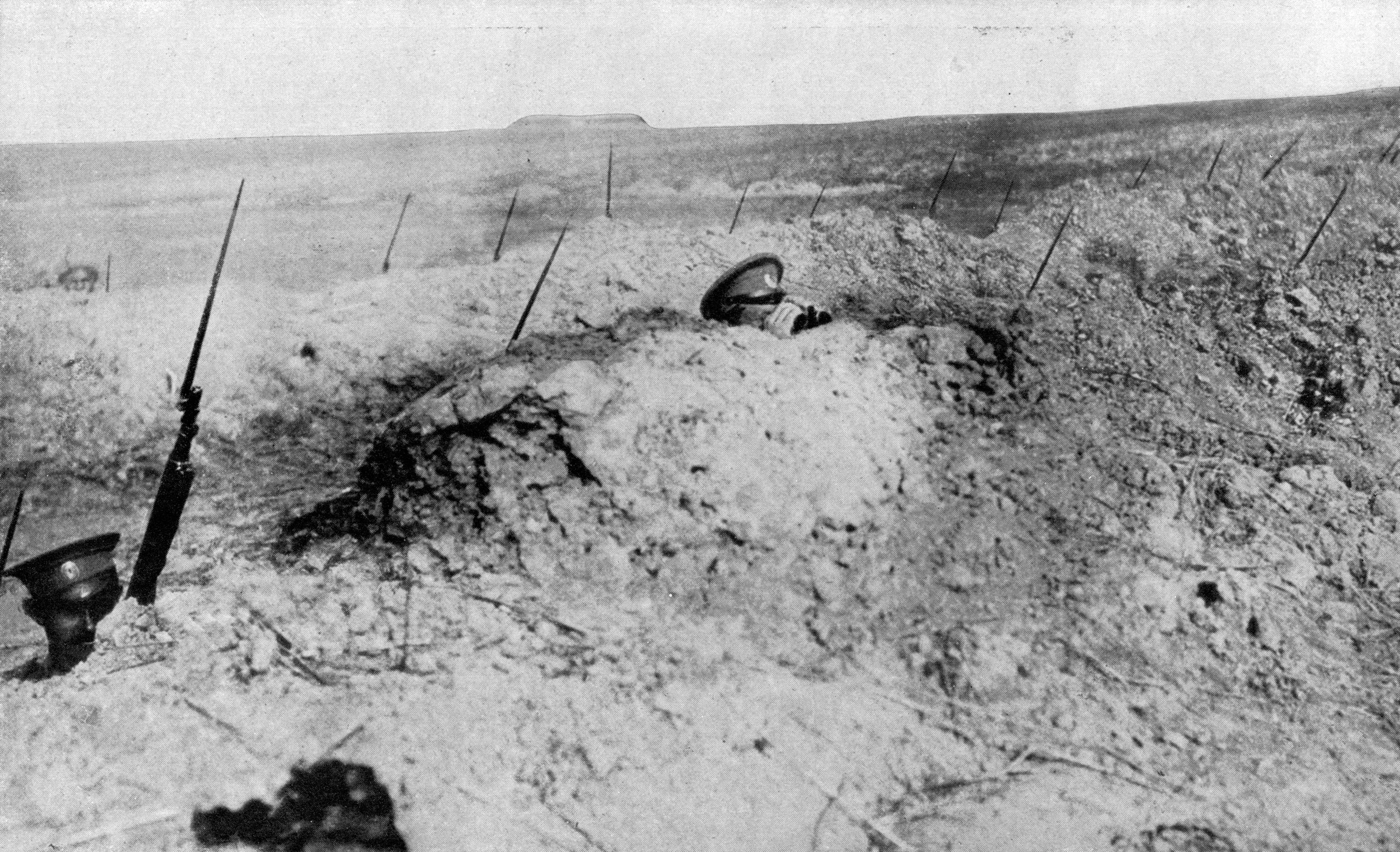
Imperial Russian Soldiers in a trench on the Eastern Front
In October of 1917 the communist Bolsheviks launched a revolution against the provisional government, causing it to collapse and launching the Russian Civil War. The Kargopol Dragoon Regiment disintegrated, with many of its officers and men going their separate ways, and Rokossovsky joined the Bolshevik Red Guards with some of his comrades. Serving throughout the Civil War in various campaigns against anti-communist White forces, Rokossovsky led an assault on White troops near Omsk in 1919, personally killing General Nikolai Voznesensky with his sabre as his cavalry overran the enemy position. For this he was awarded the the prestigious Order of the Red Banner.
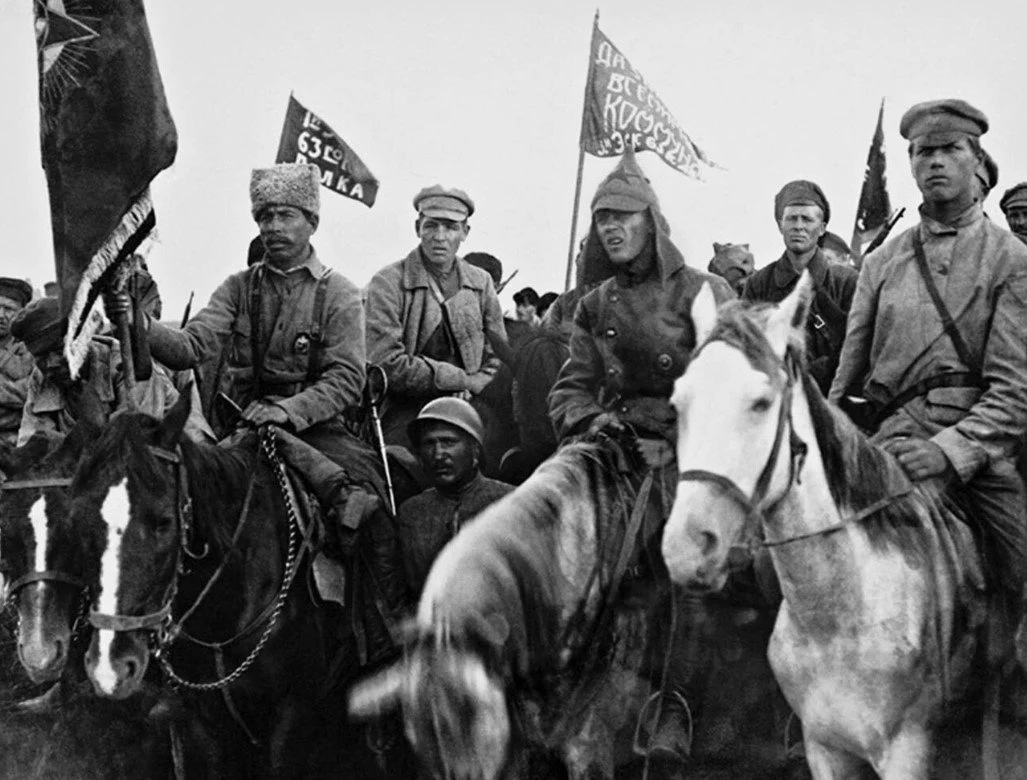
Bolshevik cavalry in the Russian Civil War
Later in the war Rokossovsky and his division were dispatched to Mongolia, where a renegade White general, Roman von Ungern-Sternberg, had attempted to declare an independent state under his own leadership alongside a Khan. the Bolshevik forces were able to route the Mongolians, and Rokossovsky was again decorated after being wounded in battle. In Mongolia he also met the young teacher Julia Barminian, whom he married in 1923, before being sent to the recently renamed Leningrad (formerly St. Petersburg) to attend cavalry officer’s school. While studying there Julia gave birth to a daughter, Ariadna, in 1925.
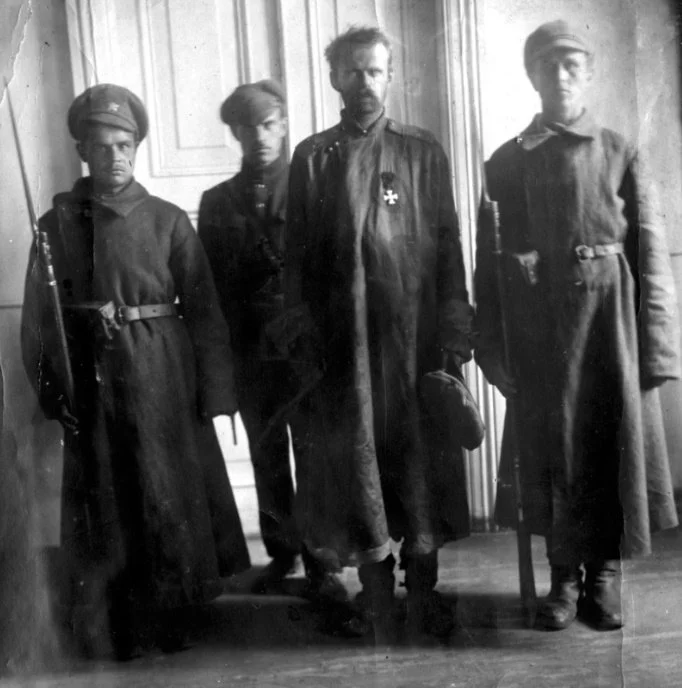
The “Mad Baron” Roman von Ungern-Sternberg under guard after his capture by Bolshevik troops
Following his education Rokossovsky was sent back to Mongolia to train the new Mongolian People’s Army, and subsequently served for the remainder of the decade in that area, including campaigns against the Chinese to secure the Eastern China Railway, which had been disputed with Chiang Kai Shek’s government and its associated warlords since the Russian Revolution. Following the end of that brief conflict in 1929 Rokossovsky was posted as a cavalry commander under the command of Semyon Timoshenko, and commanded a vigorous junior officer, Georgy Zhukov. Rokossovsky personally noted him to be an excellent officer, if a little obstinate in staff roles.
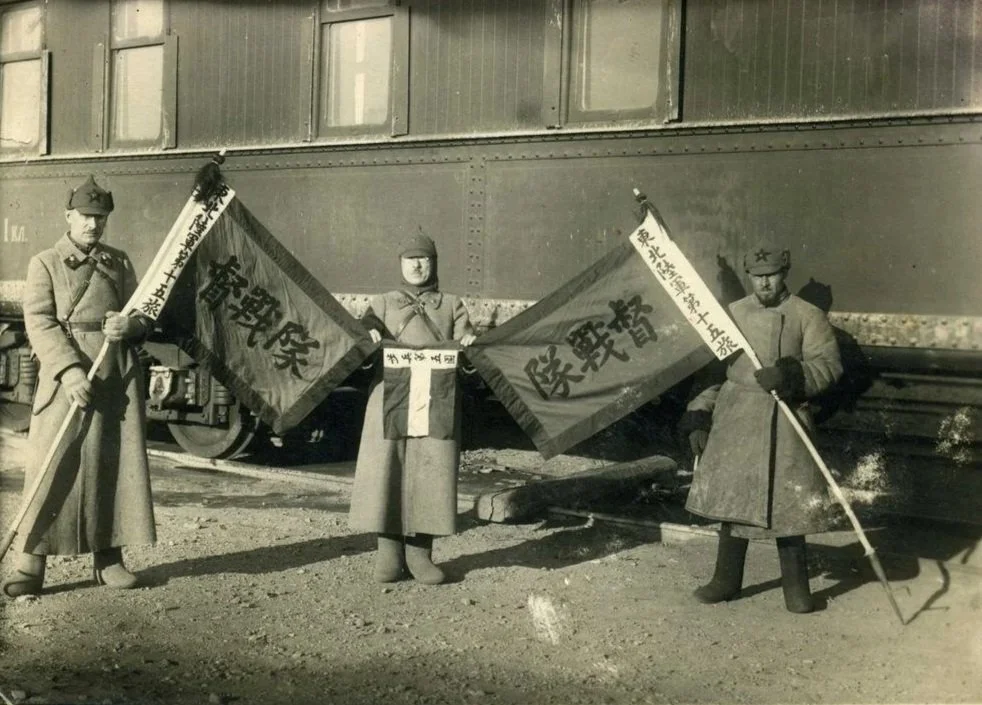
Soviet soldiers pose with captured Chinese flags during the 1929 railroad dispute
During the interwar years Rokossovsky had also made a reputation as a fierce advocate of tank warfare, clashing with powerful cavalry commanders. Despite his long service to Russia and the Soviet Union, in 1937 Rokossovsky was denounced by rivals and was accused of being a spy for Poland among other charges. He was dismissed from the army, arrested by the NKVD, and held in Leningrad, where he was subjected to intense interrogation and torture intended to extract a false confession. Among other acts he had to endure was the pulling of his teeth, and after his release he would replace them with stainless steel dentures, which would become his most recognizable feature.
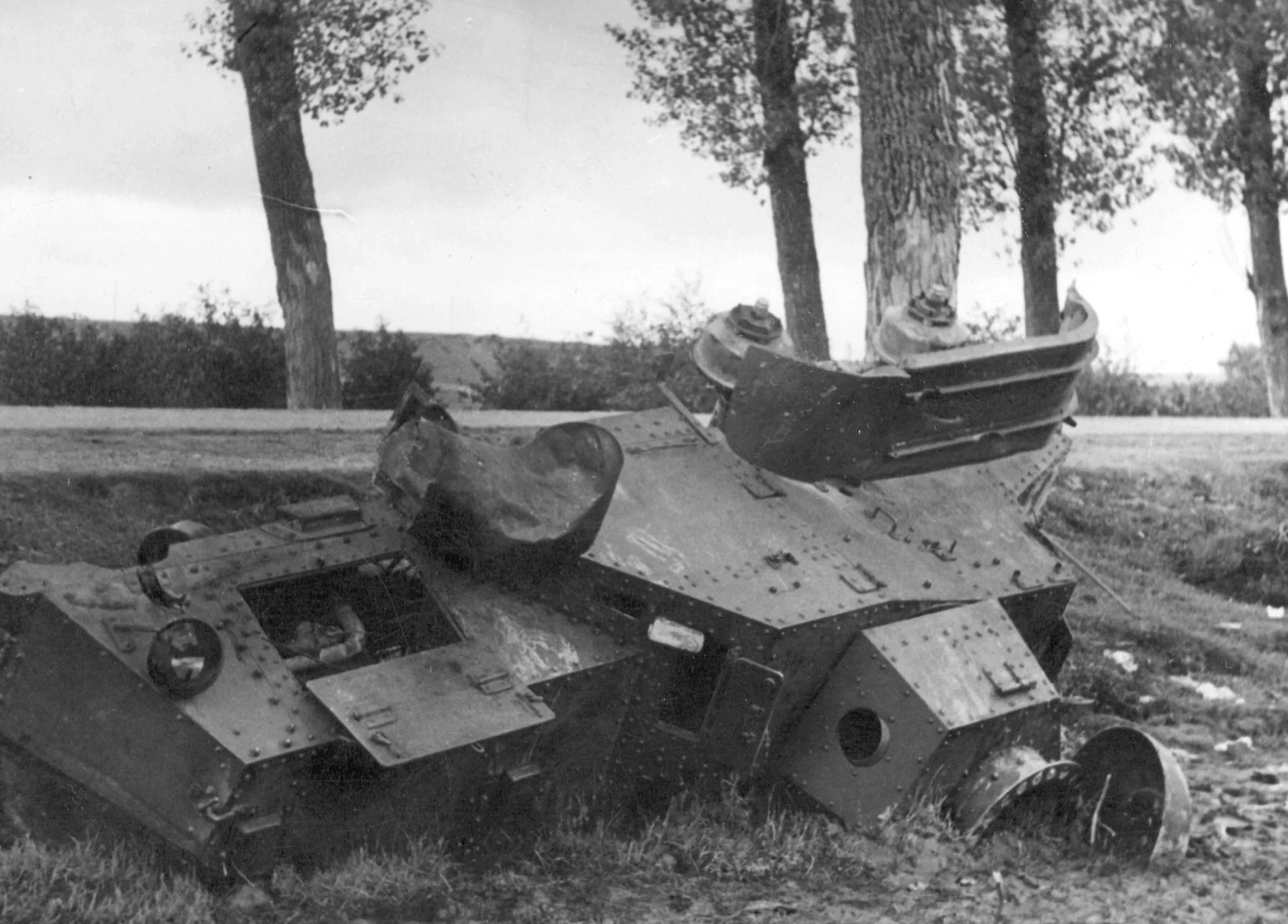
A Soviet armored car knocked out during the German invasion of 1941
During his incarceration the Red Army was rebuffed from their attempted invasion of Finland in the winter of 1939, and in the spring of 1940 he was released from prison when his refusal to testify and the lack of evidence against him became too much to ignore. Restored to a generalship in the Red Army, a year after his release he was in command of a mechanized corps stationed in Ukraine. When the Germans launched Operation Barbarossa in June of 1941 Rokossovsky and his corps moved to engage the invaders with a counterattack, which was repulsed. Despite this, Rokossovsky was decorated for his service, and placed in command of the 4th Army and moved to aid in the defense of Smolensk in July.
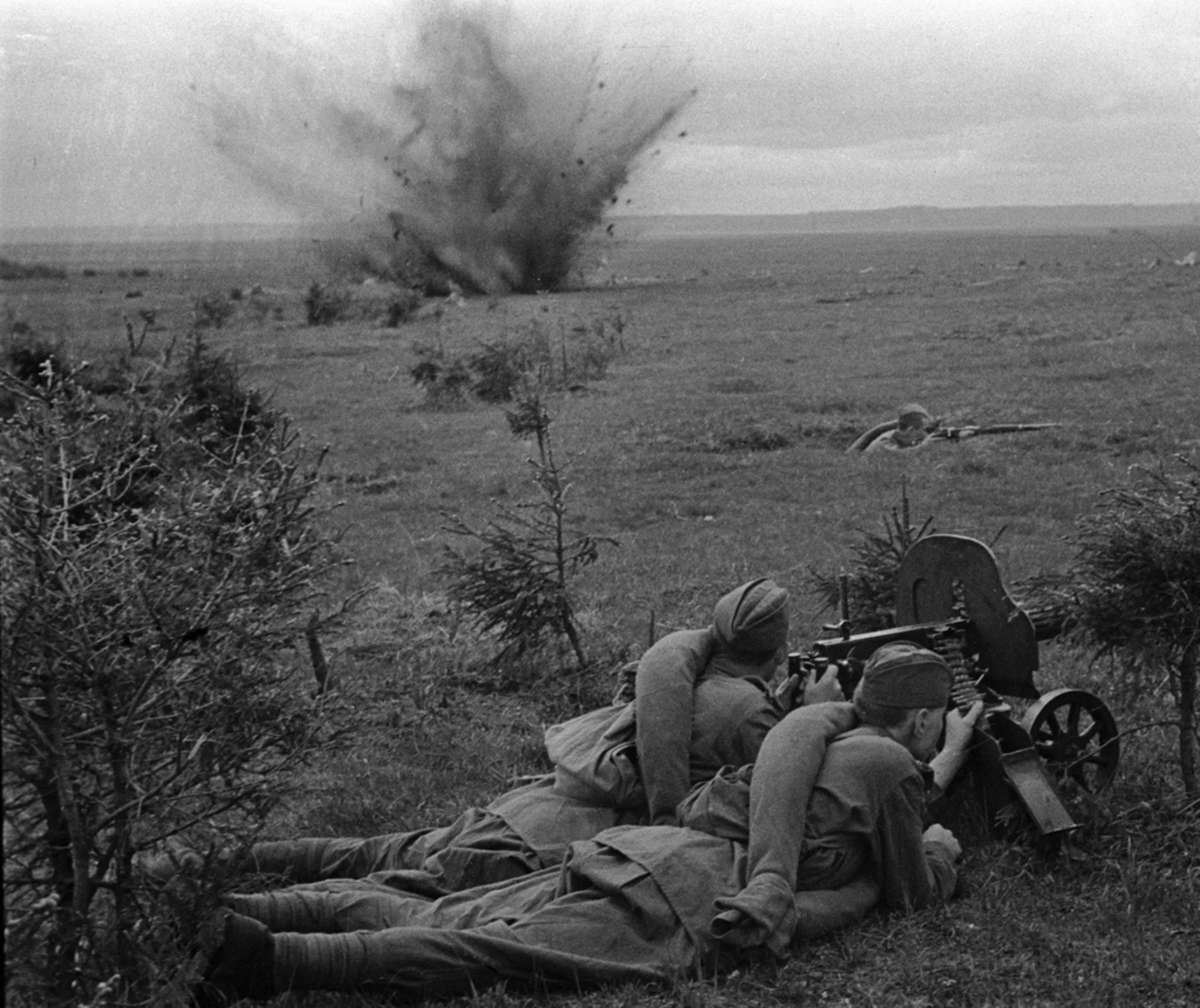
Soviet soldiers in a position along the Dnepr near Smolensk
Russian International News Agency
The 4th had been badly battered in the early phases of the German invasion, and in the end the situation around Smolensk had deteriorated to such an extent that Rokossovsky was never able to physically take command of the formation. Instead he was detailed by Marshal Timoshenko to take command of a Soviet ad-hoc formation being assembled to save the city from flanking panzers. Only a small corridor prevented complete envelopment of the city, and Rokossovsky was to hold the line at the Dnepr River to prevent it being sealed. His “Army”, in reality consisted of a small handful of light vehicles and his staff, and as a result he quickly set about building up a force by rounding up various stragglers from shattered units moving aimlessly eastward away from the German onslaught. Although in the end Smolensk was beyond saving, Rokossovsky’s command was able to hold open the line long enough to prevent a complete annihilation of the defenders, slowing the Germans considerably on their path towards Moscow.
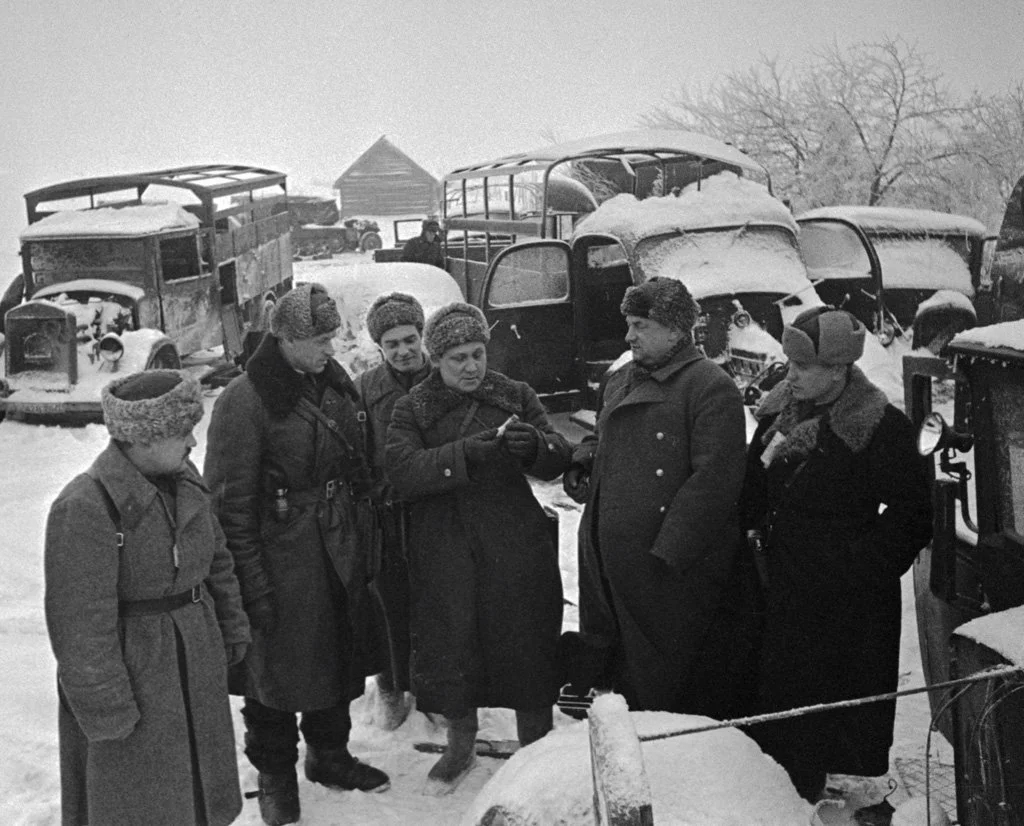
Rokossovsky confers with other officers on the Moscow Front
Russian International News Agency
Moved to defend the Soviet capitol, Rokossovsky took control of the 16th Army, while command of the Western Front was handed over to his old subordinate Georgy Zhukov. In front of Moscow on the Volokolamsk road the 16th bore the brunt of the German Operation Typhoon, with Zhukov refusing to allow the battered formation to withdraw. Rokossovsky thus went over Zhukov’s head to the Chief of the Stavka to receive permission, which was granted, but Zhukov then stepped in to countermand the order. The 16th was thus forced to hold in place until they were forced aside by the Germans, but by that time the enemy was almost spent. The capitol was saved.
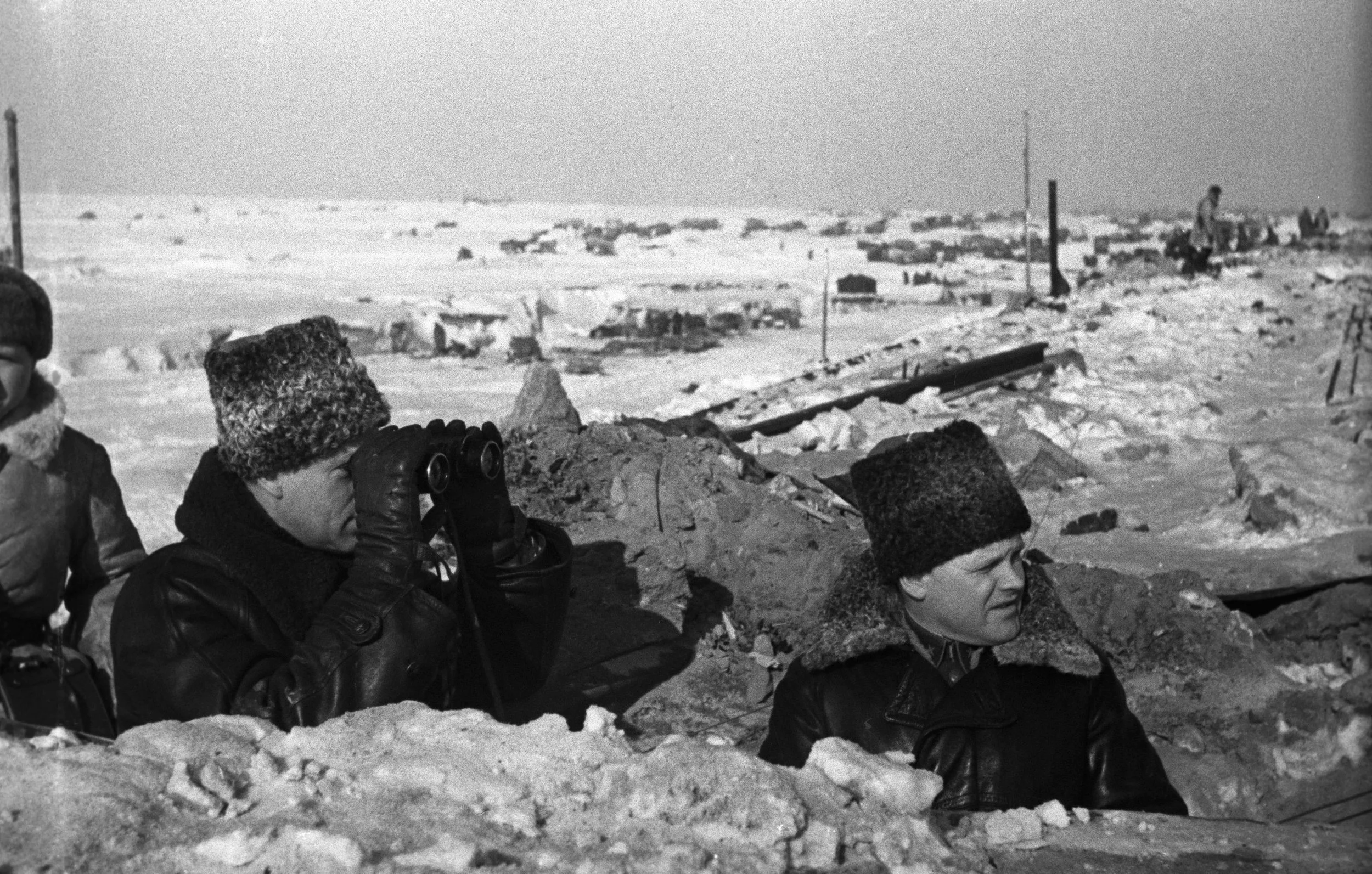
Rokossovsky observes the enemy from a position near Stalingrad in early 1943
In 1942 the Germans turned their attentions to the south, and Rokossovsky was sent to meet them after recovering from wounds received in the Spring near Moscow. With the Germans embroiled in the fierce Battle of Stalingrad, Stalin assigned Rokossovsky to command the Don Front in its counterattacks to envelop the German 6th Army in the city. Just after the new year he took the surrender of Field Marshal Friedrich Paulus when resistance in the city collapsed.
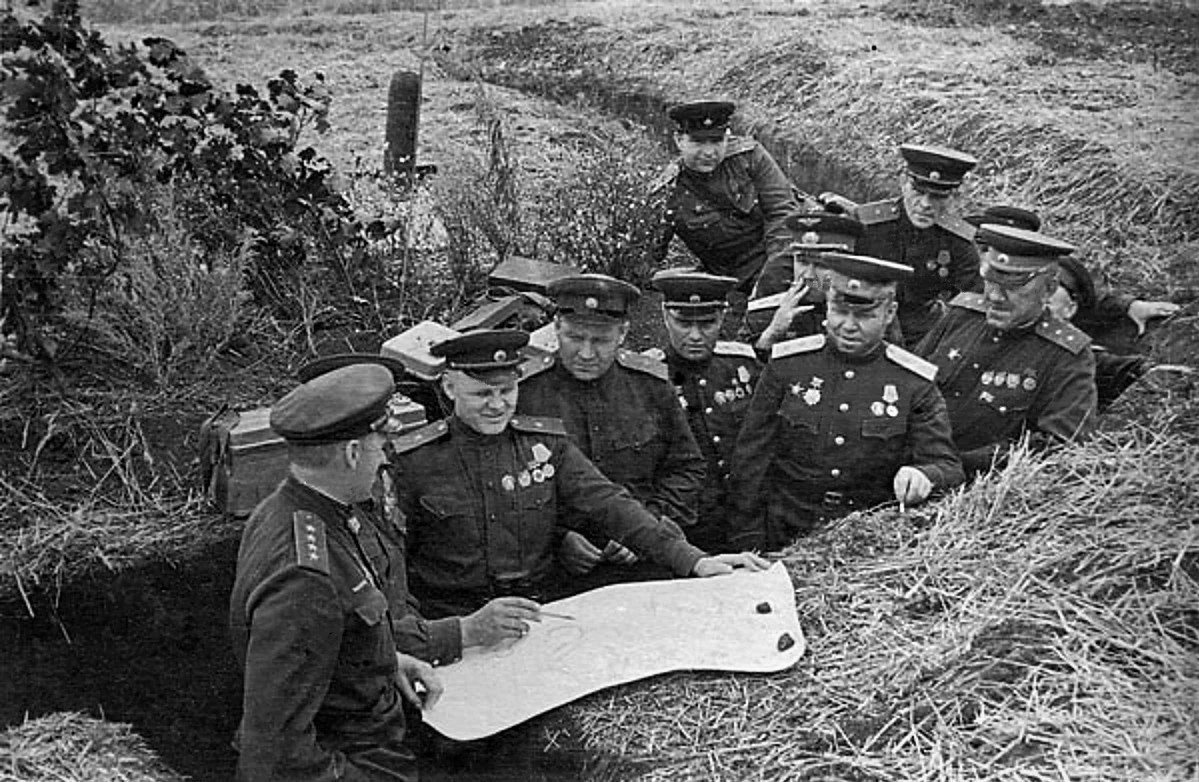
Soviet officers confer near Ponyri on the eve of the Battle of Kursk. Rokossovsky is located on the fat left of the group
In recognition of his successes, Rokossovsky was appointed commander of the Central Front for the 1943 summer campaign, positioned in the center of a salient in the lines at Kursk. It was his defenses that the Germans charged in Operation Citadel over the summer, and eventually were broken in the largest tank battle in history, permanently setting the Germans on the back foot and commencing the Red Army’s long drive on the Reich itself. The next year, as the massive summer offensive of 1944 was being planned, Rokossovsky stood firm as Stalin pressed for a single attack as opposed to multiple, eventually winning over the dictator and leading to the single largest defeat ever suffered by German armies in the field. With the success of Operation Bagration Rokossovsky found himself back in his native Poland, facing the exhausted Germans along the Vistula. Despite his Polish roots, he made no effort to support the Warsaw Uprising in late 1944, although her personally claimed it was due to his forces being overextended rather than politically motivated.
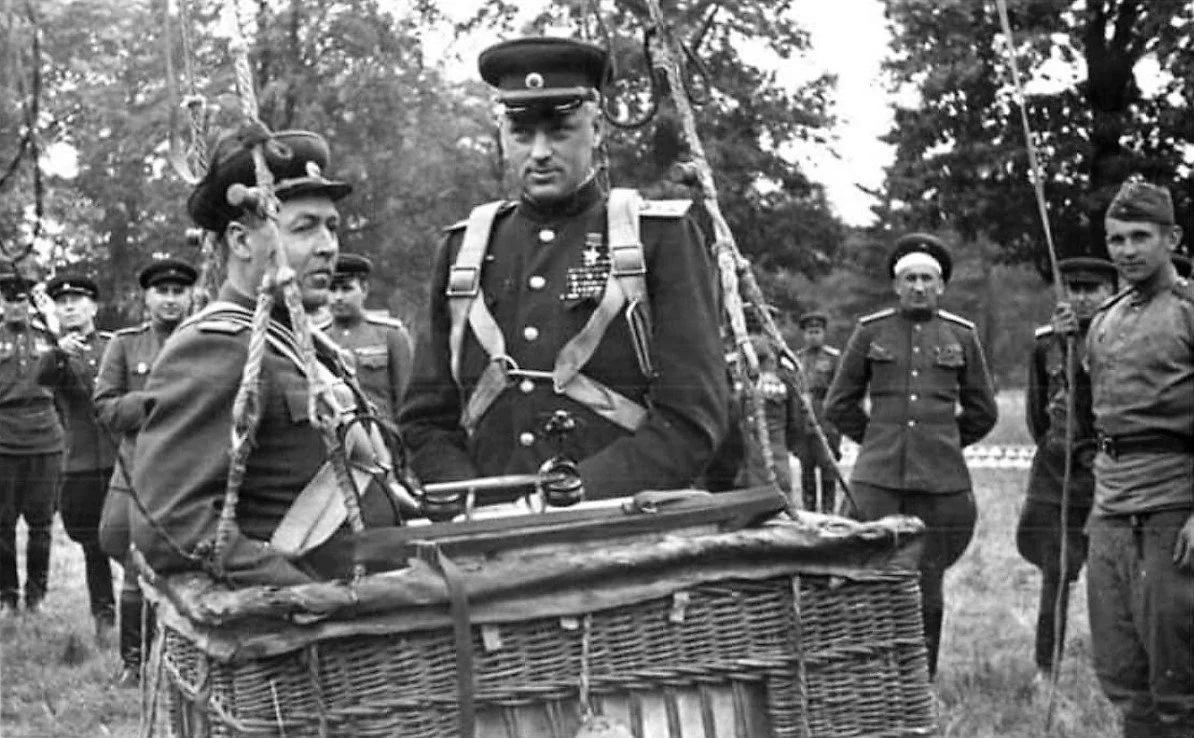
Rokossovsky boards an observation balloon in Poland later in the Second World War
In the spring of 1945 Rokossovsky was in command of the 2nd Belorussian Front, forming the right wing of the Soviet advance into Germany proper, driving through East Prussia along the Baltic coast. Positioned along the Oder in the area around Stettin for the last campaign of the war, his forces faced the German 3rd Panzer Army, and formed the right wing of the enormous Soviet army massed against Berlin. They crossed the Oder and broke out into open country on 25 April, 1945, crushing the remnants of the German forces north of Berlin and linking up with the British east of the Elbe on 3 May.
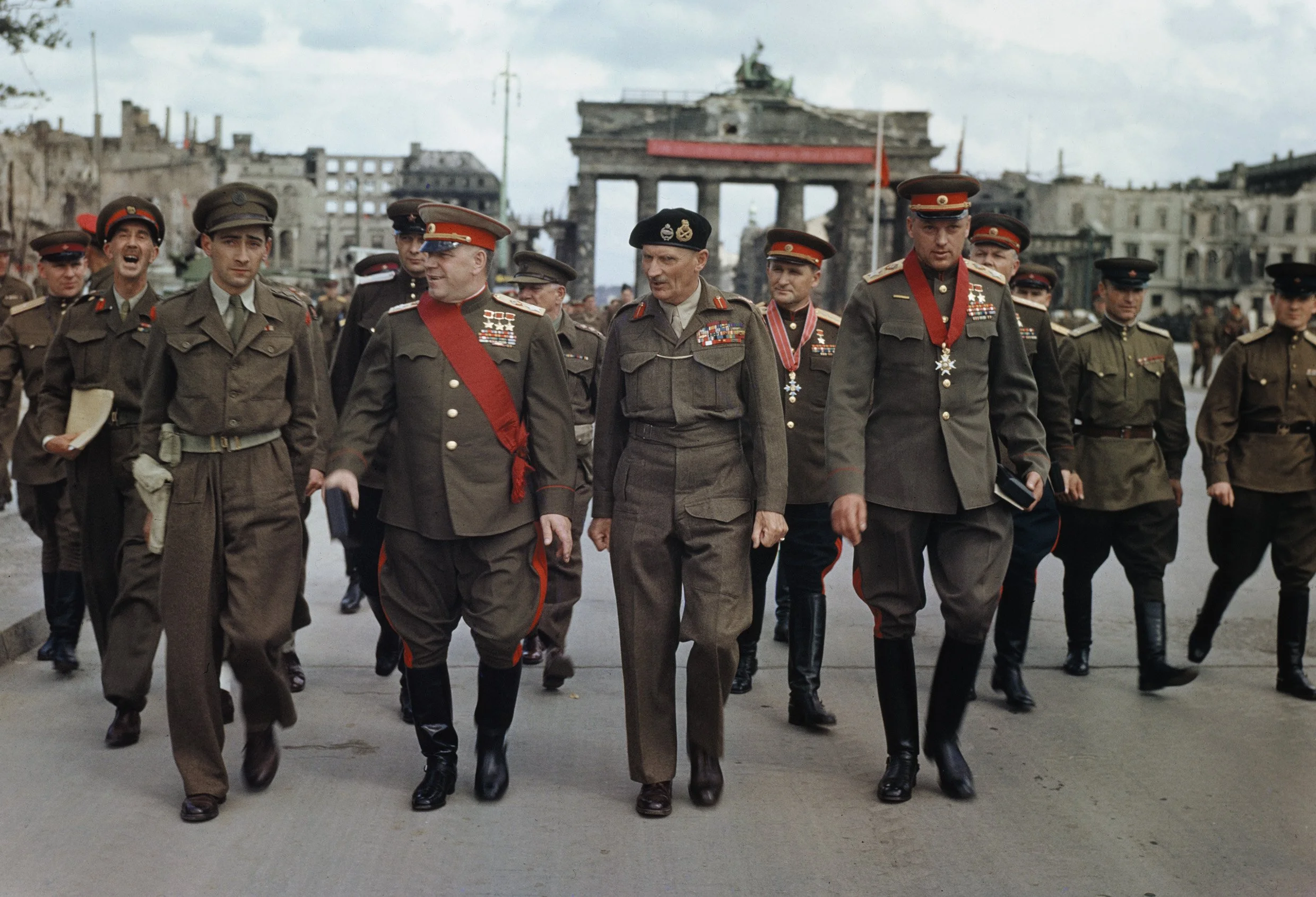
British and Soviet officers walk near the Brandenburg Gate in Berlin after the end of the war. Rokossovsky is on the right of Field Marshal Montgomery.
In the grand victory parade in Red Square, Rokossovsky rode at the front alongside Zhukov before returning to his post as commander of Red Army forces in Poland. As the new communist puppet government was established in Poland Stalin arranged for Rokossovsky to be named a Marshal of Poland and take command of its nominally independent armed forces. In this capacity he oversaw the brutal suppression of the remnants of the Polish Home Army as well as the establishment of forced labor units within the People’s Army for political dissidents.
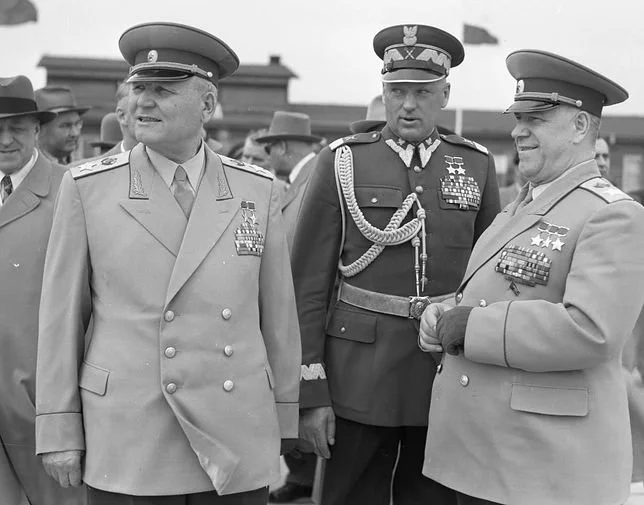
Rokossovsky (in Polish uniform) alongside Zhukov and Ivan Konev during the conference that led to the Warsaw Pact in 1945
In response to Rokossovsky’s heavy handed exercise of Soviet domination in Poland protests erupted in 1956, which were brutally crushed by the Marshal’s order with tanks and troops. In response the new Polish First Secretary traveled to Moscow, successfully lobbying Stalin’s successor, Nikita Khrushchev, to recall Rokossovsky and grant more autonomy to Poland. Rokossovsky was then named Deputy Defense Minister, and moved between several high level administrative posts until his retirement in 1962. He died eight years later in 1968, being awarded a state funeral and internment in the Kremlin Wall Necropolis by Soviet leader Leonid Brezhnev.