Walther P.38
Possibly the best overall handgun in service during the Second World War, Walther’s P.38 was an advanced design, although it was never able to eclipse the older Luger P.08 in the popular imagination.
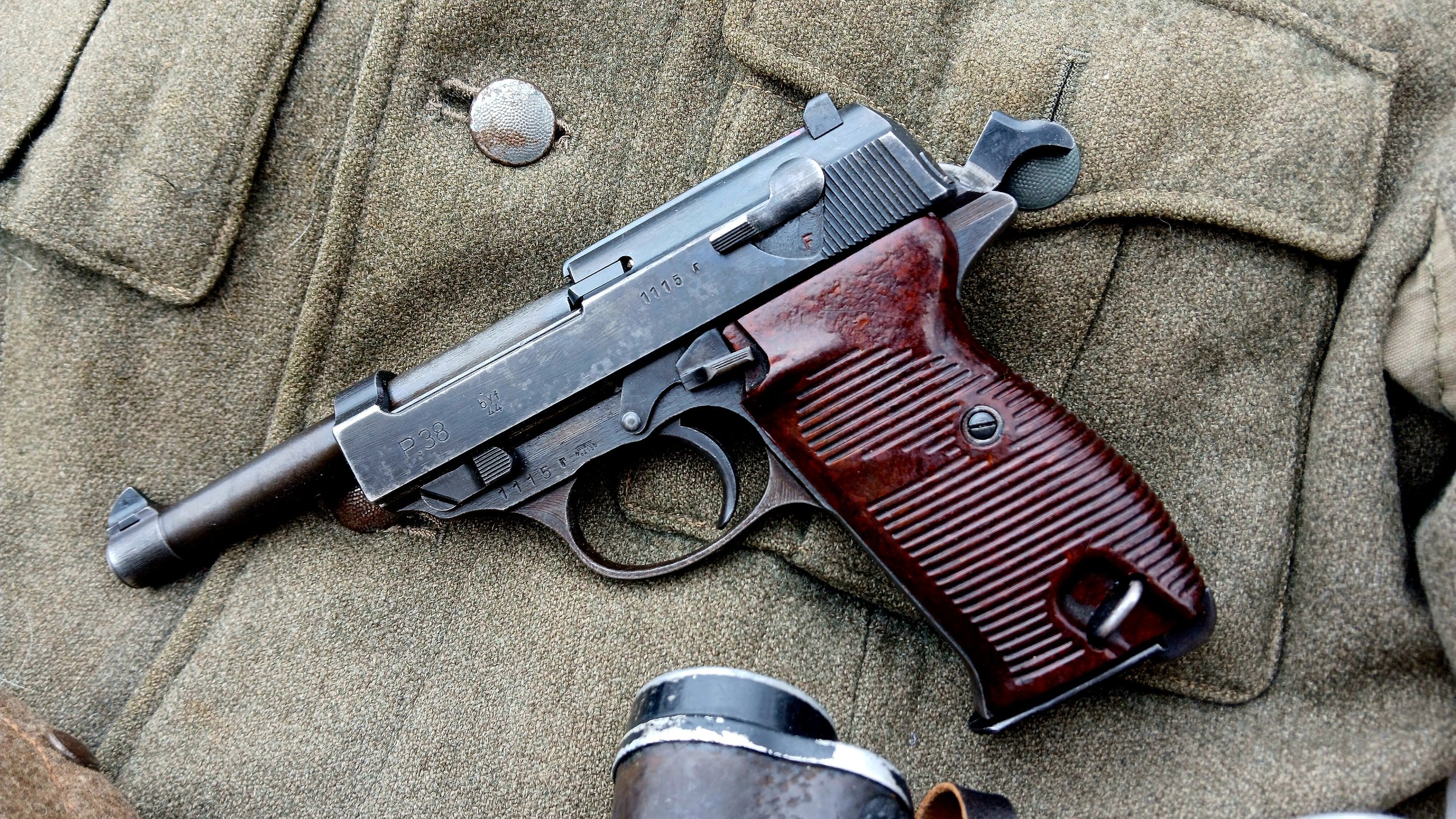
The History
In the trenches of the Great War, the armies of the Kaiser were equipped with the famous Luger pistol. This was a toggle-locked 9mm automatic, and in turn was among the more modern, robust and powerful designs in service during that conflict, but it was not without its problems. Complicated and expensive to manufacture, it was clear to the German authorities charged with rearming for the coming Second World War that a more modern design was needed for the Fuhrer’s armies.
Despite the restrictions imposed on interwar Germany by the Treaty of Versailles domestic arms production had managed to continue, particularly in the handgun market. Walther had made a name for themselves as designers and producers of a number of small caliber automatics before, during, and after the Great War, with the Walther PP being the most popular.
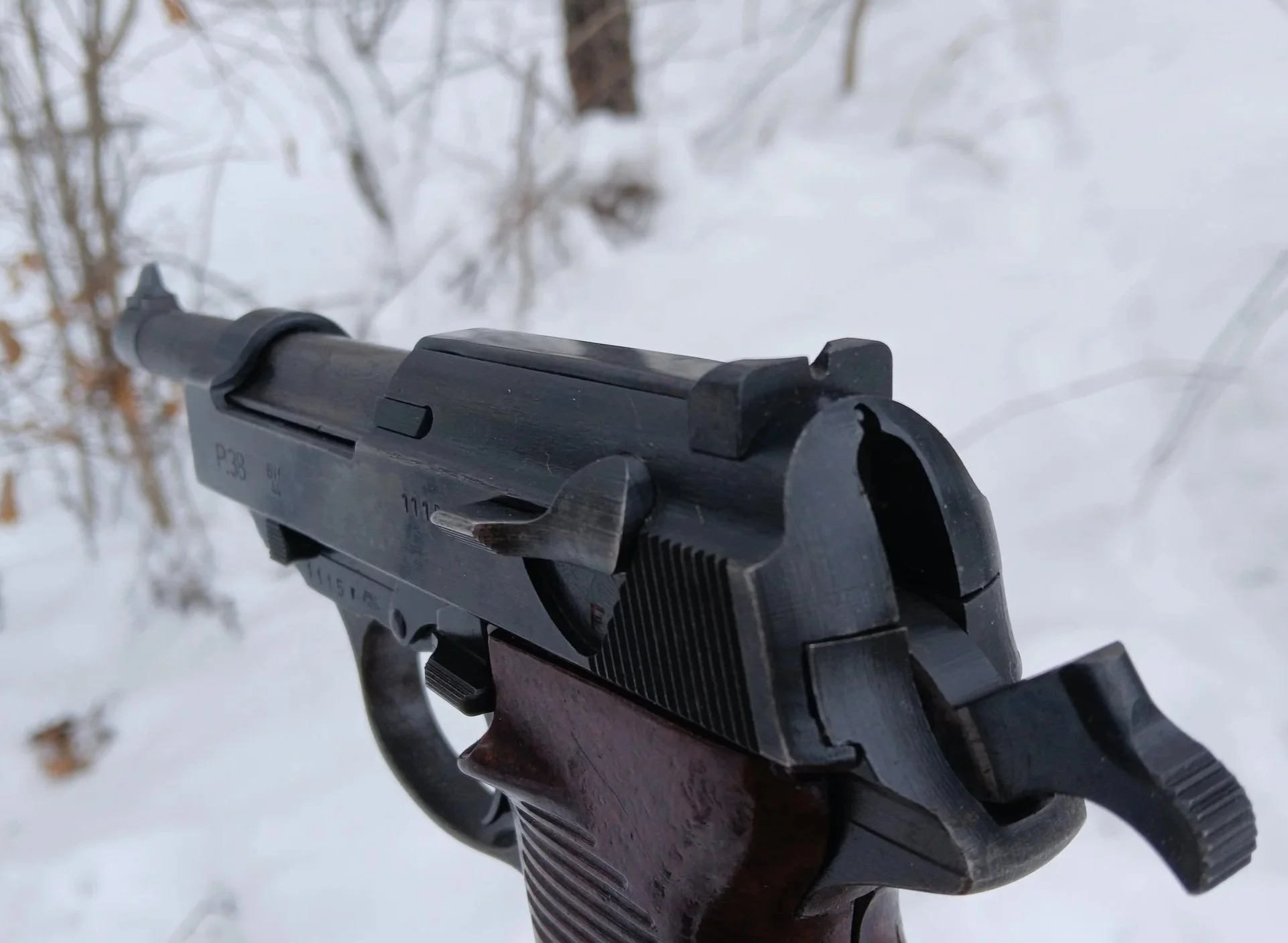
The P.38 features a clear rear sight that can be easily replaced by an armorer if needed. Also note the sheet steel cover atop the slide that allows service of the firing pin
When the German Army issued a requirement for a new service pistol to replace the Luger, the PP was the first choice for a platform for Walther, but development of a full size variation proved impracticle. The eventual evolution retained the 9x19mm Parabellum cartridge of the Luger, but was otherwise an entirely modern pistol that was formally adopted as the Pistole 1938 on the eve of the Second World War in 1939.
During the conflict, the P.38 would serve alongside the older Luger as well as other foreign and domestic designs in 9mm, and would gain a reputation as a robust and reliable weapon in the various disparate battlefields. In much the same manner, it would be second only to the Luger as the most desireable trophy for Allied soldiers in the field.
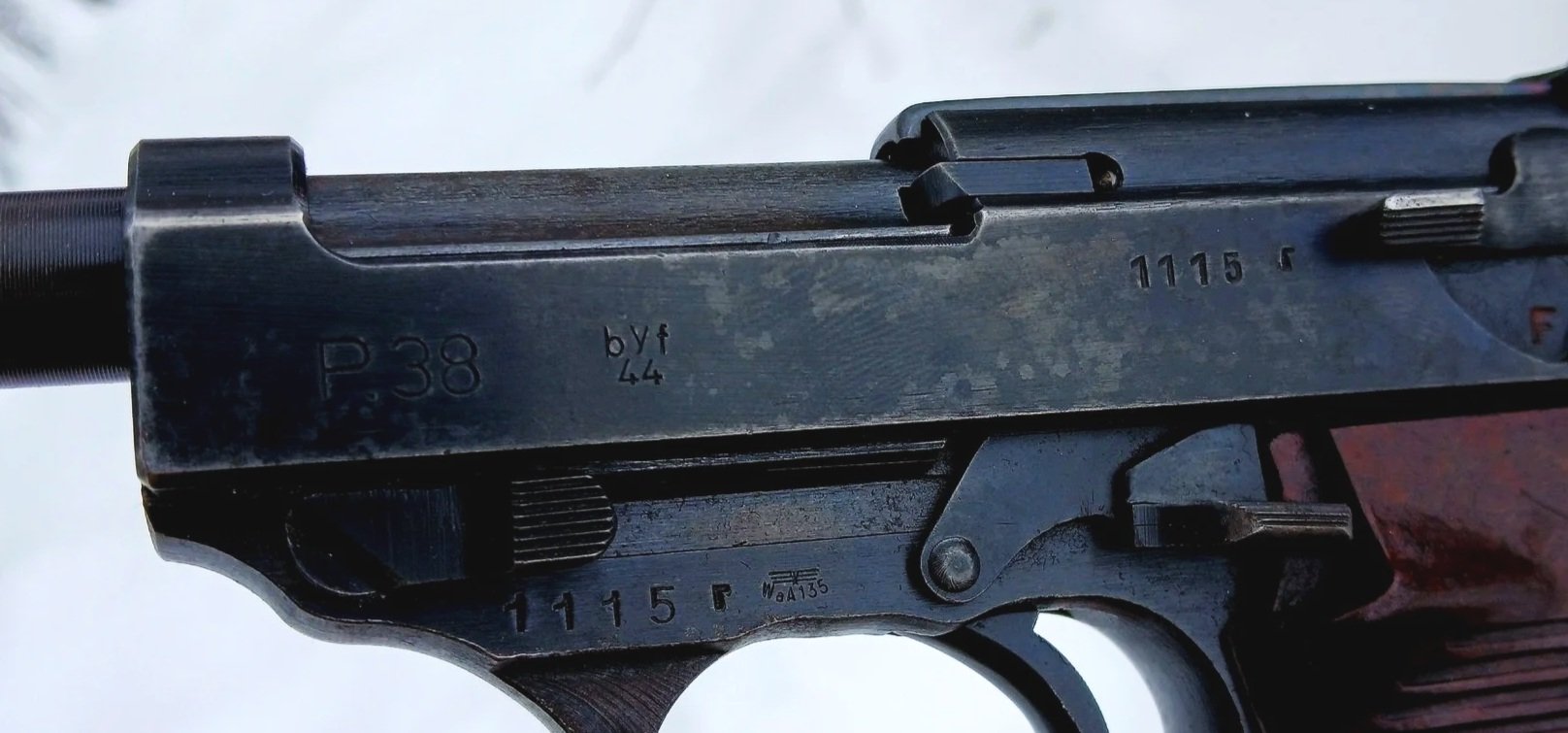
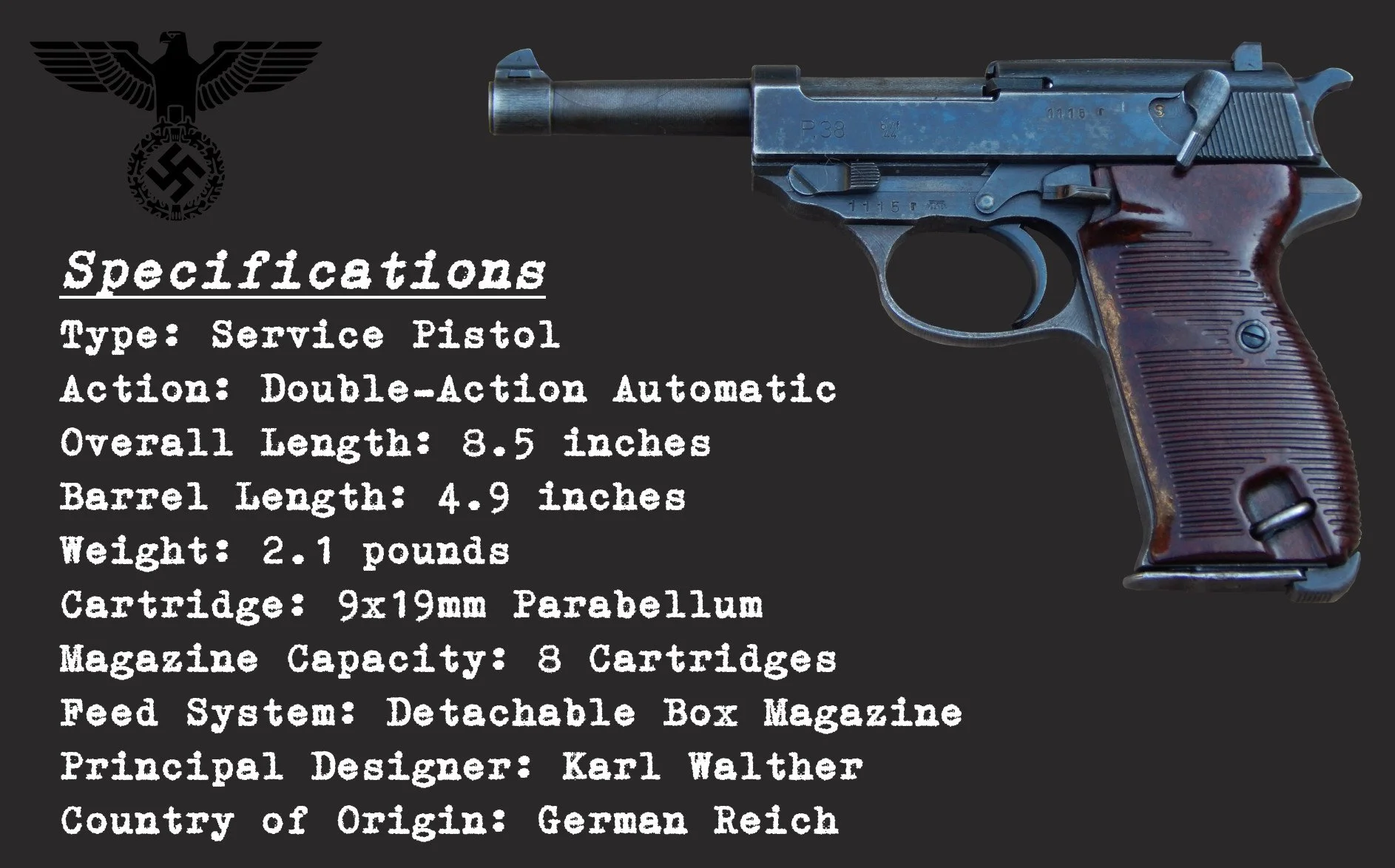
The left side of the slide features the model designation, manufacture code and year, as well as serial numbers
The P.38 would subsequently survive the fall of the Third Reich, with production continuing under French authority for some time, and the eventual evolution into the aluminum framed P1 that would equip the West German Bundeswehr in the Cold War. Its progeny, as a double action automatic service pistol, would become the global standard, with even the eventual US M9 being mechanically a near copy of the old Walther.
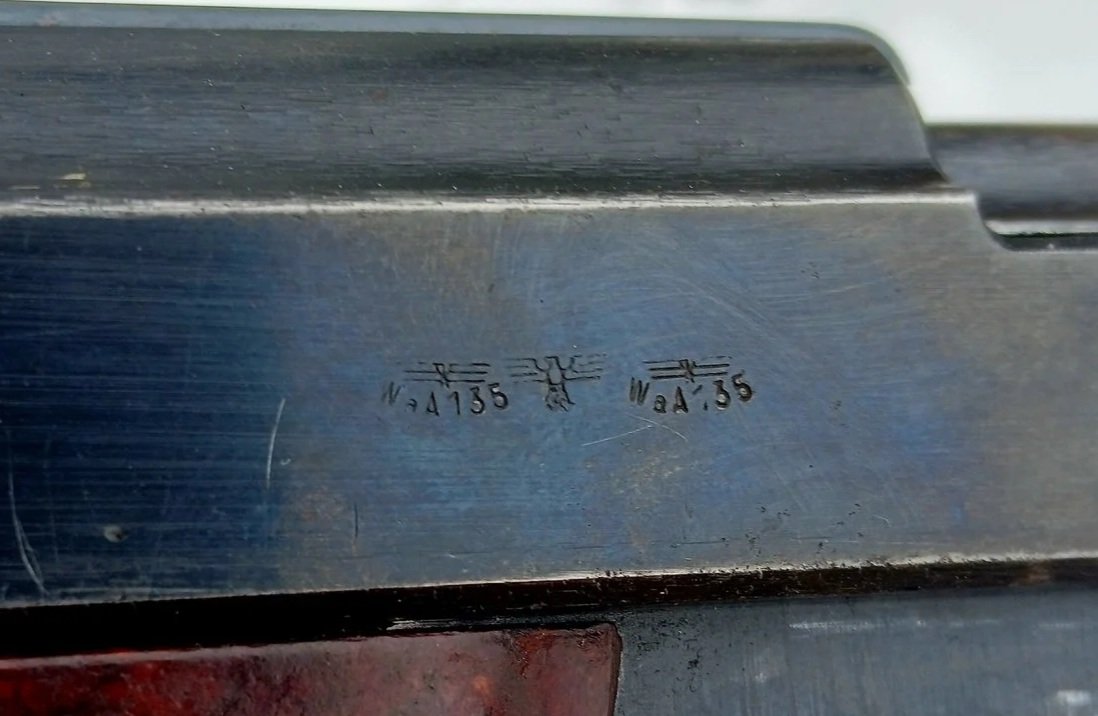
The right side of the slide features German property markings as well as inspection stamps
The Design
At a glance, there are some similarities present with the earlier Luger, chiefly the exposed barrel (a holdover mandated by the German Army Weapons Office), as well as holding eight 9x19mm Parabellum cartridges in a grip mounted magazine. Beyond this, however, the similarities come to an end. The P.38 has dispensed with the esoteric toggle locking action in favor of a traditional slide, although it also features a distinctive locking block mechanism. The slide has a large open top to serve as its ejection port, with a sheetmetal cover on the top that conceals the smaller mechanical components.
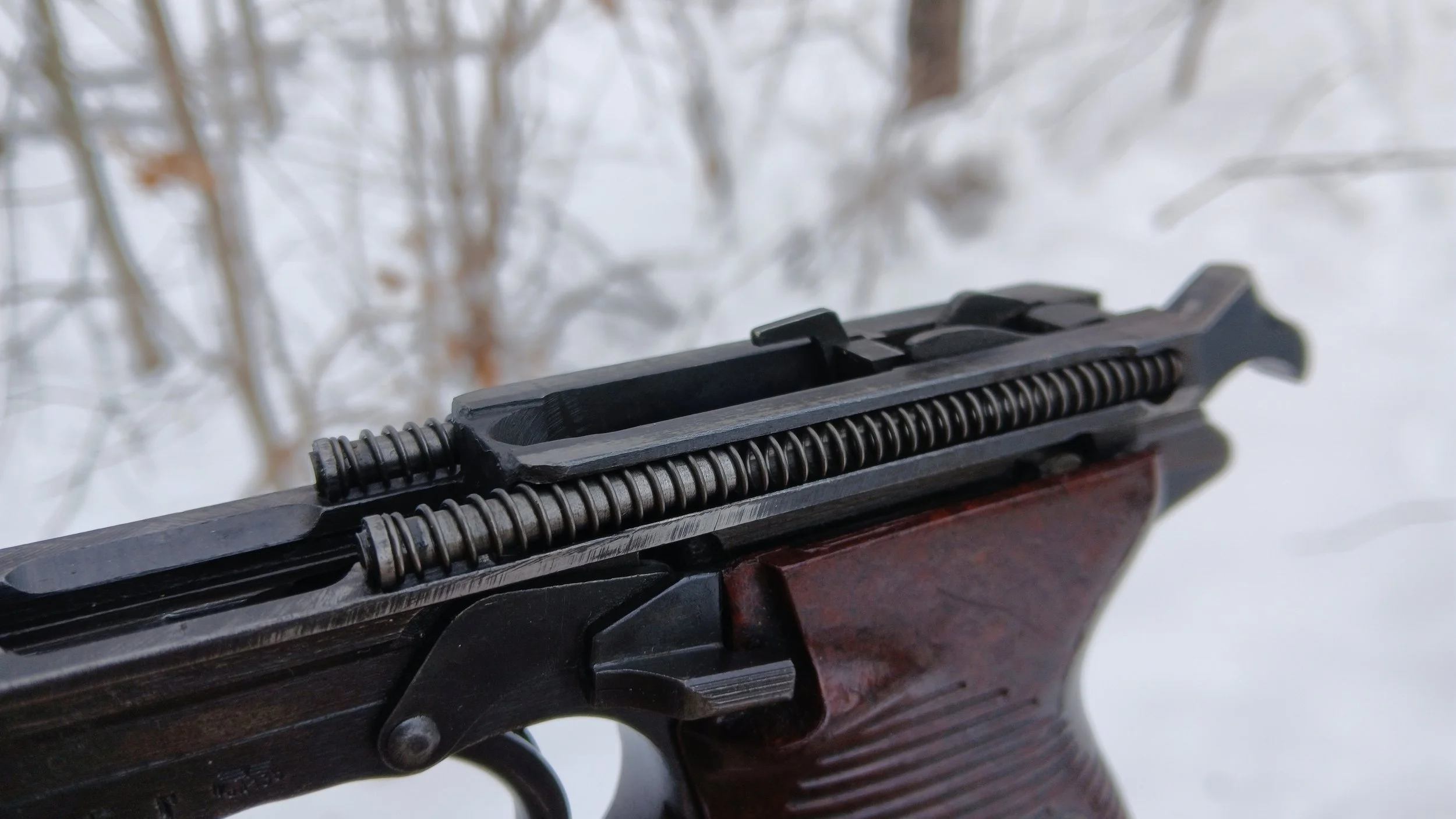
A distinctive feature of the P.38 is the system of dual recoil springs that are capture at the rear of the frame
The pistol also features a large exposed hammer, with a slide mounted safety that also serves as a decocker. On the frame, dual parallel recoil springs power the slide, while the trigger mechanism is a double-action type (a first for a full size, general issue military handgun). Wraparound bakelite grips enclose a relatively slight frame, with the mainspring enclosed only by the grip panels. The eight round detachable magazine is retained via a heel-catch, and is an altogether more modern design than that of the Luger.
This Example
The example seen here was produced by Mauser (code BYF) in 1944, one of the three wartime manufacturers of the P.38 (the others being Walther, code AC, and Spreewerk, code CYQ, although some code variations also exist depending on the year). It features reddish colored bakelite grips and is overall in very good condition, with matching serial numbers on all components. It shows some later war production hallmarks, such as millmarks on the barrel, but is generally a fine specimin.
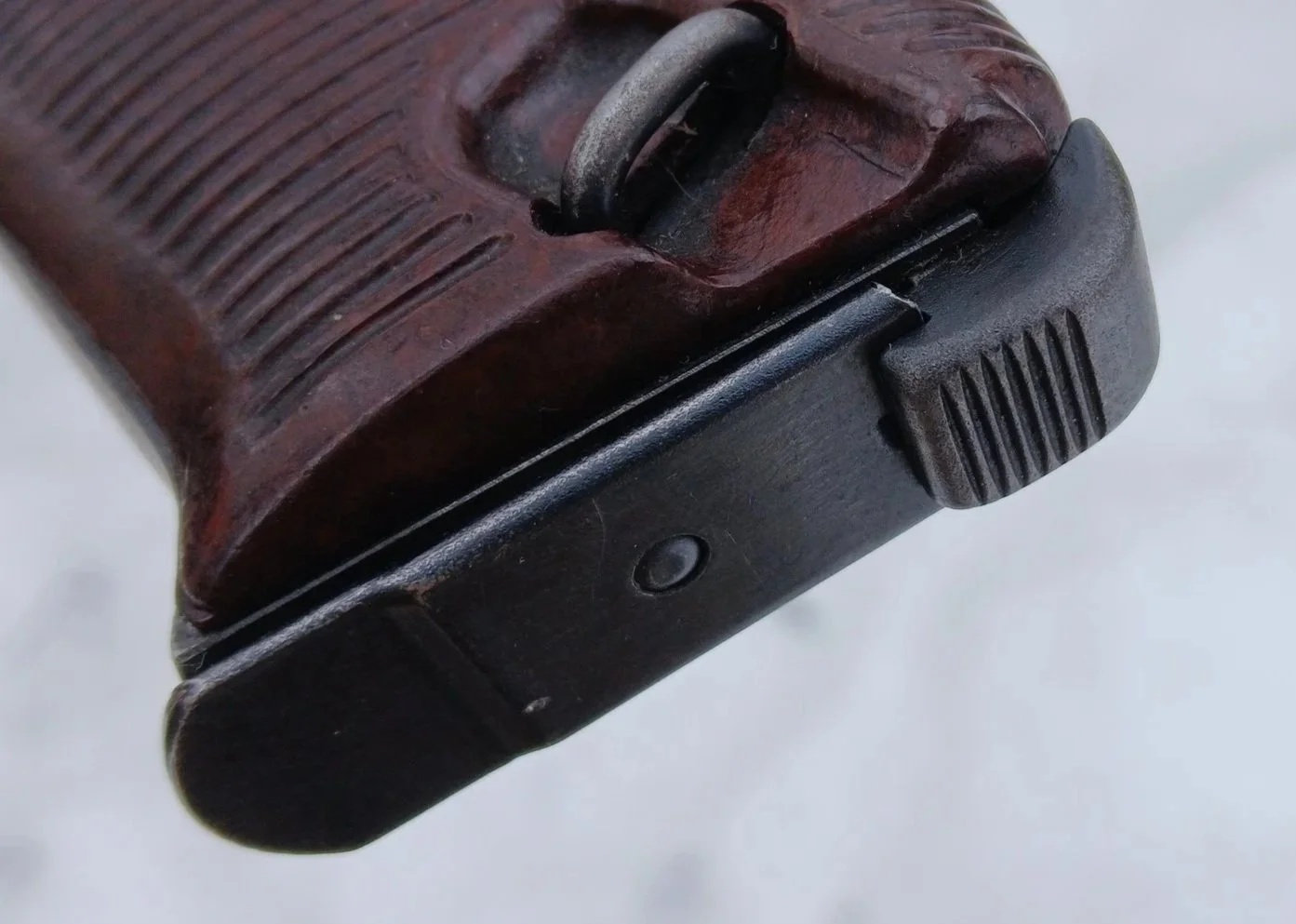
The heel magazine catch is notably one of the larger and easier to use of the type that can be encountered, as well as having strong positive retention
Opinions
Despite the author’s penchant for the US M1911 series of pistols, when one looks objectively the P.38 is a strong contender for the finest all around combat handgun of the Second World War. Chambering a potent cartridge, it combines good ergonomics with decent sights and a double-action trigger, placing it above most all of its contemporaries. The P.38 is a fine combat handgun, and aside from its smaller capacity is otherwise modern in all respects as a steel frame pistol.

An American GI guards two German prisoners, armed with a captured P.38 as well as his own Thompson submachine gun
Observed Values and Frequency
Updated: December, 2025
AVERAGE VALUE (USD): $,250.00
FREQUENCY: Common
COLLECTOR’S NOTES: Spreewerk (CYQ) examples generally command slightly less than other wartime models. Some late models have code CVQ due to a damaged die