Winter, 1945
Chapter 44
Götterdämmerung
January - March, 1945
Europe: The Western Front
Following the failure of the German offensive in the Ardennes, the Western Allies set about preparing for their invasion of Germany proper. Losses incurred in the Ardennes set back their plans, but by this point such a delay was the best the Reich could hope for. In early February the British launched Operation Blockbuster, driving into the forests of the Reichswald, while the Americans began to sweep the Hurtgen Forest.
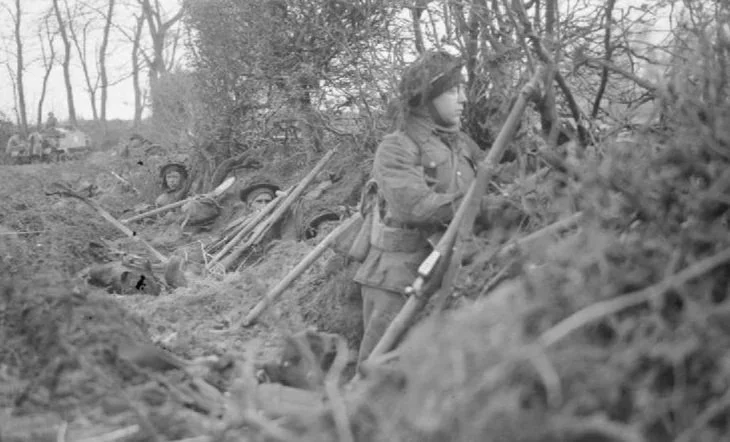
British troops in the Reichswald
The Germans, for their part, began to pull back toward the River Rhine, although the continued obstinance of the Fuhrer regarding any kind of withdrawal ensured that this was done piecemeal. Many units stood, fought and were destroyed uselessly in their positions further west, as the massive Allied force pressed them eastward.
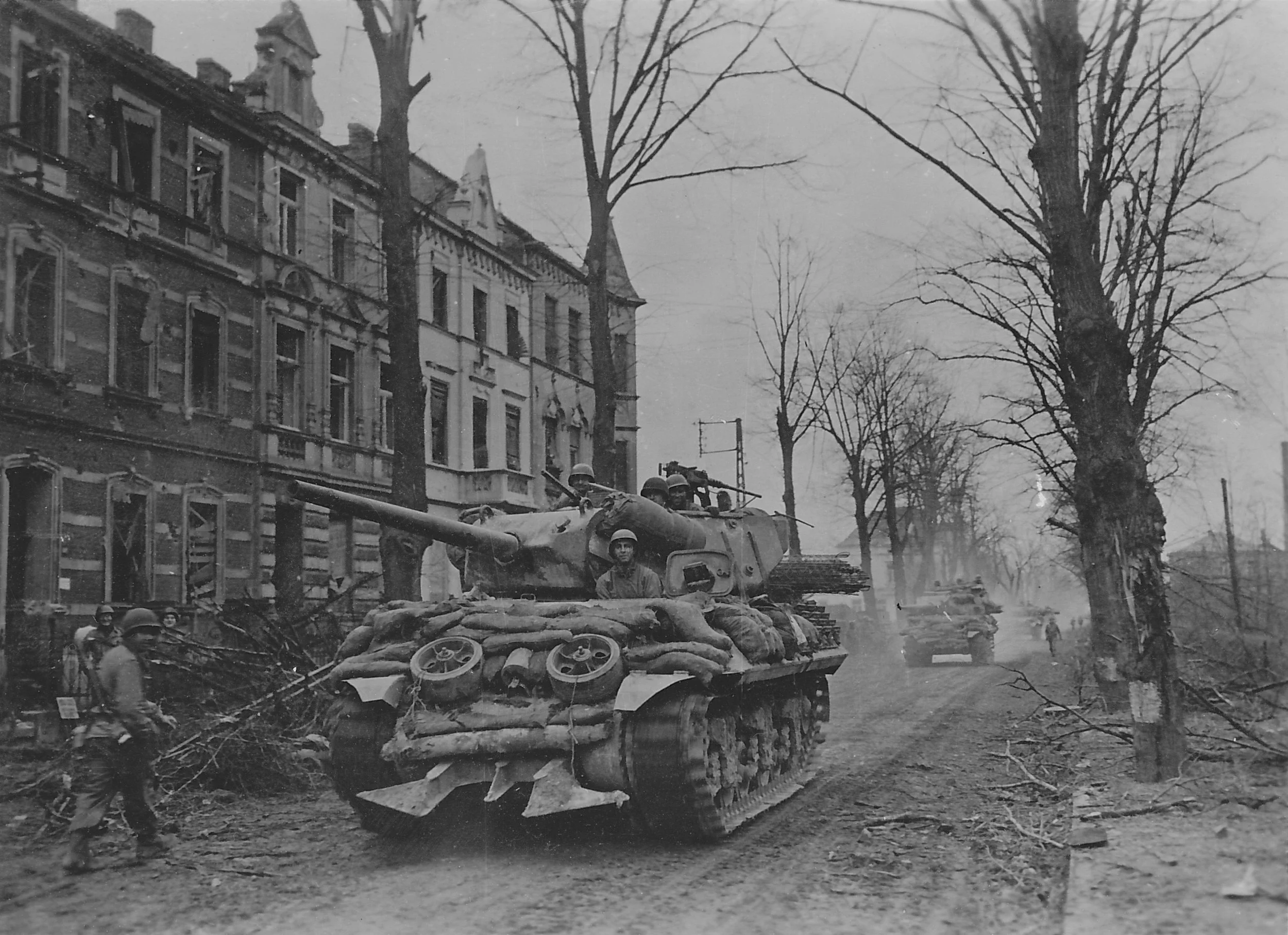
American troops and armor move throught the Roer
Striking through the Hurtgen Forest, the Americans swept aside the broken remnants of the German forces there and captured the Rur Dam on 10 February, shortly after the Germans had opened its gates to flood the areas downriver to slow the advance. Days prior, the British had entered the Reichswald following a massive artillery barrage. Fighting was fierce, and delayed by the opening of additional dams along the Roer. By the end of the month, Operation Blockbuster was launched to break out of the Reichswald and drive on the Rhine, and by the beginning of March Allied forces were in sight of the river.
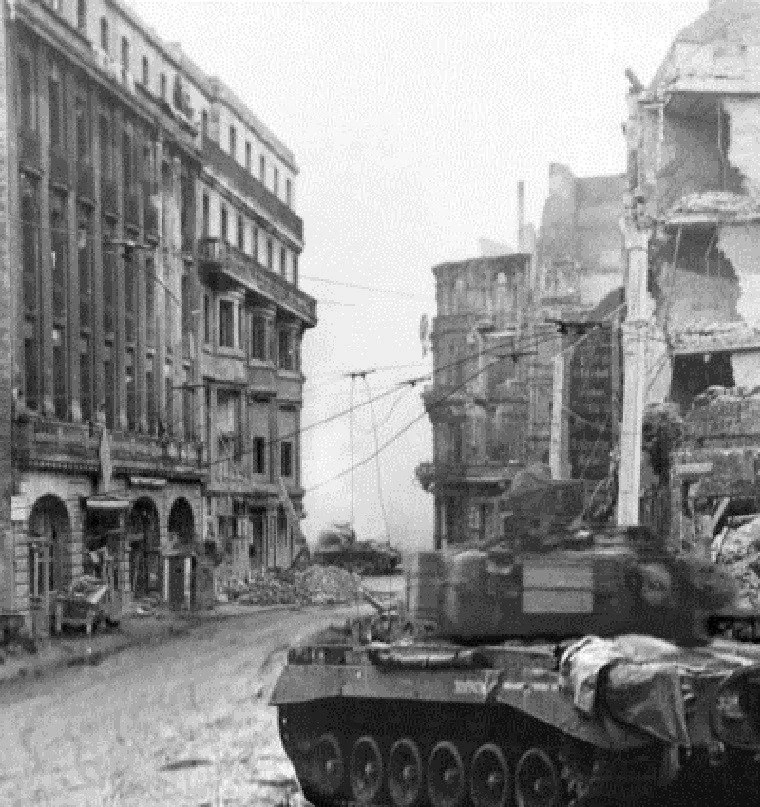
An American M26 Pershing heavy tank engages a German Panther on the streets of Cologne
In early March American forces reached the city of Cologne along the Rhine, engaging in urban combat amongst the bombed out ruins. In a notable incident, a German Panther tank was engaged and destroyed by one of the new American Pershing heavy tanks near the Cologne Cathedral. As the Americans made their final drive through the city center, however, the Germans destroyed the Hohebzollern Bridge; the last river crossing in the city. Thus temporarily halted, the Americans moved to consolidate their positions, swinging south to capture Bonn, while they searched for a viable crossing point on the Rhine.
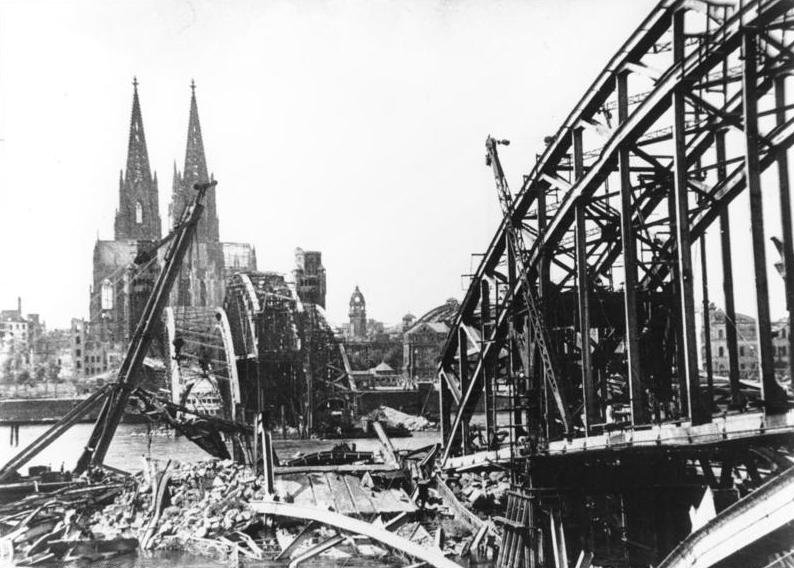
The wreck of the Hohenzollern Bridge in Cologne after the battle for the city
Europe: The Eastern Front
In the East, the Soviet armies had been massing along the line of the Vistula and East Prussian borders since the end of Operation Bagration the previous summer, and by the start of 1945 they were ready to strike once again. The OKW was increasingly concerned, as their own units had been stripped away to support the Ardennes offensive along with other operations, with estimates that when the Red Army attacked the drive would likely smash their lines quickly and threaten the industrial areas of German Silesia within days.
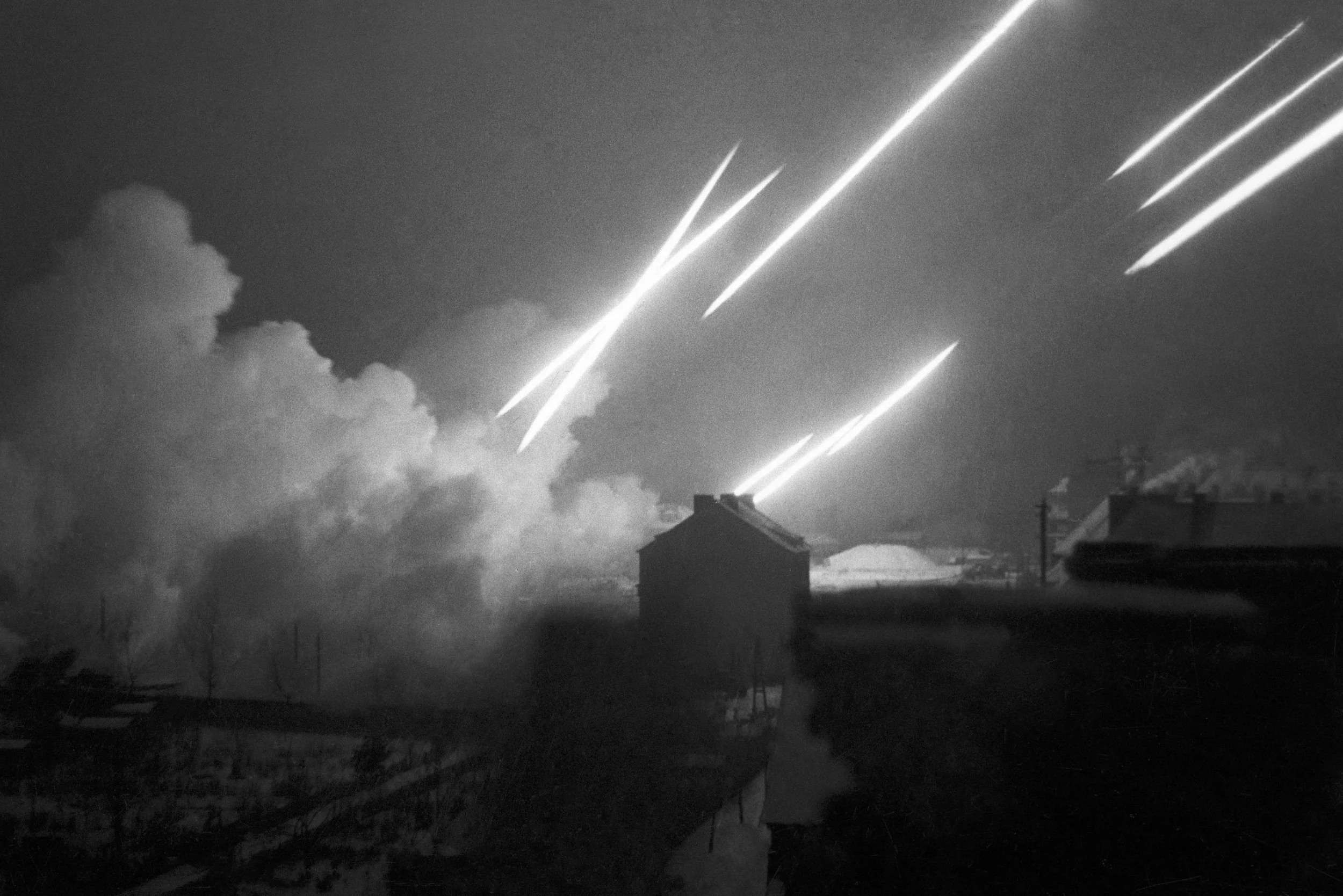
Soviet Katyusha rockets fired against German positions as the Vistula-Oder Offensive commences
The attack began on 12 January, and as the Germans expected significant breaches developed by the end of the day, with Soviet tanks and troops streaming into the gaps. Attempts to make a tactical withdrawal were vetoed by Hitler, and as a result many units of the battered Army Group Center found themselves being enveloped. The blasted ruins of Warsaw fell to the Soviets on 17 January, with the Fuhrer ordering the arrest of Army Operations Chief for the lack of effort in holding the city.
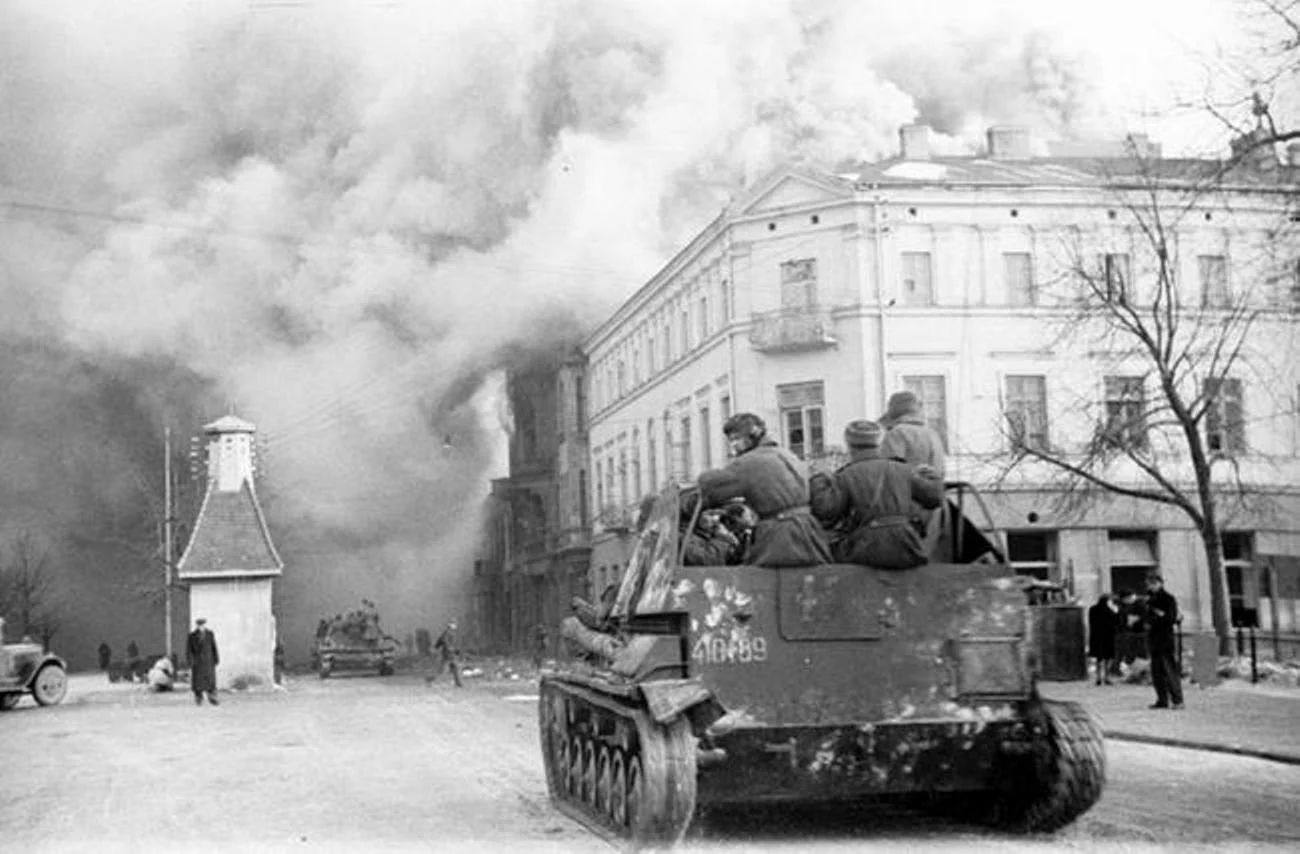
Soviet self propelled guns advance through a Polish city
Meanwhile, the Soviet advance continued at a frenzied pace, smashing German units aside as they drove through Poland, and by the end of January had invested the German city of Breslau and penetrated into Lower Silesia, beginning the evisceration of one of Germany’s last major industrial zones. Soon the Red Army was at the Oder River, positoned along the borders of Pomerania and Brandenburg, while to the north the Soviets were able to reach the Baltic coast on 24 January, cutting off East Prussia from the remainder of the Reich.
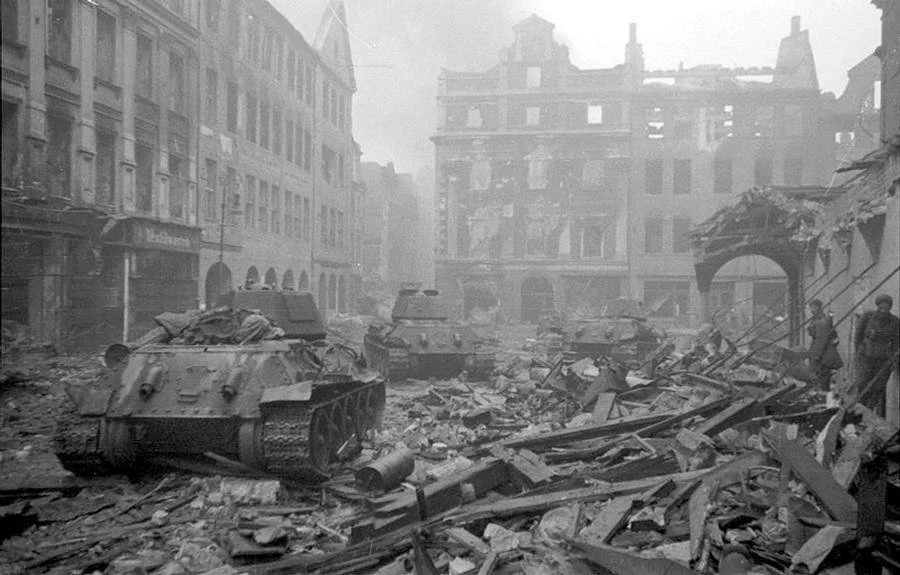
Soviet tank amidst the ruins of Poznan
On 29 January Soviet troops surrounded the East Prussian capitol city of Konigsberg was thus besieged as the Soviets pressed from all sides, with the only hope of escape being a dangerous trek across the frozen lagoon of the Vistula toward Pillau, where naval evacuations were taking place. A German counterattack from there in late February succeeded in reopening a land corridor to Konigsberg. As the month of March wore on, the situation continued to deteriorate, with rations declining for civilians and for defenders of the city. Meanwhile the German 4th Army had been corralled into a pocket near Heiligenbeil, and by the end of March the entire force had been destroyed, leaving East Prussia all but defenseless. As the month came to an end, the Soviets were almost ready to launch an assault to capture the city proper, as the defenders dug in for a bitter urban struggle, while to the west the port city of Danzig was besieged and fell in late March.
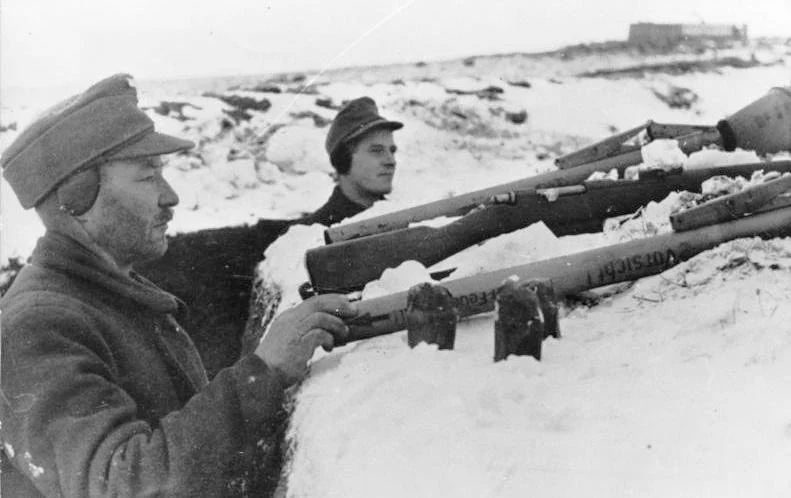
German Volkssturm in postion along the Konigsberg perimeter
Farther south, the Hungarian capitol of Budapest had been fully encircled by the Soviets on Boxing Day, and heavy fighting now raged along the Danube. Multiple German/Hungarian were made in an attempt to relieve the city throughout January, but with no success. Inside the shrinking perimeter of the city itself, the fighting began to resemble that experienced at Stalingrad two years prior, as streets, buildings and even the sewers became bitterly contested battlegrounds. In mid January the defenders evacuated Pest on the eastern bank of the Danube in order to attempt to hold the hilly Buda on the western bank, destroying the bridges as they did so amidst a throng of terrified civilians.
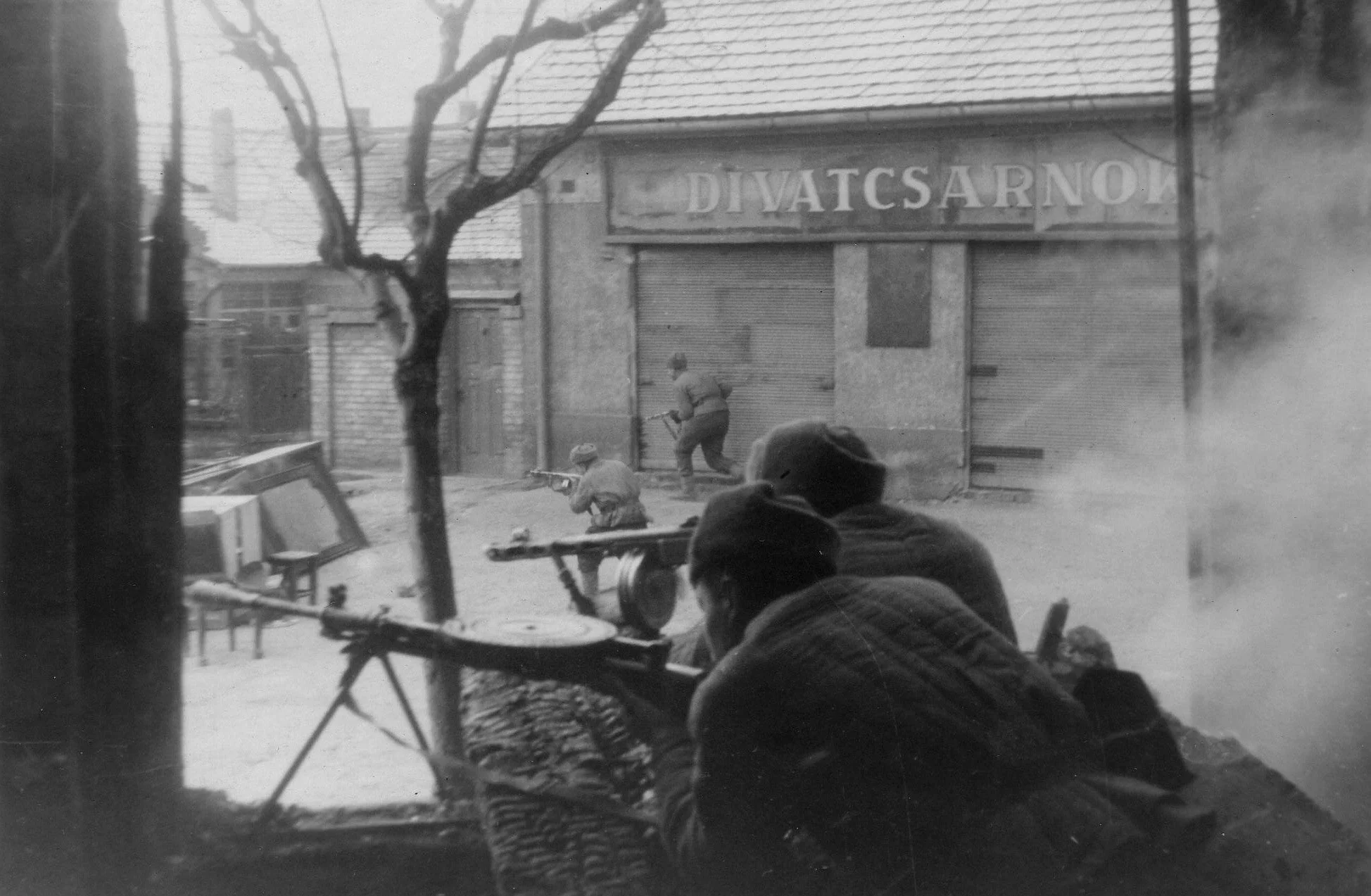
Soviet infantry engaged in street fighting in Budapest
Heavy fighting continued to rage amongst the hills of Buda, with the Germans and Hungarians making good use of the high ground to delay the Soviets. A final attempt at relieving the city by the Germans was launched toward the end of the month, succeeding in breaking the Soviet lines and advancing to the Danube south of Budapest, but was in the end unable to break into the city itself. In the ruined city, the German and Hungarian forces were slowly whittled down in February, with the citadel atop Gellert Hill being overrun on 11 February. In defiance of Hitler’s orders, the defenders attempted to breakout of the city that night, failing with heavy casaualties, before finally capitulating on 13 February.
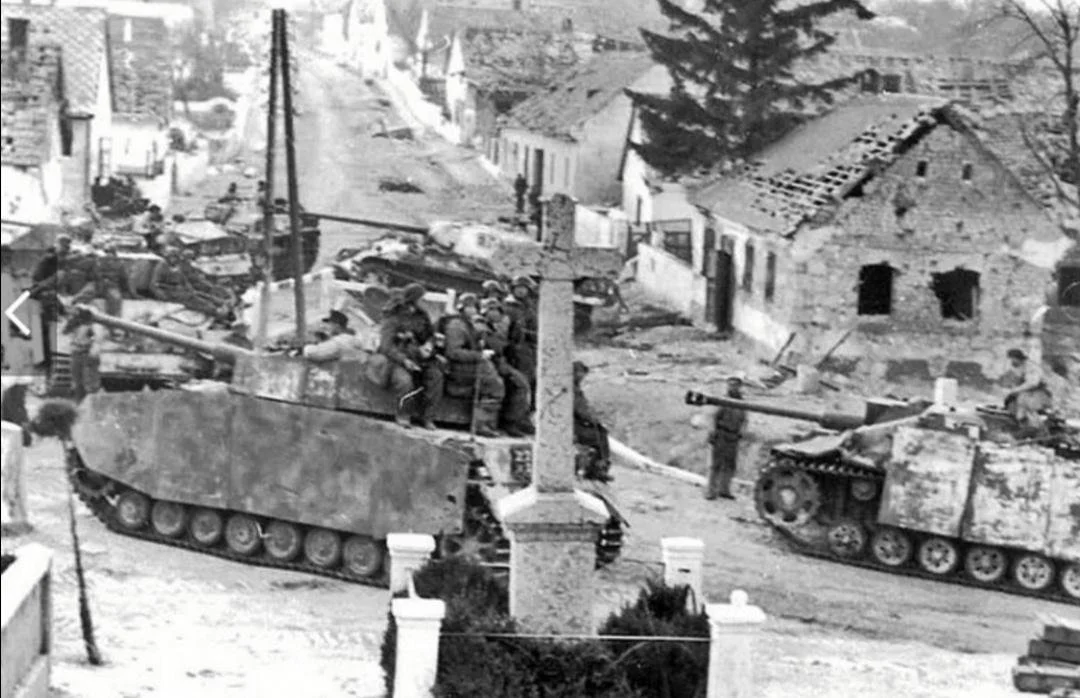
Panzers in a Hungarian village during the attempted relief of Budapest
The Germans, despite their weakened state, attempted to launch counteroffensives against the Soviets. Operation Solstice in Pomerania in February resulted only on turning the Stavka’s attention; causing them to prioritize the clearing of Pomerania before the capture of Berlin. A larger offensive was launched into Hungary in mid March, Operation Spring Awakening, aimed at retaking Hungarian oilfields. This failed as well, and by the end of the month the Germans had been swept aside as the Red Army drove on Vienna.
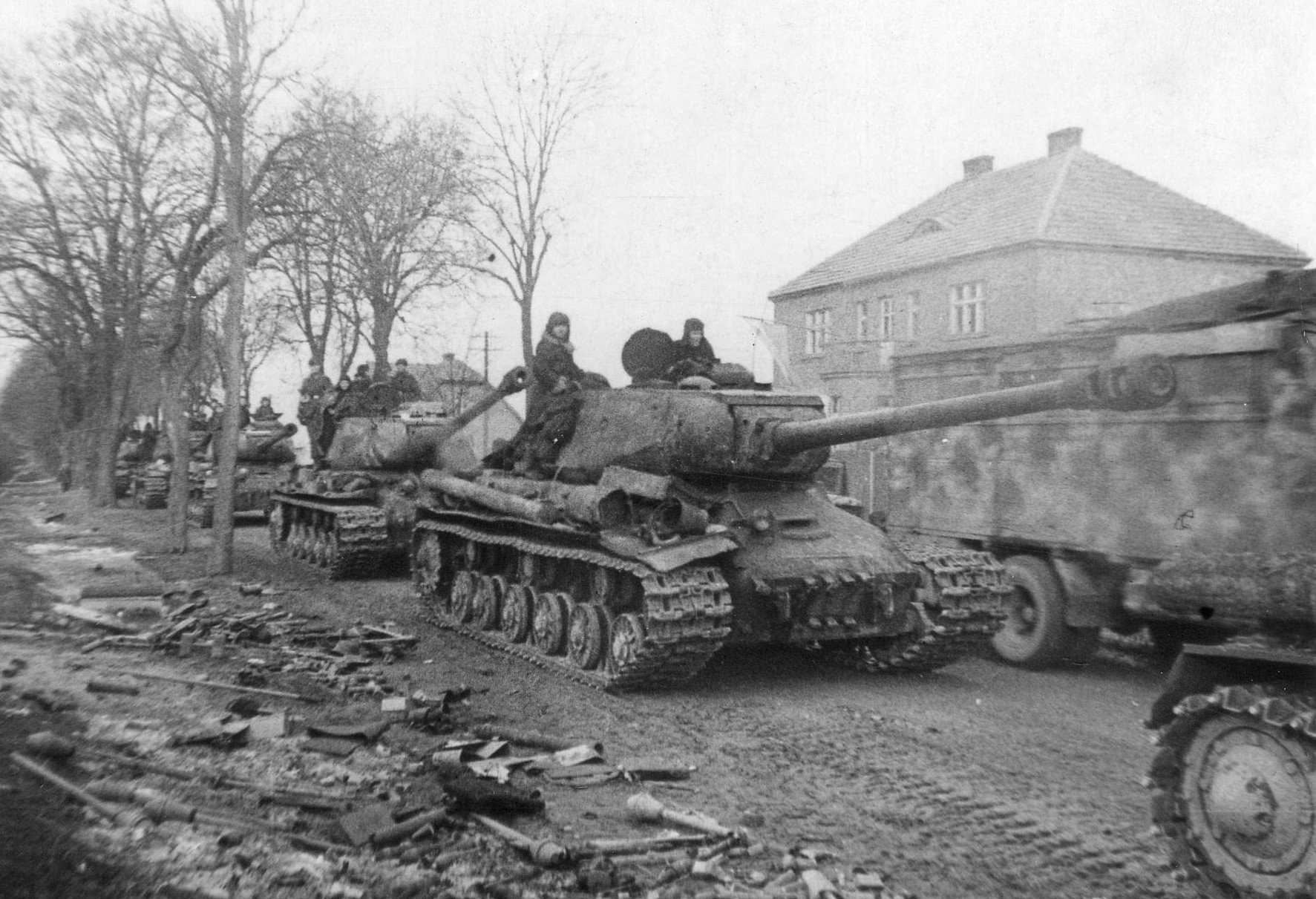
Soviet tanks on a German road
Europe: The Italian Front
While the large German offensive in the Ardennes was launched far to the north, another offensive was launched in Italy from the Gothic Line, designated Operation Winter Storm. Striking at the American left, the German and Fascist Italian forces were able to break through the line and push back the American lines before British Indian troops arrived to reinforce them. The attacks then withdrew behind the line, their true objective having been accomplished (that being forcing the Allies to redeploy and stall their planned spring offensive against the line).
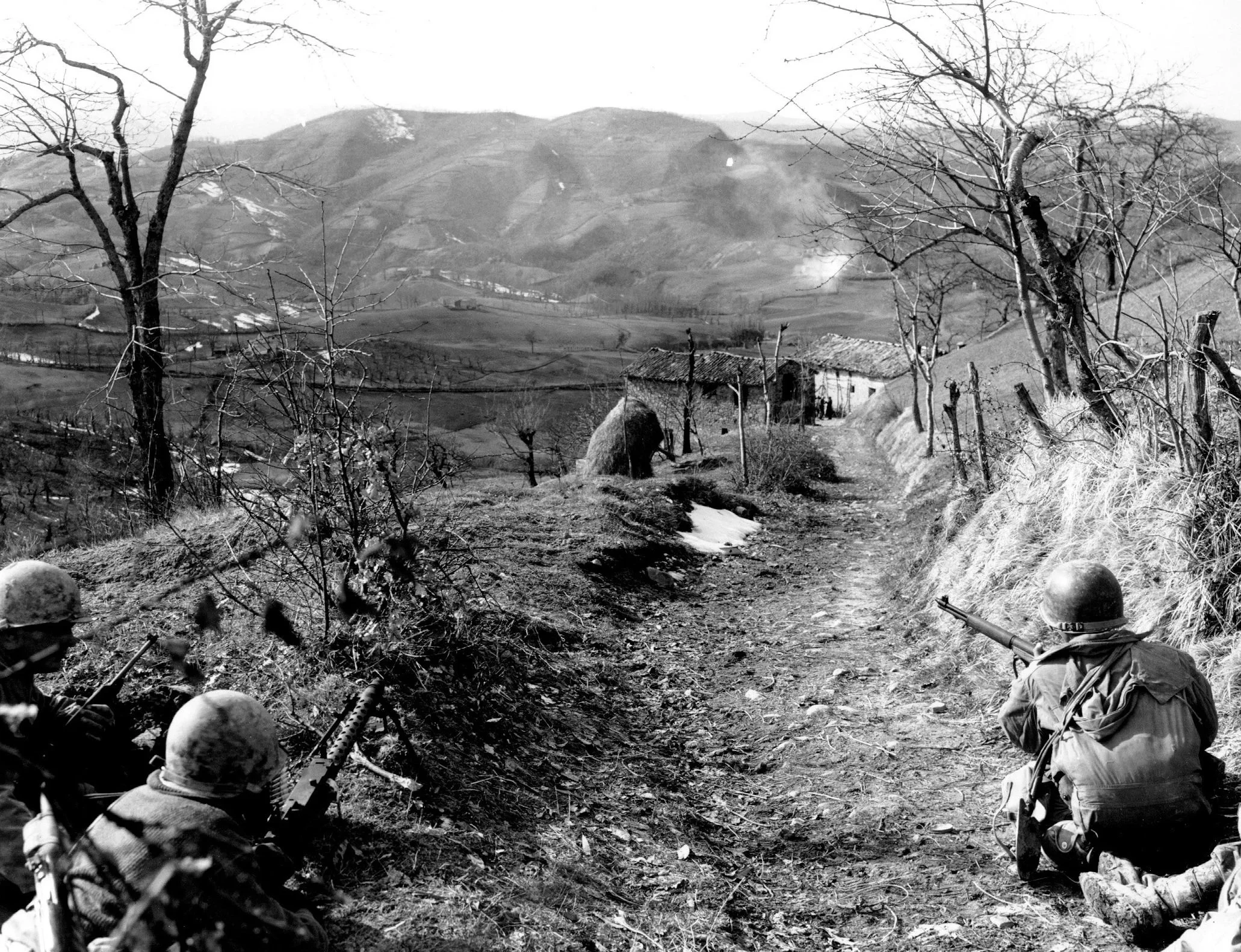
Americans advancing on the Gothic Line
Despite this victory, the writing was on the wall by the start of 1945. The Gothic Line was subjected to a new American offensive in February, with Operation Encore succeeding in breeching the line in several places, rendering its continued defense untenable. As the Allies built up for an offensive drive into the Po Valley in the spring, SS General Karl Wolff, commander of SS forces in Italy, made a secret approach to Allied commanders, hoping to arrange a surrender in order to shield himself from the inevitable tribunals to follow the now certain defeat. In the end, these went nowhere, although they did cause some tensions between the Americans and Soviets when Stalin’s intelligence services believed the negotiations were intended for a seperate peace with the Reich in general.
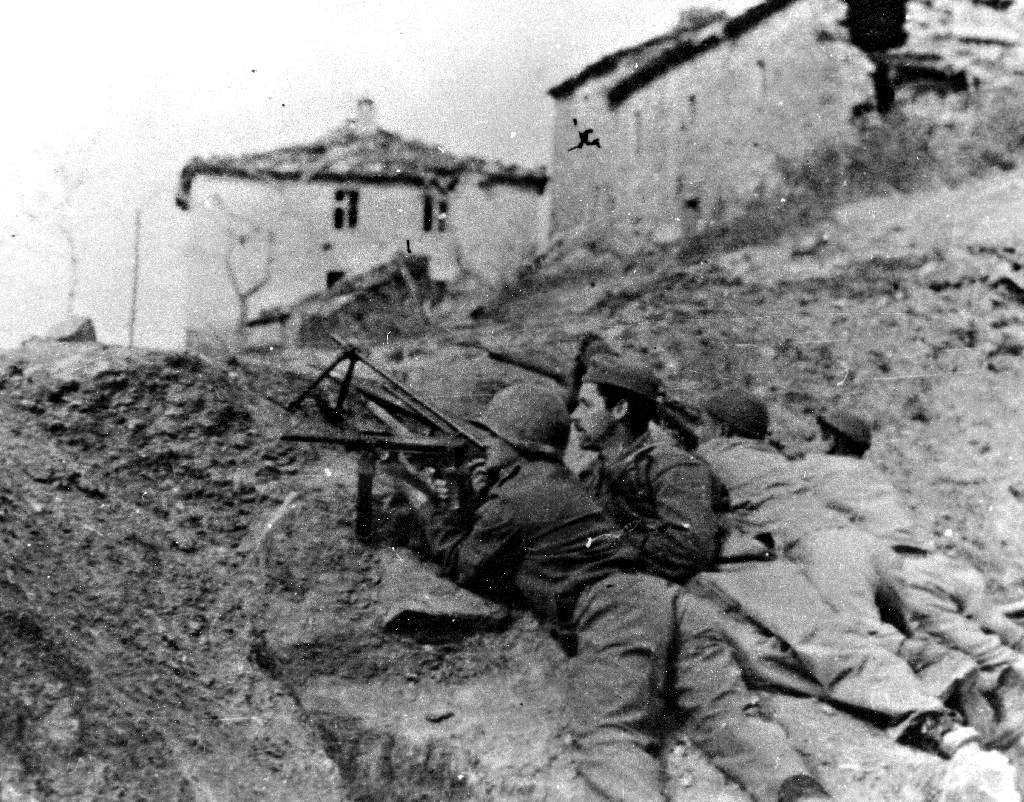
Brazilian troops in action in Italy in the spring of 1945
Europe: The Air War
On New Year’s Day, 1945 the skies over Western Europe came alive with German aircraft as they had not since 1940. Operation Bodenplatte was intended to sweep Allied air power from the skies to screen the Ardennes Offensive, mostly by striking airfields at dawn. The result of this operation was the destruction of up to 500 planes on the ground, while the Germans lost up to two hundred machines and pilots. Despite this, while the Allies could easily absorb the materiel losses, the weakened Germans most certainly could not.
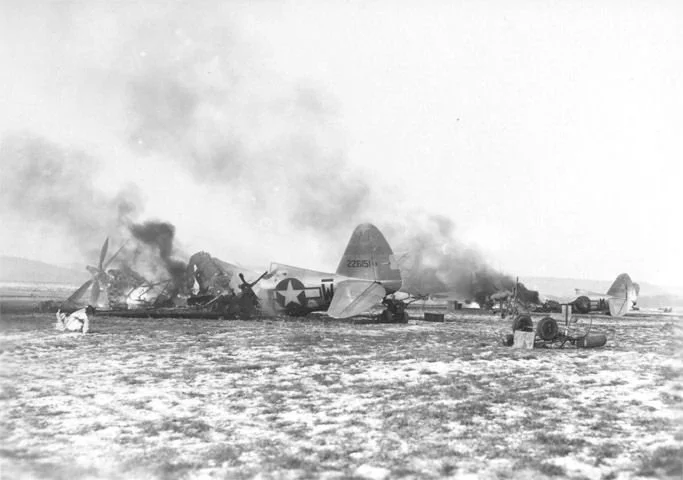
USAAF P47 fighters destroyed on the ground during Bodenplatte
Bodenplatte in the end primarily achieved the decimation of the Luftwaffe’s fighter forces, leaving them nearly totally unable to continue to defend the Reich against air raids, much less to support the beleaguered Wehrmacht on the ground. In response to this failure as well as internal politics, and despite his earlier opposition to the operation, Hitler ordered the dismissal of General Adolf Galland, commander of the Jagdwaffe (Fighter Forces) in late January as a result of the failure of the operation.
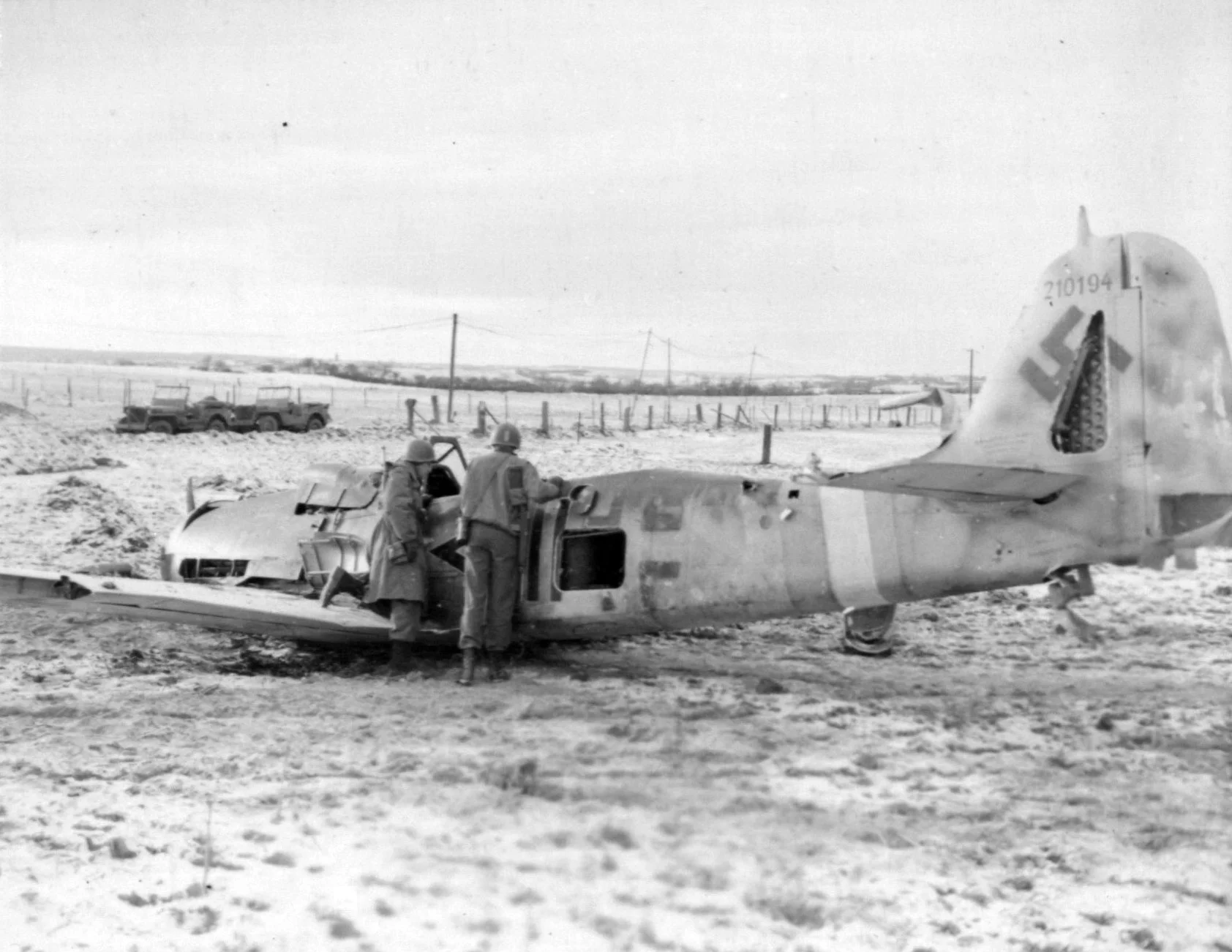
American soldeirs inspect a crashed German FW190 after the failure of Bodenplatte
Meanwhile, the V-weapons attacks continued through the winter, with V1 and V1 missiles striking mostly toward London and other targets in England. By this point the RAF was becoming adept at stopping the pulsejet powered V1s, including through interception by their Meteor jet fighters, but no effective countermeasure was developed against the V2 missiles, which continued to land with devastating effect in civilian areas. The poor guidance systems of these missiles would in the end be of use to the terroristic end of their deployment, as they were so inaccurate that therte was no real way of predicting which areas would be struck. Attacks continued until the end of March, as the last launch sites were overrun, ending the V-weapons program permanently.
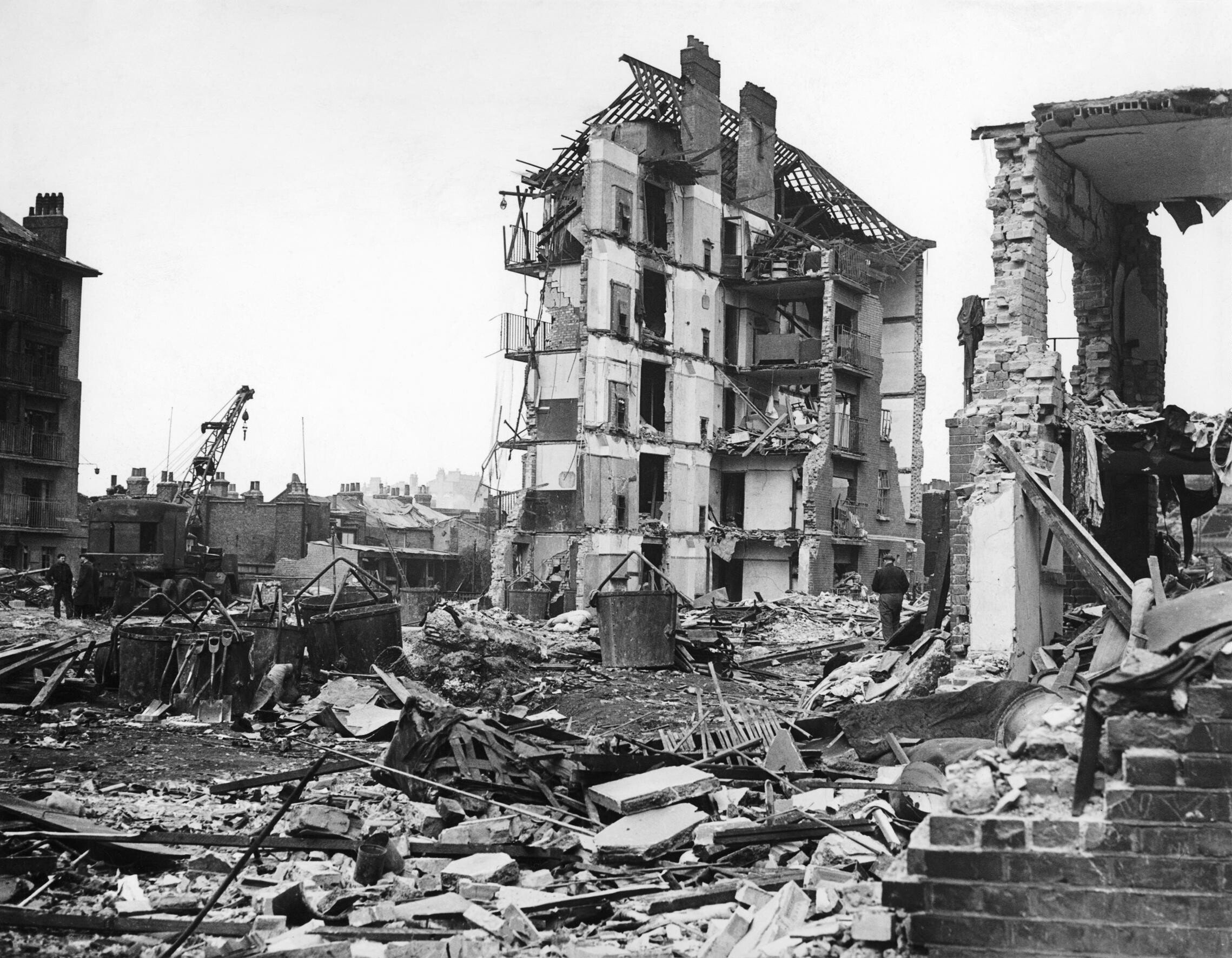
The aftermath of a V2 strike in London toward the end of the attacks on the city in 1945
Despite the advances of Allied forces on both sides of Germany, the air raids continued over the shrinking territory of the Reich as well. Large raids struck at Nuremburg, Ludwigshafen, Munich and Berlin during the first months of 1945, with navigation errors also resulting in accidental bombings of Prague as well as Swiss cities. Even equipped with new jet fighters, the depleted Luftwaffe was nearly powerless to stop the massive fleets of bombers over their cities as the end drew ever nearer.
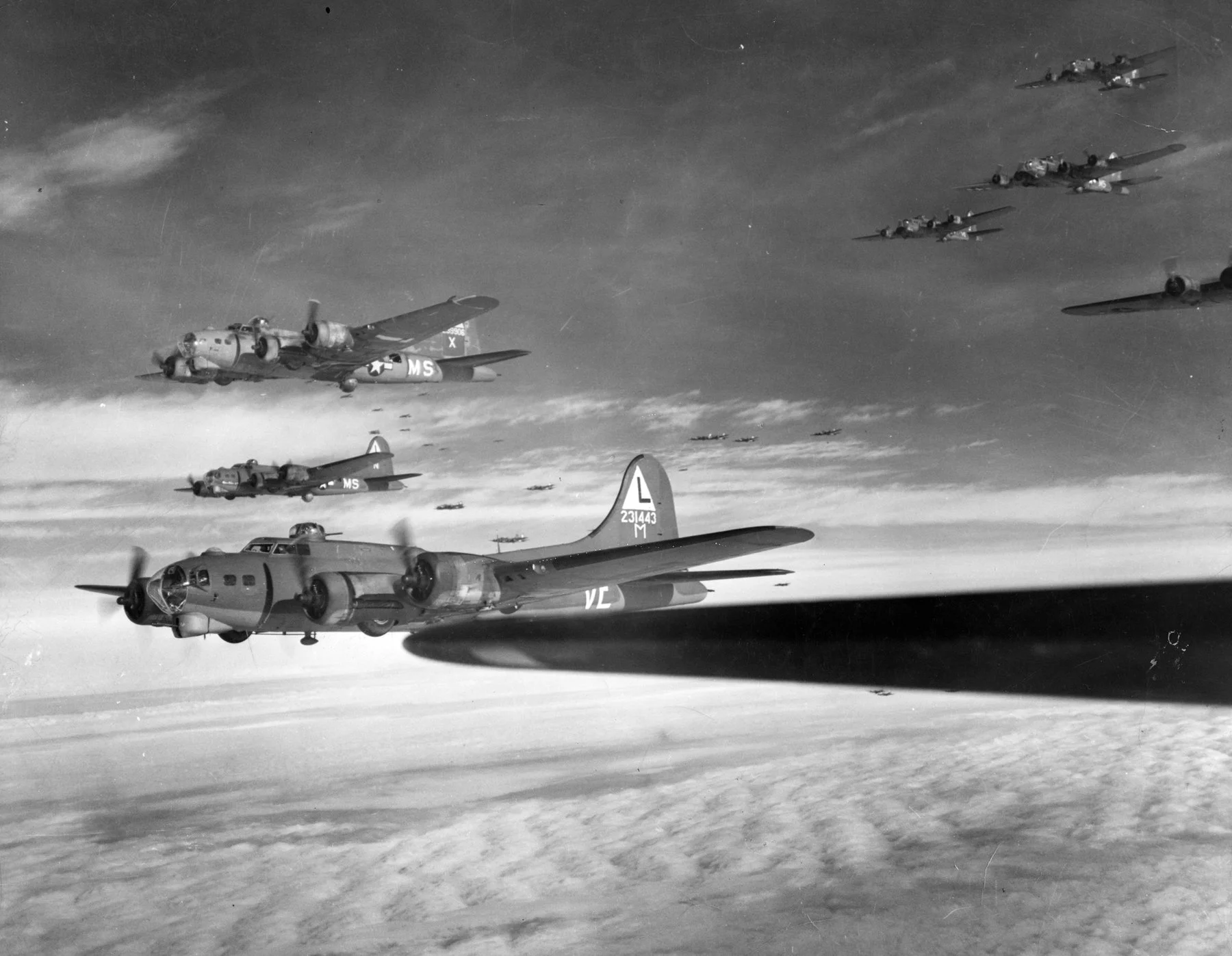
USAAF B17s en route to target in Germany
Europe: The War at Sea
The Battle of the Atlantic was by this phase of the war all but over, with the Kriegsmarine deprived of most of its bases and being depleted of manpower and ships. With the collapsing front in East Prussia, the decision was made to evacuate all German naval bases in the Baltic in early 1945, as Soviet ground forces rapidly advanced and captured or besieged ports such as Danzig, Konigsberg and Gotenhafen.
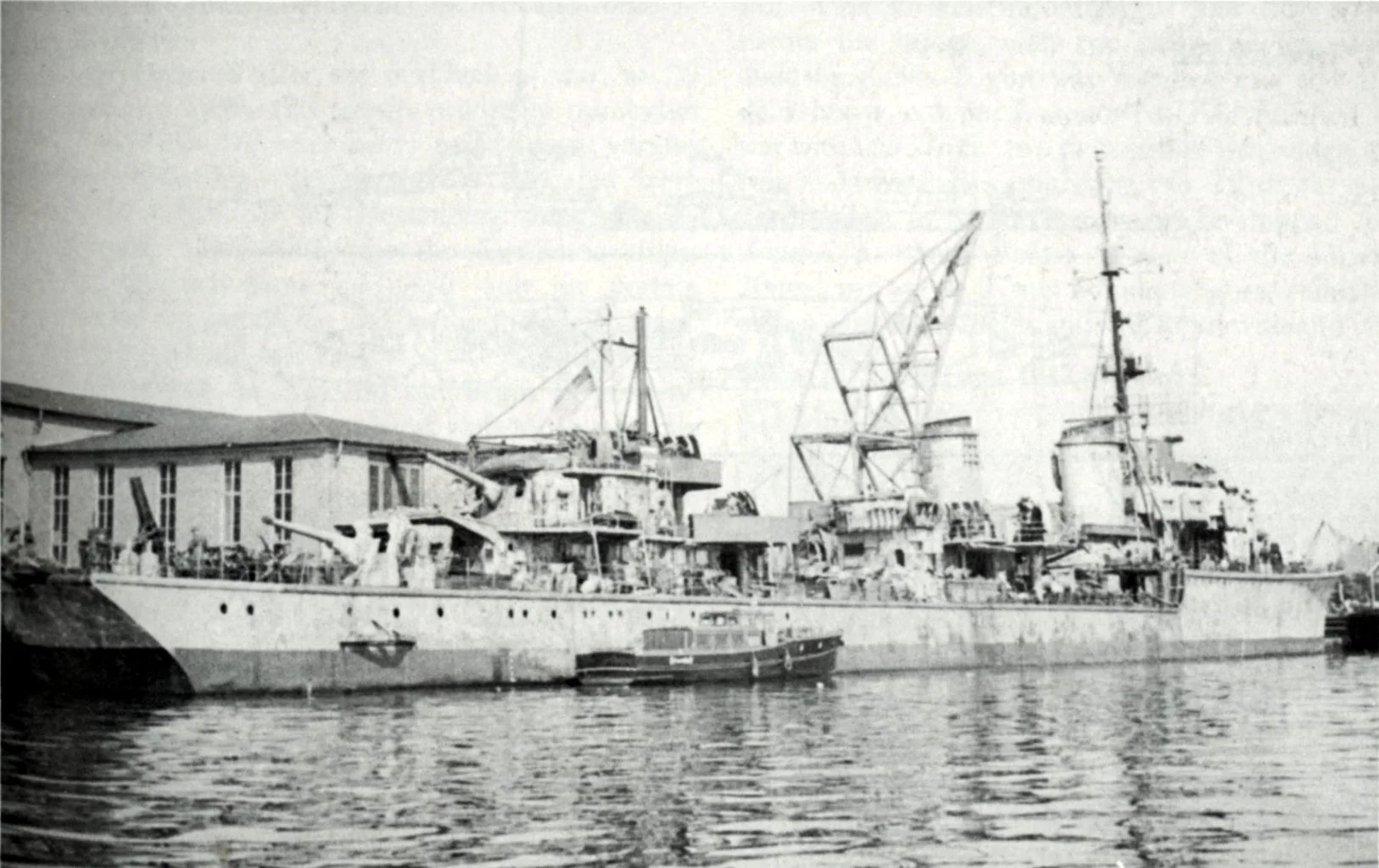
A German Narvik class destroyer in 1945
At Kolberg in Pomerania, the Soviets besieged the city at the start of March, and the Kriegsmarine was called in to evacuate the garrison and civilian population, while providing naval gunfire support from the cruisers Admiral Scheer and Lutzow and a destroyer group. The evacuation was completed by 17 March, with the city that had ironically just been used for a massive propaganda film to inspire resistance falling under the Soviet flag.
Europe: Under Occupation
By this point in the conflict, the majority of occupied Europe was actually under Allied control, including increasing territory of Germany itself. Only Denmark and Norway remained entirely under German control, and while the Reich was invaded these were rapidly becoming little more than a redundant waste of resources. Large numbers of German troops and equipment were needed to maintain control of these territories in the face of continued resistance activity. An example stands out in January, where Norwegian resistance fighters destroyed a railway bridge, causing a crash that killed almost one hundred German soldiers.
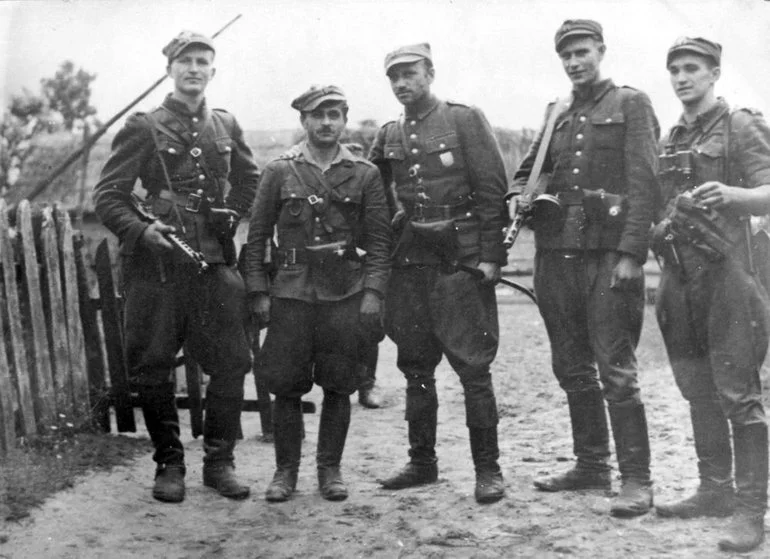
Anti-communist Polish resistance fighters
Meanwhile, the German occupation in the East had been replaced with Stalin’s Red Army. During their withdrawal, the Germans had made several attempts to increase their pogroms against the Poles, and when they were gone the Soviets commenced their drive to transform Poland into a communist puppet state. Many civilians were slaughtered or imprisoned, as were most members of the Polish resistance. The Home Army was crippled by its would-be liberators, and officials of the Polish government that were still in the country were quickly rounded up and deported to assure the new Russian backed government would be able to take power in the aftermath of the conflict.
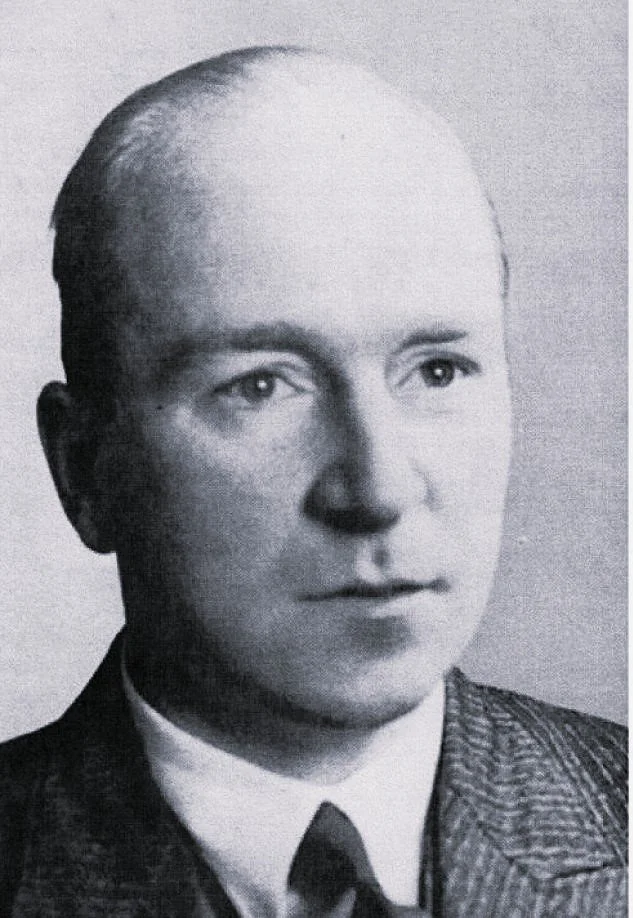
Franz Oppenhoff, American-instaled Burgermeister of Aachen
In the west, the Allied powers were rebuilding their own governments, and setting up a new administration in Germany. In Aachen, the Americans had set to work restoring some semblance of normalcy almost immediately after the city had fallen the previous fall. They had appointed a local attorney, Franz Oppenhoff, as Burgermeister, due to his work defending several local figures in court against the Party. Despite this, Goebbels’ Propaganda Ministry had declared that anyone who attempted to assist the enemy in administering territory would be killed, and the Nazis intended to honor this promise. In a secret plan designated Operation Carnival, SS commandos (possibly involved with Werwolf; an intended irregular resistance force, although this claim is considered dubious by some historians) were infiltrated into the Aachen area in late March. They assassinated the Burgermeister outside of a residence, subsequently escaping the city.
Pacific: The Philippines
Following the taking of Leyte, the Americans began to mass their forces for the strike at Luzon, heart of the Philippines and seat of government. Defending the island was the bulk of General Yamashita’s troops, primarily concentrated in the north near the city of Baguio. In this mountainous jungle Yamashita planned to hold the Americans as long as possible, hoping to inflict as much attrition on them as possible before they could begin the invasion of Japan proper. Additional forces were stationed in the south and center of the islands, although these were intended mainly to delay the advance to Baguio. The city of Manila, considered by American General MacArthur as the great prize of the campaign, was to be left undefended, although the Imperial Navy garrison in the city was disinclined to comply with Yamashita’s orders to abandon the important anchorage.
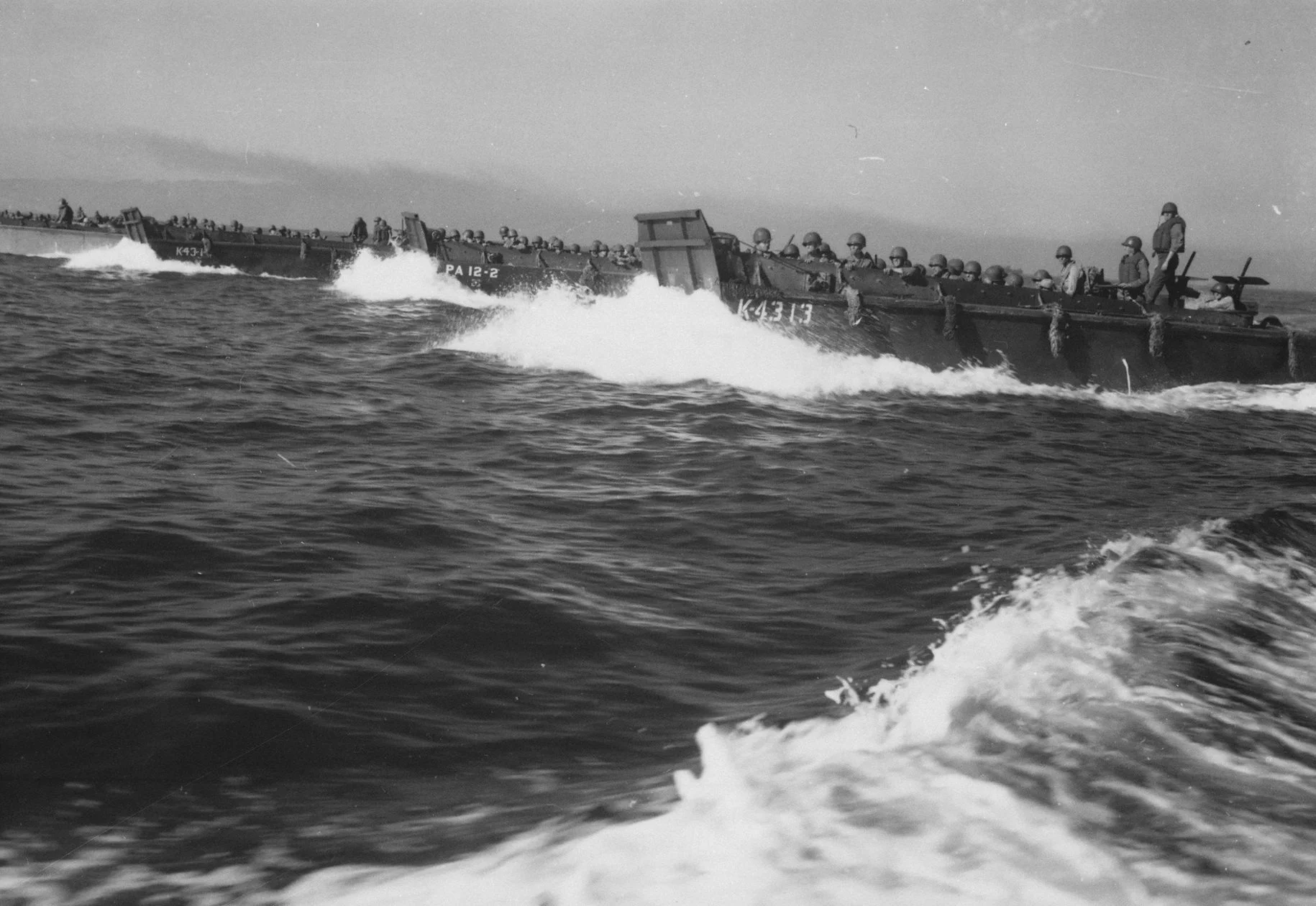
American landing craft head for the beach at Lingayen Gulf
American landings began on 9 January, with US forces landing on the same beaches at Lingayen Gulf that the Japanese had used three years prior. Resistance was light, and within days the large airbase at Clark Field south of the beachhead was back in American hands. Additional landings took place farther south toward the end of the month, with paratroopers of the 11th Airborne Division landing at Nasugbu south of Manila, as well as dropping on Tagatay Ridge, driving northward to meet the main force heading south into Manila.
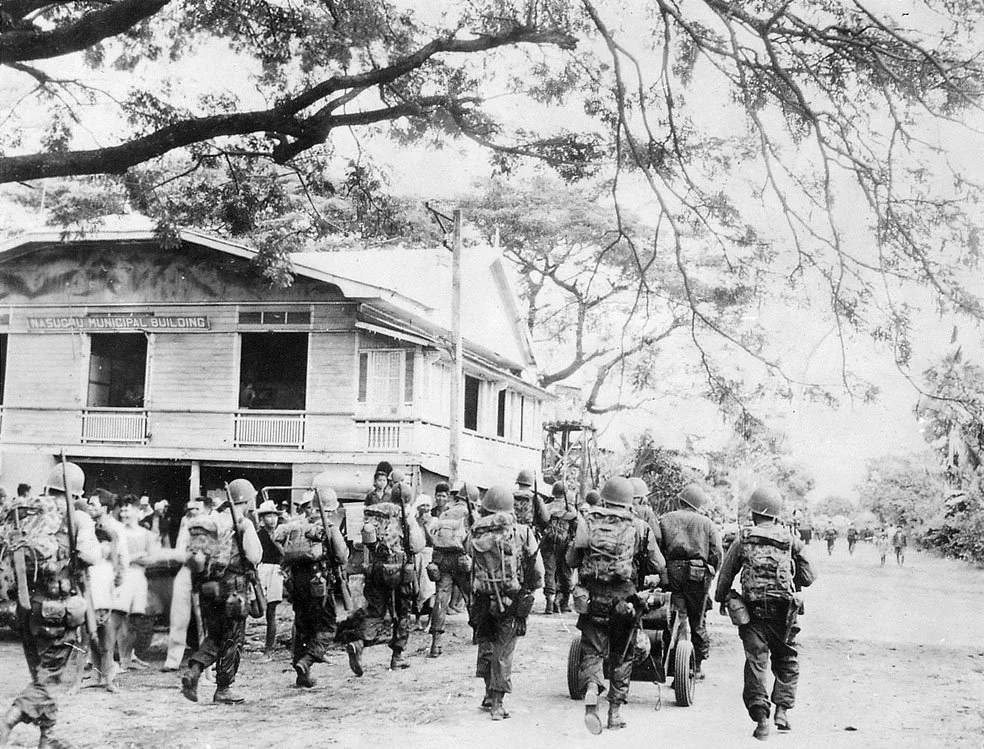
American paratroopers coming ashore at Nasugbu
Meanwhile, US forces swiftly secured the Bataan Peninsula, site of their last stand in 1942, while a large scale tank battle raged on the open country spreading out from Lingayen Gulf, with the Japanese bringing the largest concentration of armor they had ever assembled against the invasion forces, the the weeklong battle resulting in the annihilation of the IJA’s 2nd Armored Division. Heavy fighting began to develop in March as the Americans pushed northward toward Baguio, although the city remained in the hands of the Japanese at the end of March.
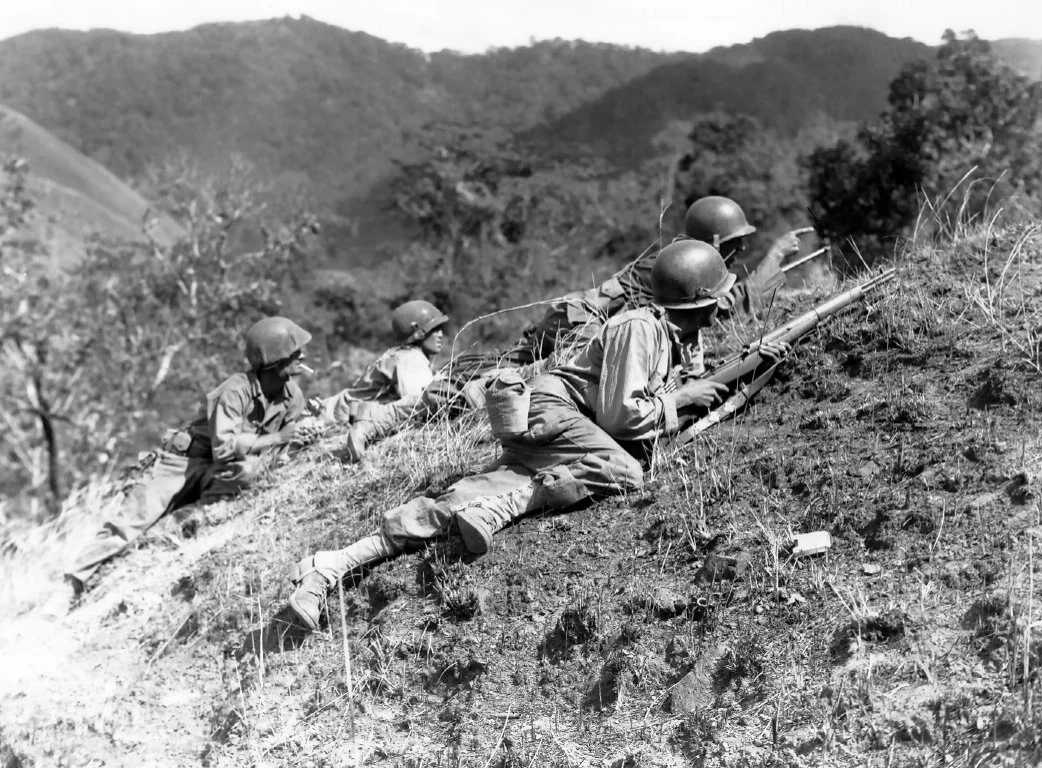
American troops near Baguio
While the large armies were on the move, smaller units were also hard at work. Prisoners of war, captured during the Fall of the Philippines in 1942, had mostly been kept in camps on Luzon under appalling conditions, and now with liberation at hand local Filipino guerillas as well as US special forces moved to break open these camps before the Japanese could liquidate their occupants. The first major raid was on the POW camp at Cabanatuan, which resulted in a brutal half hour fight and ended with the rescue of 522 men and their extraction through thirty miles of enemy territory. Another successful raid took place almost a month later, as the prisoners held at Los Banos were freed by a similar combined US Army and Filipino raid late in February.
Pacific: New Guinea
Following the American withdrawal from Bougainville, the Australians adopted an offensive posture, and in January of 1945 they launched a drive to destroy the remaining Japanese forces on the island. Striking north from their perimeter around Torokina against the Tsimba Ridge, they were stalled by entrenched Japanese forces for the better part of a month before finally clearing the ridge by the end of February, setting their sights yet further north as the remnants of the Japanese garrison in turn prepared for another long defensive fight.
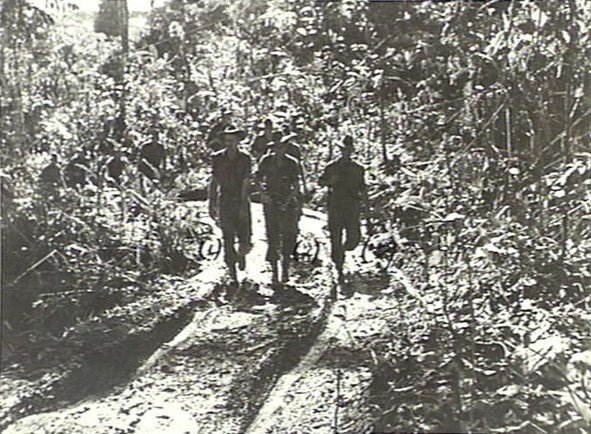
Australian soldiers in the jungle near Tsimba Ridge on Bougainville
Meanwhile, on New Britain, Australian forces had made dual landings at Wide Bay and Open Bay, intending to secure the isthmus between the two and cut the Japanese forces on the island in two. Joined by additional forces advancing northward, and by the end of March the line was all but secured, with the Australians moving into a holding pattern, intending to simply contain the isolated Japanese on the Gazelle Peninsula. The infamous Japanese stronghold at Rabaul, now isolated and besieged, had been effectively neutralized, with the Japanese evacuating their remaining air forces in February, leaving the garrison to its fate.
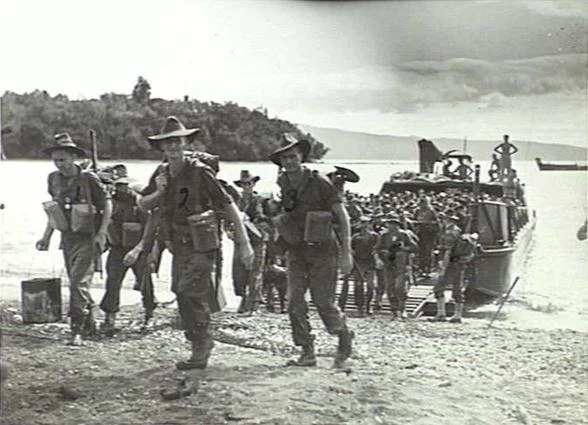
Australian troops come ashore at Wide Bay on New Britain
On Morotai, American forces continued their fight against the Japanese, regrouping in mid January after destroying Japanese forces in heavy fighting around Hill 40 just after the New Year. In March, some units were withdrawn to support the operations on Luzon, while the US 93rd infantry Division (one of the “Colored” divisions in the still segregated American military) was deployed to take up the offensive in April to secure the island. On New Guinea proper, a combined American-Australian force continued the Wewak campaign, although the rainy season had brought the operations to a near standstill.
Pacific: Southeast Asia
In Burma, the Allies followed the end of the monsoon season with attacks along the front, driving toward and liberating Gangaw and Muse in January. Toward the end of January, British commandos landed on the Arakan peninsula, securing the high ground at Hill 170, cutting off the Japanese in the area and forcing a general withdrawal by the IJA 28th Army when it found itself faced with envelopment.
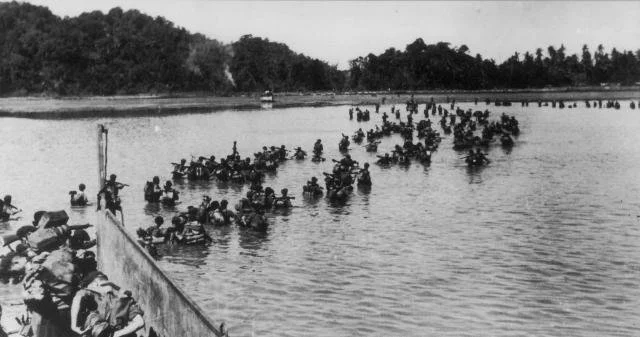
British commandos go ashore near Arakan
This was followed by a general offensive driving on Rangoon. Heavy fighting around Ramree Island took place, becoming famous for the (likely apocryphal) story of the Japanese attempting to retreat through swampland and being decimated by crocodile attacks. Further advances led to a battle for Meiktila, positioned at a choke point on the line of advance between two lakes. The town was taken by the British on 1 March, and was subsequently besieged by counterattacking Japanese, but their counterattacks succeeded only in incurring heavy casualties for the Imperial Army.
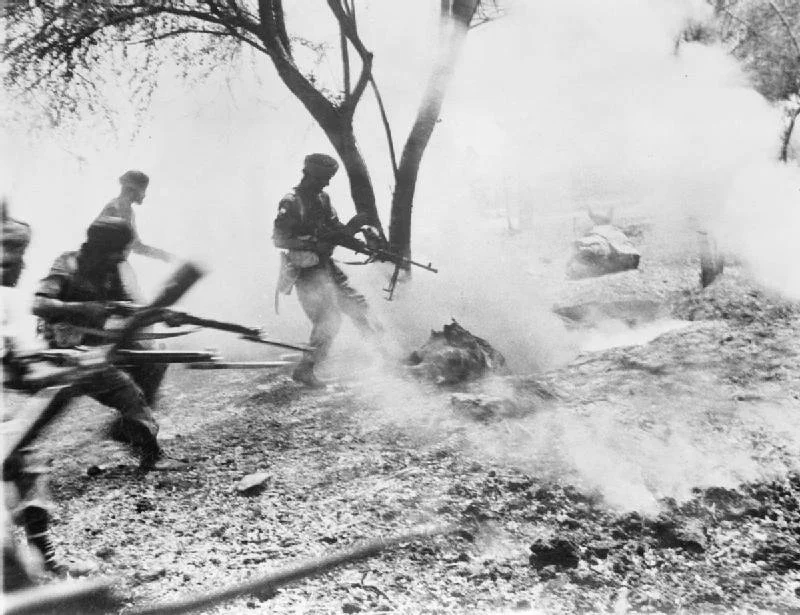
Indian troops assault Japanese foxholes in Mandalay
On 8 March The British and Indian forces reached Mandalay, engaging in fierce fighting with the Japanese garrison in the city. After taking Mandalay Hill, fighting centered around the old Royal Palace, with numerous assaults blunted over the month of March. Towards the end of the month the remnants of the Japanese forces in the city withdrew via the sewer system, and shortly afterward the siege of Meiktila was also abandoned as the Japanese armies in Burma, depleted of manpower and munitions, began to collapse.
Pacific: The Air War
In the skies, the Americans were escalating their attacks against the Japanese. In January carrier planes launched large scale raids on Japanese bases in French Indochina, striking at Saigon, Cam Ranh Bay, as well as bases in Formosa. These were intended to precent the reinforcement or support of the Japanese troops on Luzon in the Philippines, and took full advantage of the collapsing state of the Imperial Japanese Navy. Additional raids were also launched further north against bases in the Ryukyu Islands, helping to clear the way for planned future landings of the island hopping campaign as they closed the distance toward Japan.
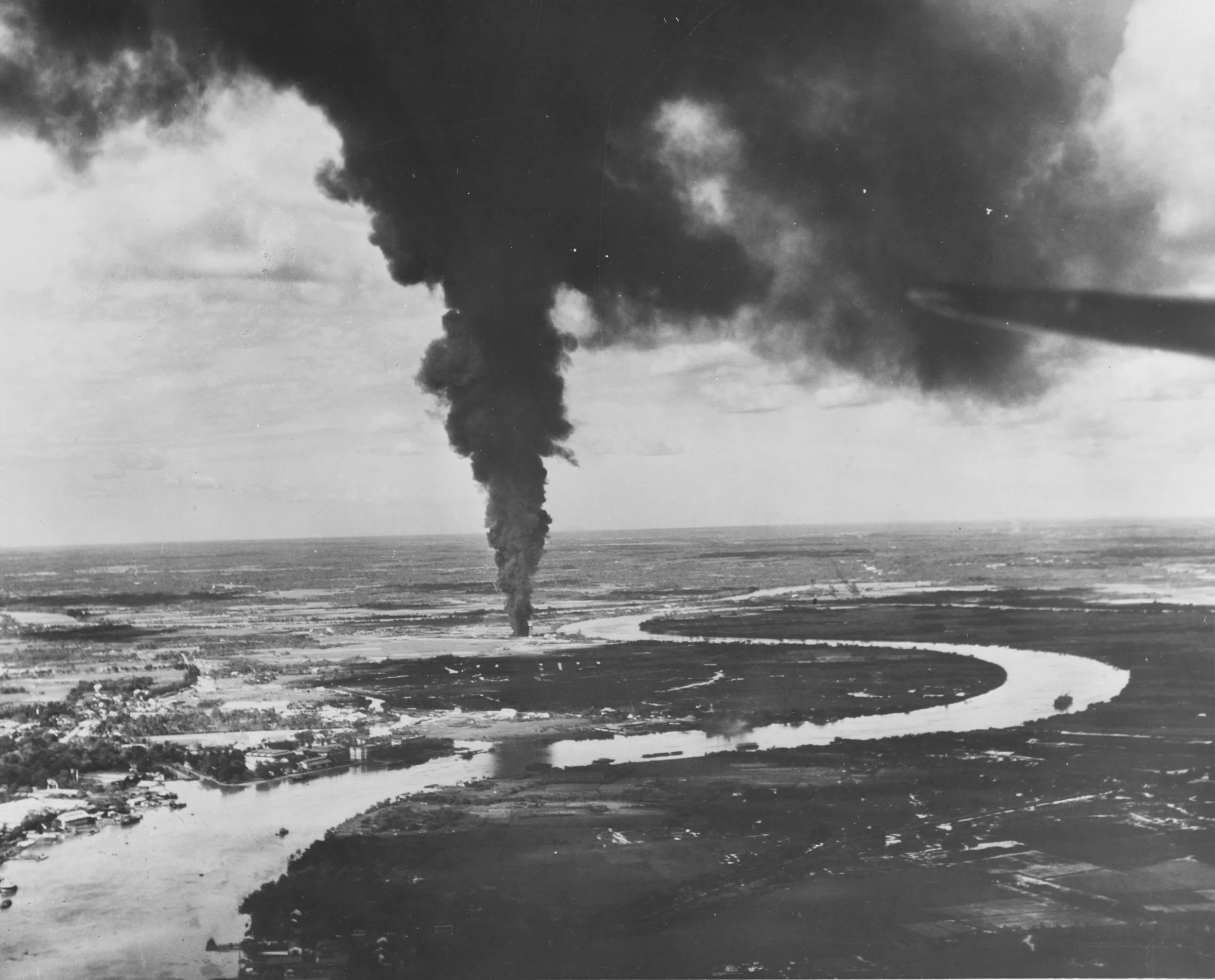
Smoke rises from a target struck by American carrier planes in Saigon
American carrier based planes also began to raid Tokyo in February, the first since the Doolittle Raid of 1942. The escorting Navy fighters were simultaneously deployed to sweep the dwindling Japanese fighter forces from the skies, inflicting heavy casualties. B29 raids also continued to escalate, with a switch to incendiaries in February demonstrating a terrible efficiency against the primarily wooden cities of Japan compared to the high explosives hitherto used.
Political Developments
In Bulgaria, following the communist putsch the previous September, mass arrests began of officials of the fallen monarchy. Most former leadership, including the deposed Prince Regent Kiril, were executed along with almost seventy others as the communists consolidated power. Free elections were promised for the next year, although most of the opposition parties that were not yet suppressed held little hope for anything other than a communist dictatorship under the ultimate rule of the USSR. A similar fate awaited Romania, as the King was pressured into appointing a communist Prime Minister by the occupying Red Army in March.
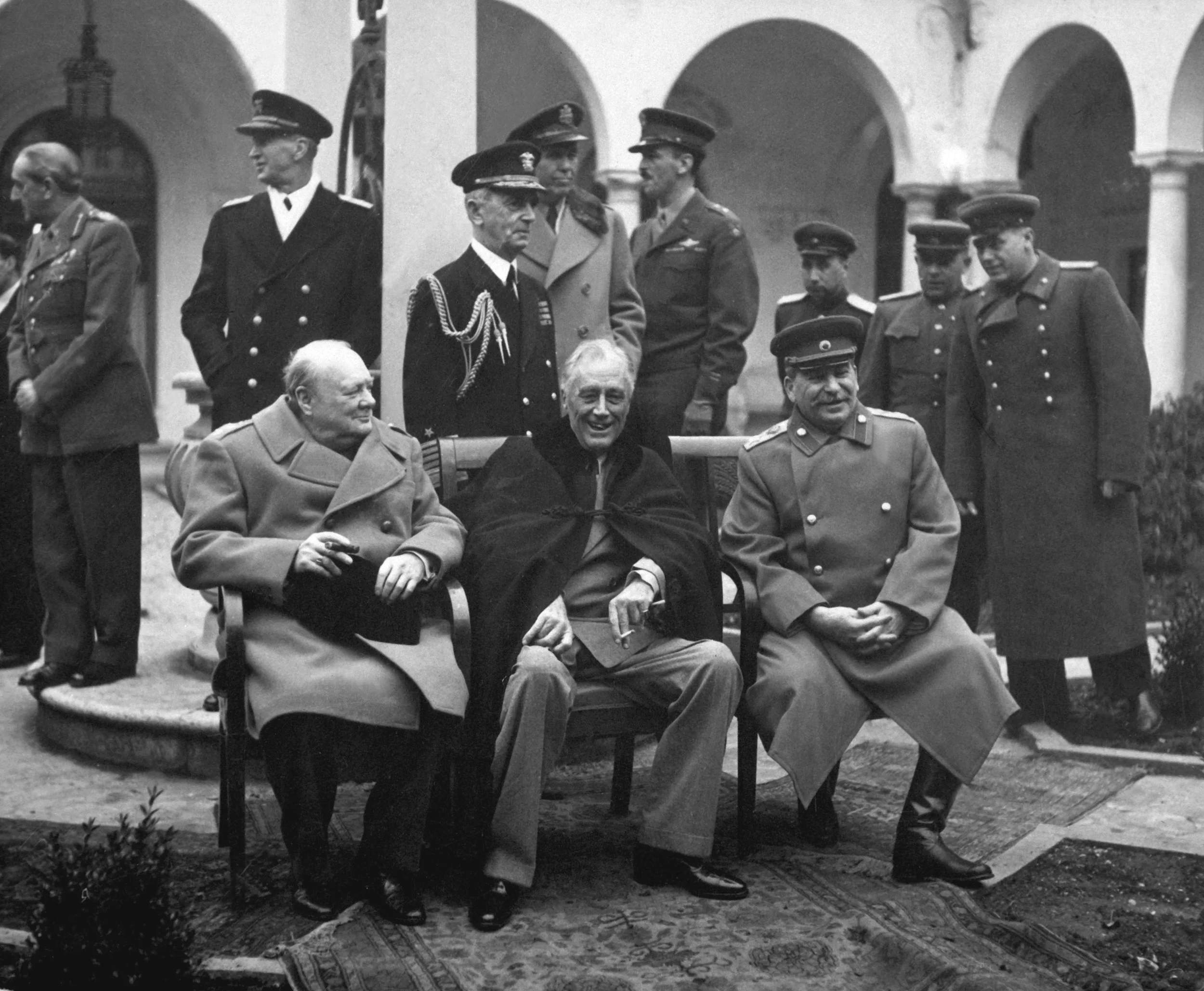
The “Big Three” (Churchill, Roosevelt, and Stalin) at Yalta
As the end of the war in Europe drew near, in February a high level conference was convened at Yalta in the Crimea, with Stalin, Churchill and Roosevelt coming together to set down their plans for the world following the destruction of Germany. Some tensions were felt just under the surface, particularly over the issue of Poland. Churchill considered the independence of Poland (the issue that had brought the British declaration of war in 1939) to be non-negotiable, while Stalin was equally resolute that the country fall under communist influence. Roosevelt, for his part, was ready to make concessions to the Soviet dictator in the hope that the Red Army could be turned against Japan.
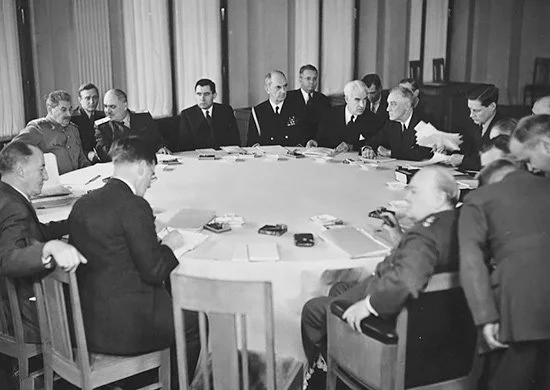
Negotiations at the Yalta Conference
As far as Germany itself, the country was to be pushed to the point of complete and unconditional surrender. Following this, a concentrated effort to stamp out National Socialism would commence, with the country divided into four zones (American, British, French and Soviet) of occupation. There would be no German government in the aftermath of the war, instead the country was to be administered by the victorious Allied military commands. War criminals would be located and placed on trial by the nations victimized by them, and it was concluded that the high level Nazi leadership would face execution.
The Homefront
At home, the political machines continued to turn as always. In the United States President Roosevelt gave the annual State of the Union address to Congress, but in this first year of his fourth term he did so by letter rather than in person. His inauguration later in January was a much smaller affair than in the past as well, taking place at the White House and lacking the usual parade and other public festivities. Following his return from Yalta it was obvious that the President was in a state of serious physical decline, and toward the end of March Roosevelt left Washington for his retreat at Warm Springs in Georgia to recuperate before the innauguration of United Nations, scheduled for the next month.
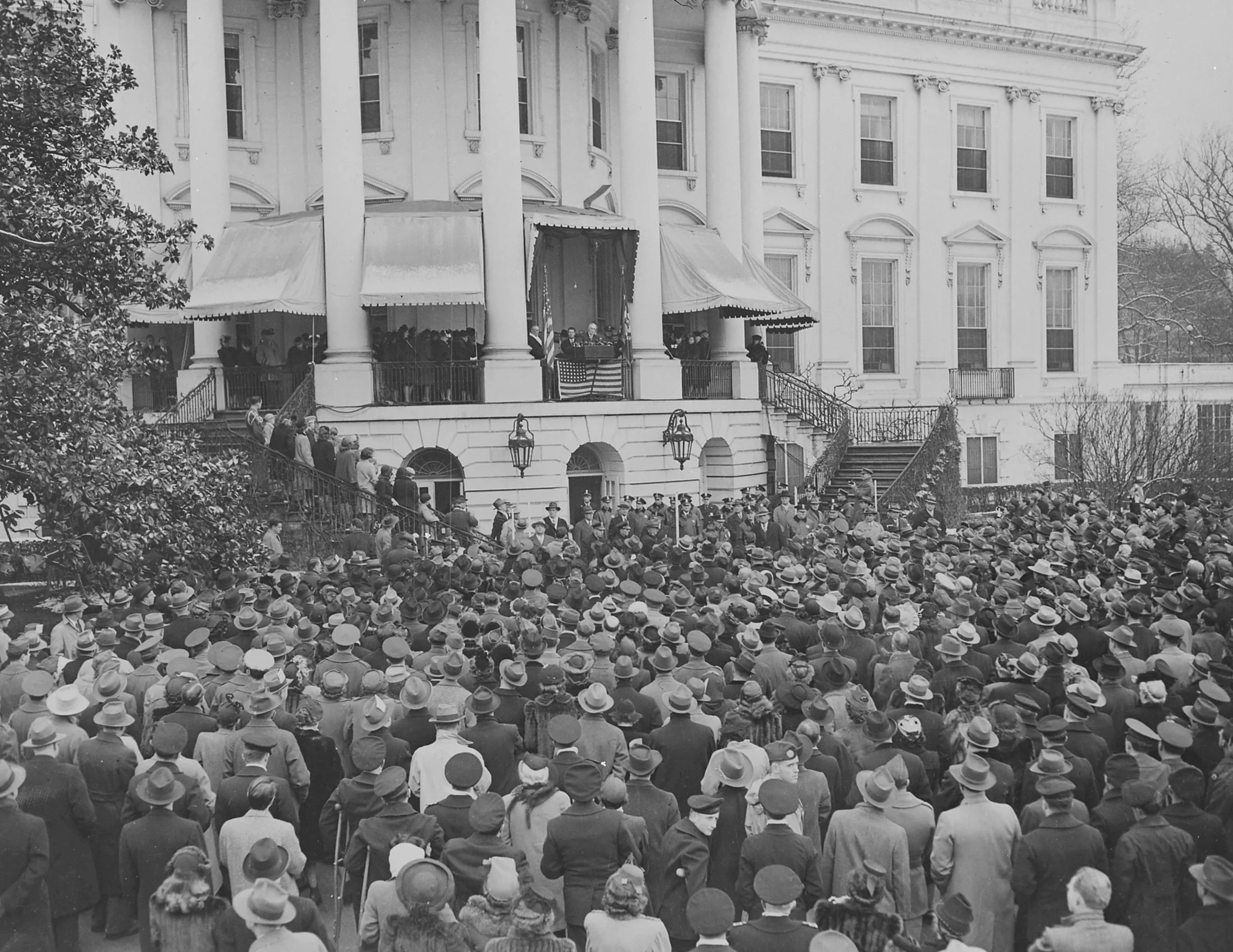
President Roosevelt takes the Oath of Office for an unprecedented fourth time
In Germany, Adolf Hitler made a speech via radio to mark the 12th anniversary of the Nazi seizure of power on 20 January 1933. This would be the last time the Fuhrer made a public address to the German people, or at least the few that still possessed functional radios. Meanwhile, preparations for the end were ongoing. The gold reserves of the Reichsbank were relocated to salt mines near Eisenach, while the top secret research base at Peenemunde was evacuated. Hitler’s last visit to the front came in March, when he travelled from Berlin to visit the headquarters of Army Group Vistula, only forty miles from the capitol. The formation had been created to hold the line of the Oder River, and was under the direct command of Reichsfuhrer SS Heinrich Himmler, but his total lack of military experience became a serious liability, and in late March he was replaced by General Gotthard Heinrici, an experienced defensive commander, as the Wehrmacht prepared for the final act of the Eastern Front.
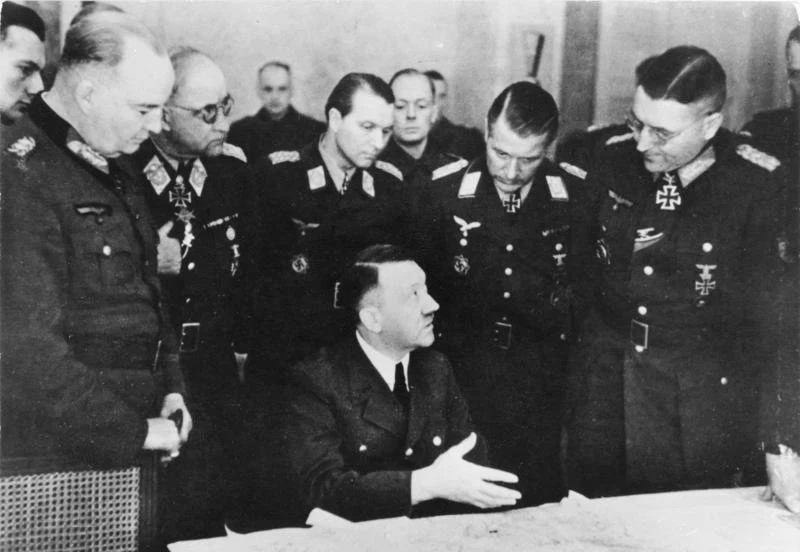
Hitler speaks with officers of Army Group Vistula during a visit to the front