Total War
Chapter 43
“I ask you: Do you want total war?! Do you want want it, if necessary, more total and radical than anything that we can yet today even conceive?”
Germany - 1945
In February of 1943, in the aftermath of the debacle at Stalingrad, German Propaganda Minister Josef Goebbels had addressed a packed Sportpalast in Berlin on the war situation, asking the crowd if they wanted a total war; a war on a scale hitherto unimagined. The result was a resounding cheer that was broadcast to the nation and the world. Two years later, the total war that Goebbels had offered was coming home to the Reich.
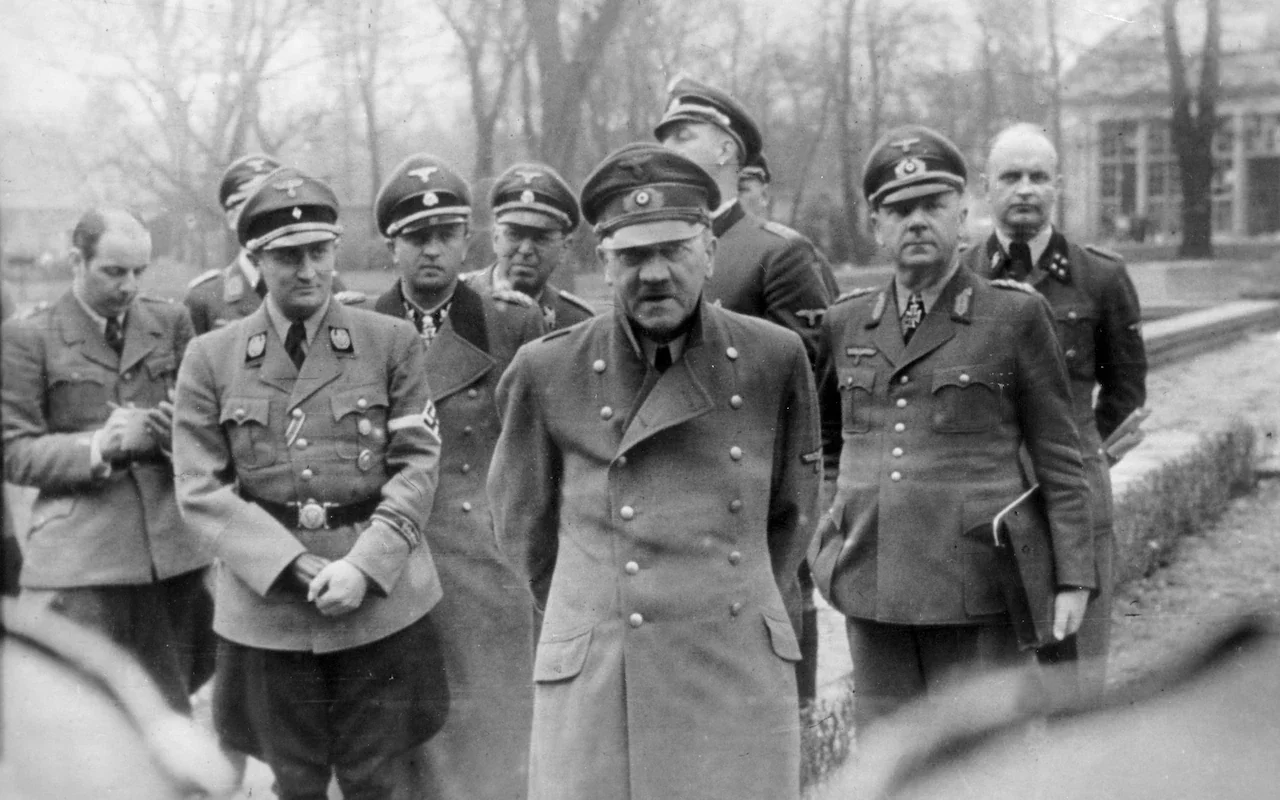
Hitler with his entourage in 1945
Shortly after the new year, as the offensive in the Ardennes fell apart, Adolf Hitler departed his Western Front headquarters at the Adlerhorst in Hesse via his special train, bound for Berlin. The arrival of the Fuhrer in the capitol was a far cry from the triumphant affairs of yore. The train arrived with shades drawn, and no crowds lined the bomb blasted streets as Hitler’s truncated motorcade passed by. Indeed, very few even knew he had returned to the city.
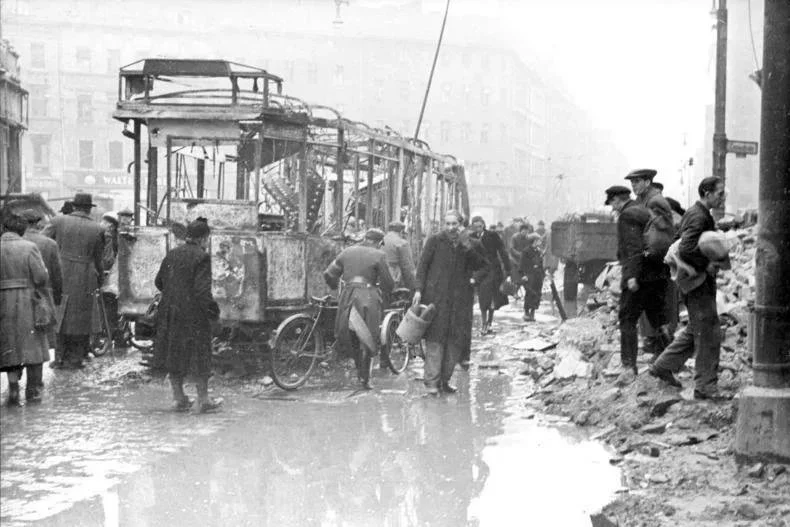
A Berlin street scene in the later months of the Second World War
German Federal Archives
Enemy violation of German territory had, up to this point, been relatively small and contained. The Soviets had made small probes into East Prussia, but were otherwise being held outside of the borders along the Vistula in occupied Poland. In the west, the Americans had captured the ancient capitol city of Aachen and made several penetrations along the West Wall defensive line, although they too were mostly in a holding pattern for the time being, concentrating on clearing the Bulge created in the Ardennes. Regardless, however, the Germans were at this phase of the war caught between two massive armies bearing down on them from two directions, and when the weather cleared with the coming of Spring, the storm would most assuredly break.
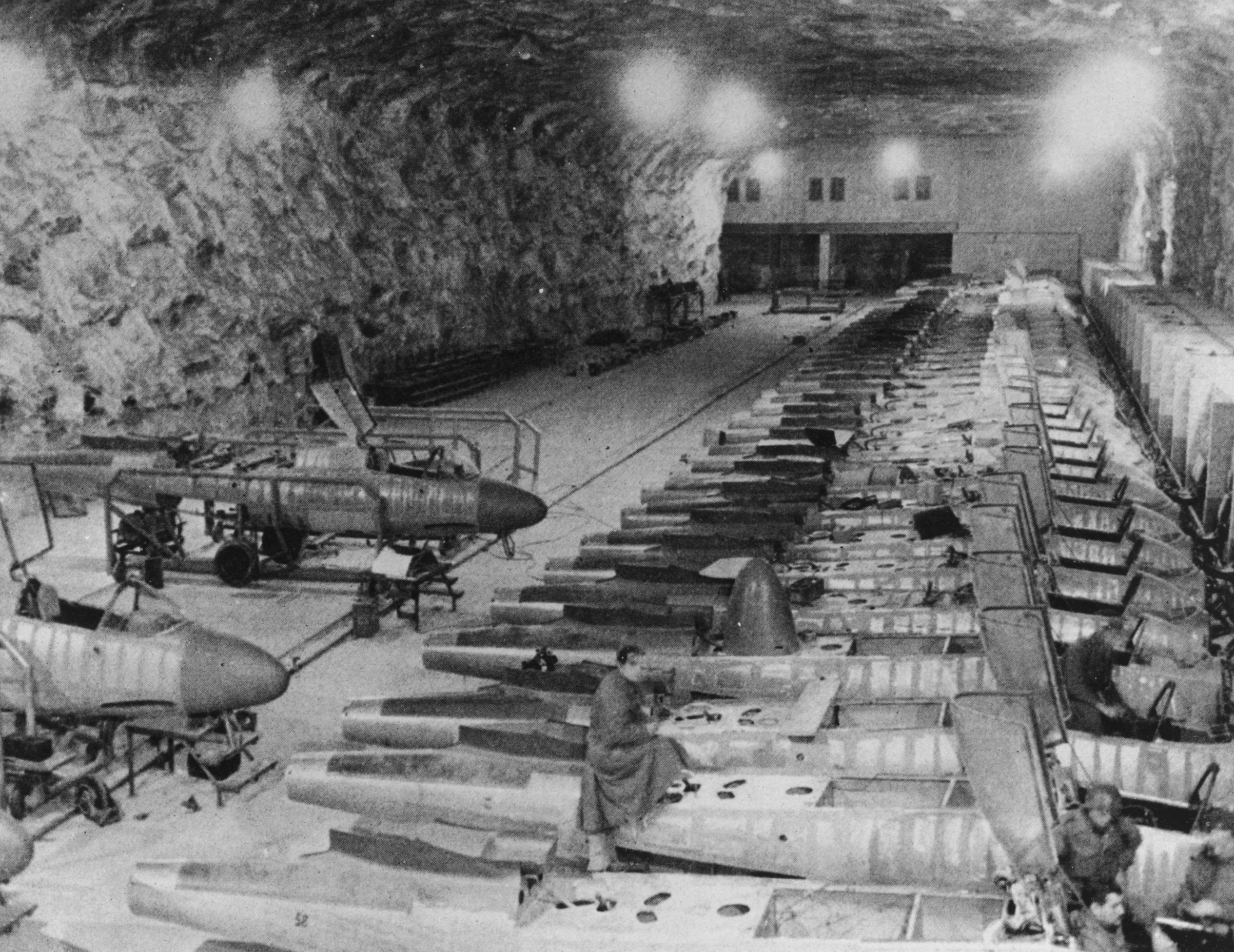
A view of Heinkel HE162 jet fighters inside an underground production plant
Just as the adoring crowds had disappeared from the streets of Berlin, so had the hope of victory disappeared from most of the populace. Despite the propaganda pushed by Josef Goebbels’ Ministry, the round the clock bombing and seemingly endless casualty lists had proven hard to conceal. Most cities were in ruins, and every night was filled with the blasts of anti-aircraft fire, the droning of thousands of planes overhead and the rolling thunder of carpet bombing. Much of the nation’s industry was by now in the process of moving underground, with old mineshafts and cave systems hastily converted into production centers, often with the use of slave labor from the various concentration camps. These same forced laborers often worked on the factory floors themselves as well, with the majority of German men drafted into the armed forces.
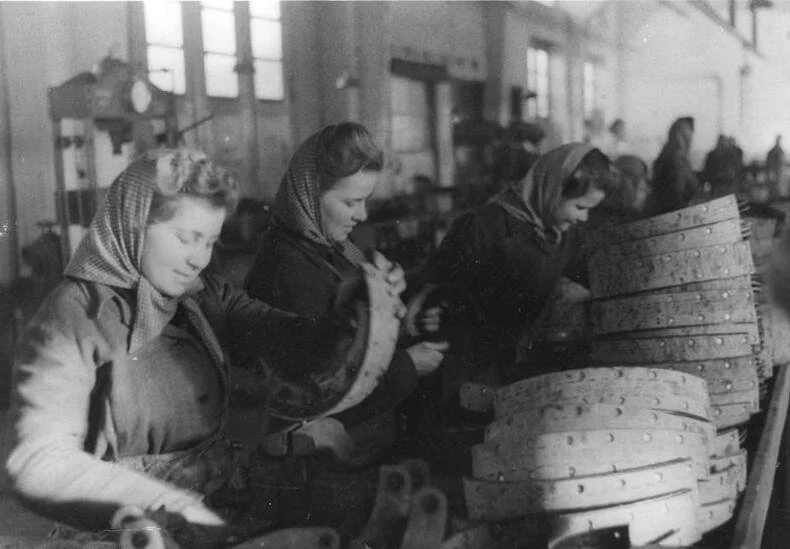
Soviet forced laborers in a German factory, brought in to replace the men sent to the front lines
By 1945 serious shortages of nearly every conceivable type of goods wracked the country, with priority always going to the war effort. Soldiers on the front were not starving, but rations were poor, and the situation for the civilians was generally worse. In addition, supply and distribution networks were crippled across the Reich, with railyards and storehouses favorite targets of air raids. Basic goods like dairy products, meat, clothing and consumer goods were increasingly difficult to obtain, and luxury goods were next to impossible to source. In the countryside and smaller villages small gardens were able to supplement a family’s rations, and sometimes animals such as chickens or rabbits would be kept to supply meat and eggs.
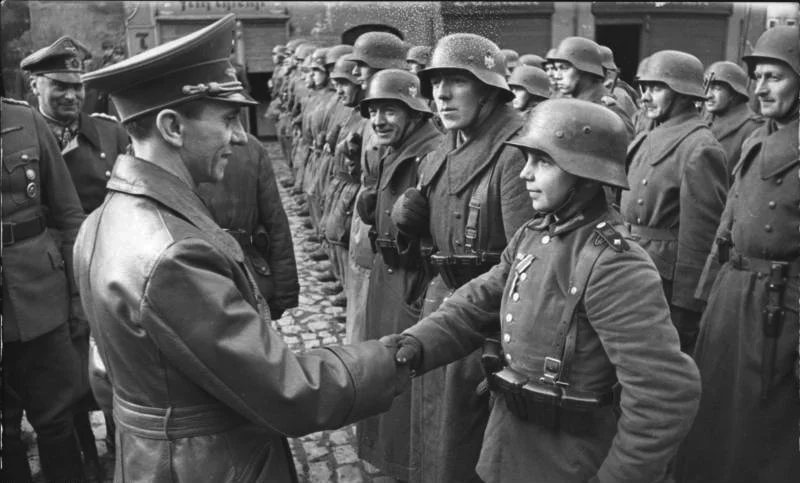
Josef Goebbels shakes the hand of a young Hitler Youth soldier
With the enemy at the gates, the increasingly desperate regime had begun moving in late 1944 to call up the last possible reserves in order to make a final stand in the homeland. In October a call had been issued to all males between the ages of 16 and 60 not already in the military to muster into the Volkssturm, an emergency militia for the defense of the Reich. Organized under the direct authority of local Nazi Party leaders as opposed to the Wehrmacht or even the Waffen SS, in practice this force would range primarily from older men, veterans of the Great War with little enthusiasm to die for a hopeless cause, and the younger, fanatical children of the Hitler Youth.
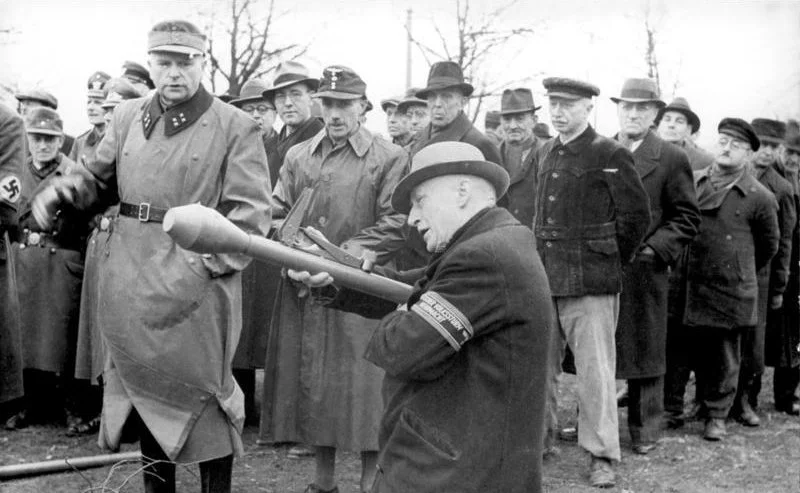
An elderly German Volkssturm member is trained on the Panzerfaust
Training for the Volkssturm was basic, as were uniforms and equipment. Many were only issued an armband, and often the only proper uniforms available were those already worn by members in civilian life such as postal service or Hitler Youth uniforms. Weapons were commonly captured foreign types or obsolete domestic models, such as Austrian Mannlichers or French Berthiers. Some simple weapons were also introduced for their use, including a stripped down variant of the standard K98k rifle and crude submachine guns based on the British Sten. Ubiquitous among the ranks of the Volkssturm was the Panzerfaust, a simple disposable anti-tank grenade launcher, issued to Volkssturm units intended to act as hunter-killers in their cities and towns.
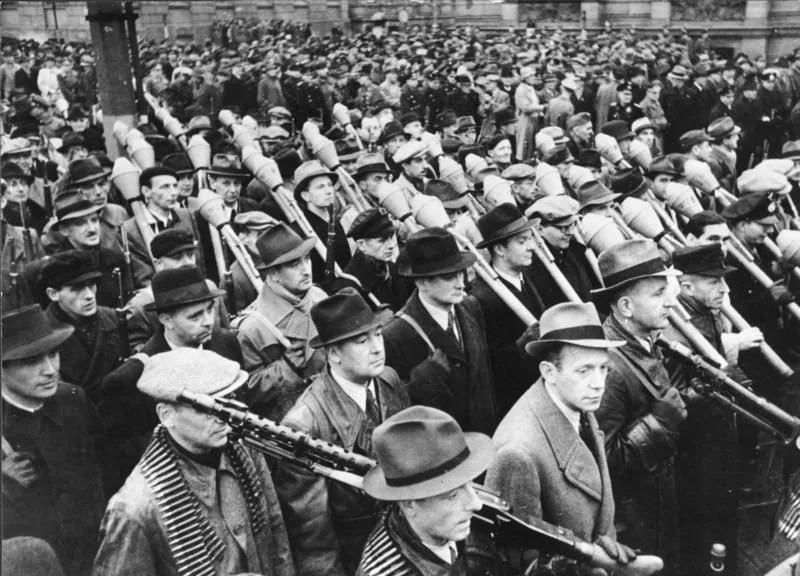
Men of the Volkssturm on parade
On the strategic side, the failure of the offensive in the Ardennes had combined with the multiple penetrations of the Siegfried Line left little option for defense but to withdraw eastward to hold the line of the river Rhine, something that Field Marshal von Rundstedt, German Commander-in-Chief in the West had been pushing for since the autumn of 1944. Hitler, for his part, had no interest in abandoning any German territory, had resisted this order, forcing German units to maintain their forces west of the river in disorganized lines, even as attempts were made to fortify their crumbling positions.
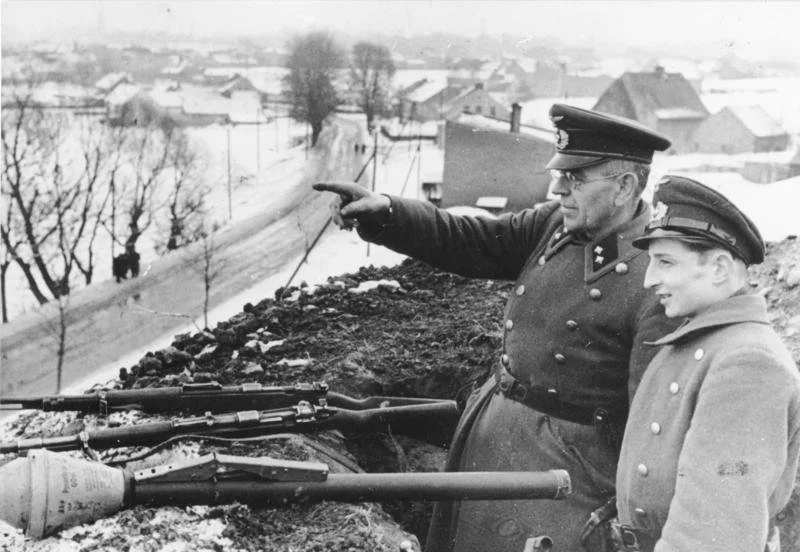
Two soldiers of the Volkssturm in a defensive position overlooking a roadway
The situation in the East was similarly poor, with the front running along the East Prussian border to the Vistula in occupied Poland, with the Red Army controlling several bridgeheads and massing their forces for a spring offensive. Hitler remained obstinate here as well, resolutely refusing to withdraw the divisions of Army Group North trapped uselesly on the Kurland Peninsula, and even redeploying much needed troops from the line in Poland in an attempt to shore up the defenses of Budapest.
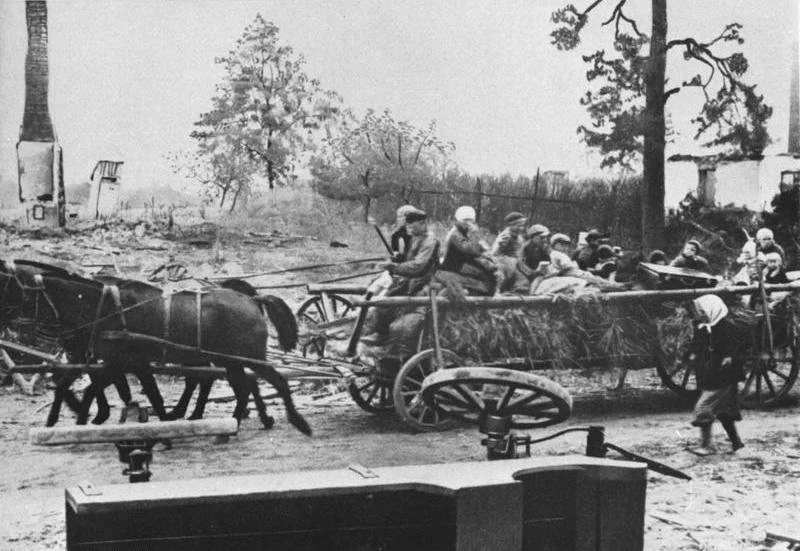
Refugees flee the Soviets in East Prussia on a horse drawn cart
In late January, the German authorities in Eastern Prussia finally had acknowledged the severity of the threat posed by the Red Army along the eastern frontier, and had commenced a frantic evacuation. Thousands of civilians, mostly women and children, began to throng westward on the frozen roads, jammed already with military traffic. Most were forced to utilize primitive transport such as horsedrawn carts, and many more were on foot, desperate to escape the advancing Soviet armies. By the end of January, the Soviets had reached the Baltic coast, cutting off East Prussia and forcing the refugees to make a dangerous crossing of the frozen Vistula Lagoon in a desperate attempt to reach Danzig, where naval evacuations were underway. Many broke through the ice and drowned in the freezing waters, and Soviet aircraft freely roamed above, targeting civilians and military convoys alike with impunity.
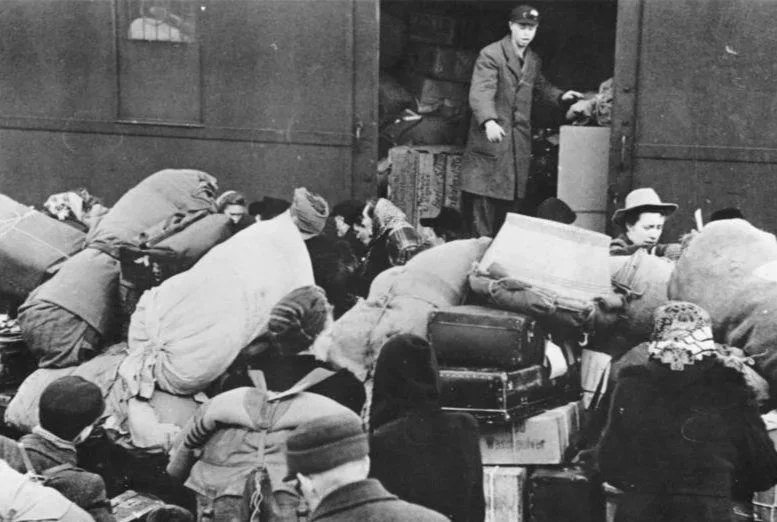
Refugees arrive in Berlin
German Federal Archives
The naval evacuation, designated Operation Hannibal, consisted of any and all ships still servicable, including warships as well as sequestered liners and merchantmen along with smaller fishing craft. Crammed to bursting, these ships left in convoys through the icy waters of the Baltic bound for the relative safety of ports farther west in Germany in an operation even larger than the evacuation of Dunkirk by the British in 1940. These ships were also targeted by Soviet air and naval forces, with the remnants of the decimated Kriegsmarine attempting to escort them as best they could.
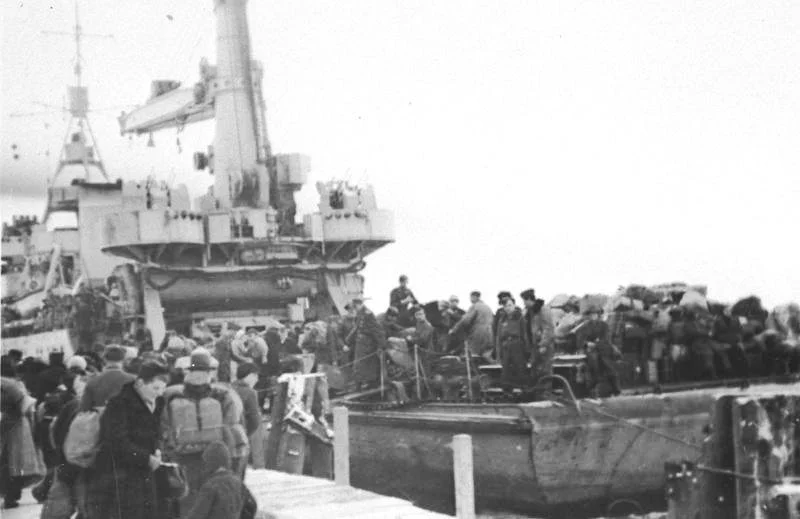
Refugees crowd aboard a shop to evacuate Danzig
On the night of 30 January, 1945 one such convoy was pushing through the floating ice off the coast of Pomerania, with the liner MV Wilhelm Gustloff, flagship of the Nazi’s Strength Through Joy Program in happier times, loaded with upwards of 10,000 souls in a ship intended to carry 1,500. Sighted by the Soviet submarine S13, the liner was struck by a spread of three torpedoes, one of which impacted its tiled swimming pool, that night drained and used for additional berthing. The mosaic tiles became deadly shrapnel that tore apart those sleeping there, while another disabled the ship’s engines and generators. With most of her lifeboats frozen in place, few were able to evacuate, and many were trampled in the pitch dark corridors attempting to escape. Shortly after the torpedo hit, the Gustloff rolled on her side, foundering shortly after. Over 9,000 would either be trapped aboard or succumb to the freezing water, marking what would become the single deadliest disaster in maritime history.
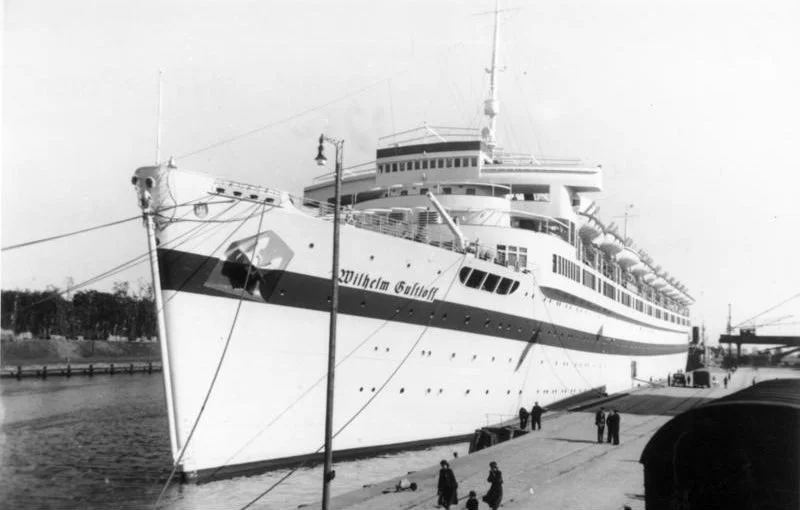
The Wilhelm Gustloff prior to the war
The Allied air campaign likewise came to its terrible climax in early 1945, as a massive joint USAAF and RAF force struck at the city of Dresden on the river Elbe. Targeting the city’s marshalling yards, the bombers ignited a massive firestorm in the previously all but untouched city. 800 RAF bombers dropped almost 3,000 tons of ordnance on the city, with the glow of the flames visible from sixty miles away. The heat was such that the unfortunate citizens were roasted in their shelters, while those on the streets found their shoes literally melting into the pavement of the street. The city would burn for days, and in the end the once picturesque city had been turned into a vast charnel house.
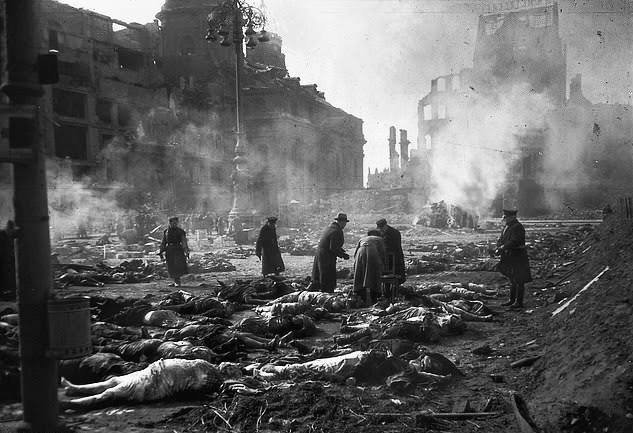
Bodies are collected in the ruins of Dresden after the raid
Inside the damp bunker under the Reichs Chancellery where Hitler had made his headquarters, the increasingly manic Fuhrer spent his nights studying situation maps and reports, issuing orders to various units regardless of whether they could be executed, or indeed if the recipients still existed. Despite an unshakeable conviction that the Endsieg (Final Victory) would come, the Fuhrer began to issue orders intended to ensure that Germany was no prize for the Allies. In mid March Hitler issued a general order to all levels of command throughout the Reich calling for the destruction of any and all usable infrastructure before it could be captured by the enemy. Becoming known to history as the “Nero Decree”, this asserted that the enemy would destroy such resources when they were repelled anyway, and thus it was imperative that their use be deprived to the invaders. It was also in keeping with the social-Darwinist philosophy of Hitler, in that if the German people were unable to defeat their enemies, they deserved to be destroyed.
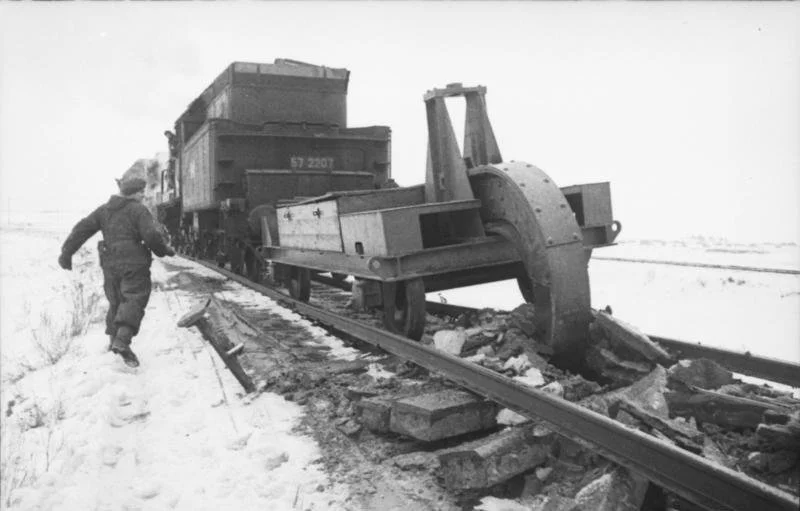
A German “Railroad Plough” destroys tracks as the Wehrmacht retreats
While Germany itself was facing imminent invasion, the lines in Italy were holding, at least for the time being, while the Wehrmacht still occupied Denmark and Norway without facing land invasion by Allied forces. These, however, served little purpose by this point other than to tie up substantial German forces. Still others were uselessly stranded in areas where Hitler refused to allow them to withdraw or be evacuated, such as the large force trapped on the Courland Peninsula along the Latvian coast. as it became apparent that the curtain was about to rise on the final act of the Third Reich.
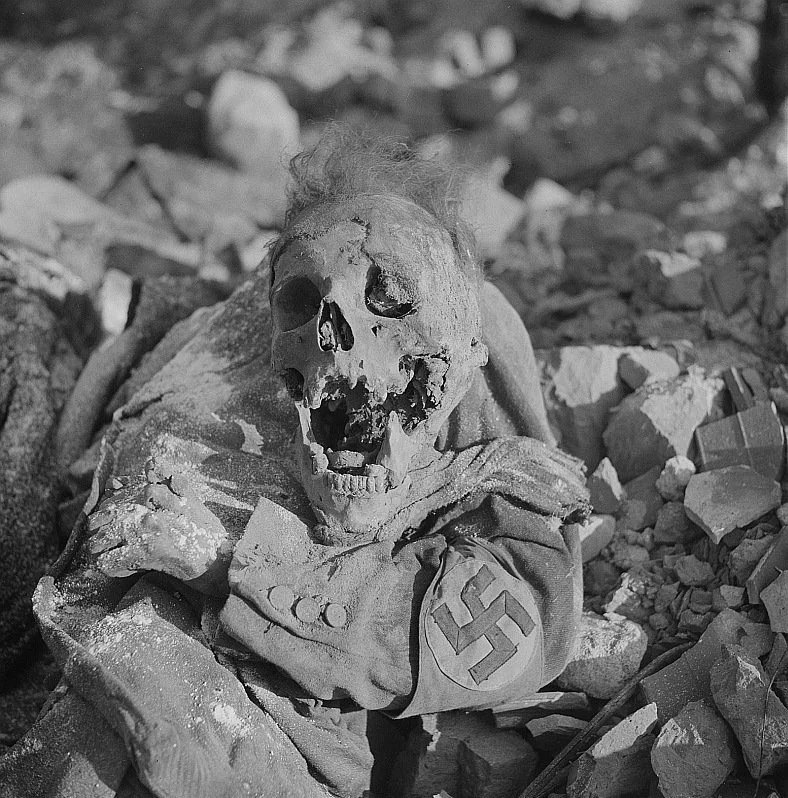
The remains of a Nazi party official recovered in Dresden