The Battle of the Ardennes
Chapter 42
“NUTS!”
16 December, 1944 - 28 January, 1945
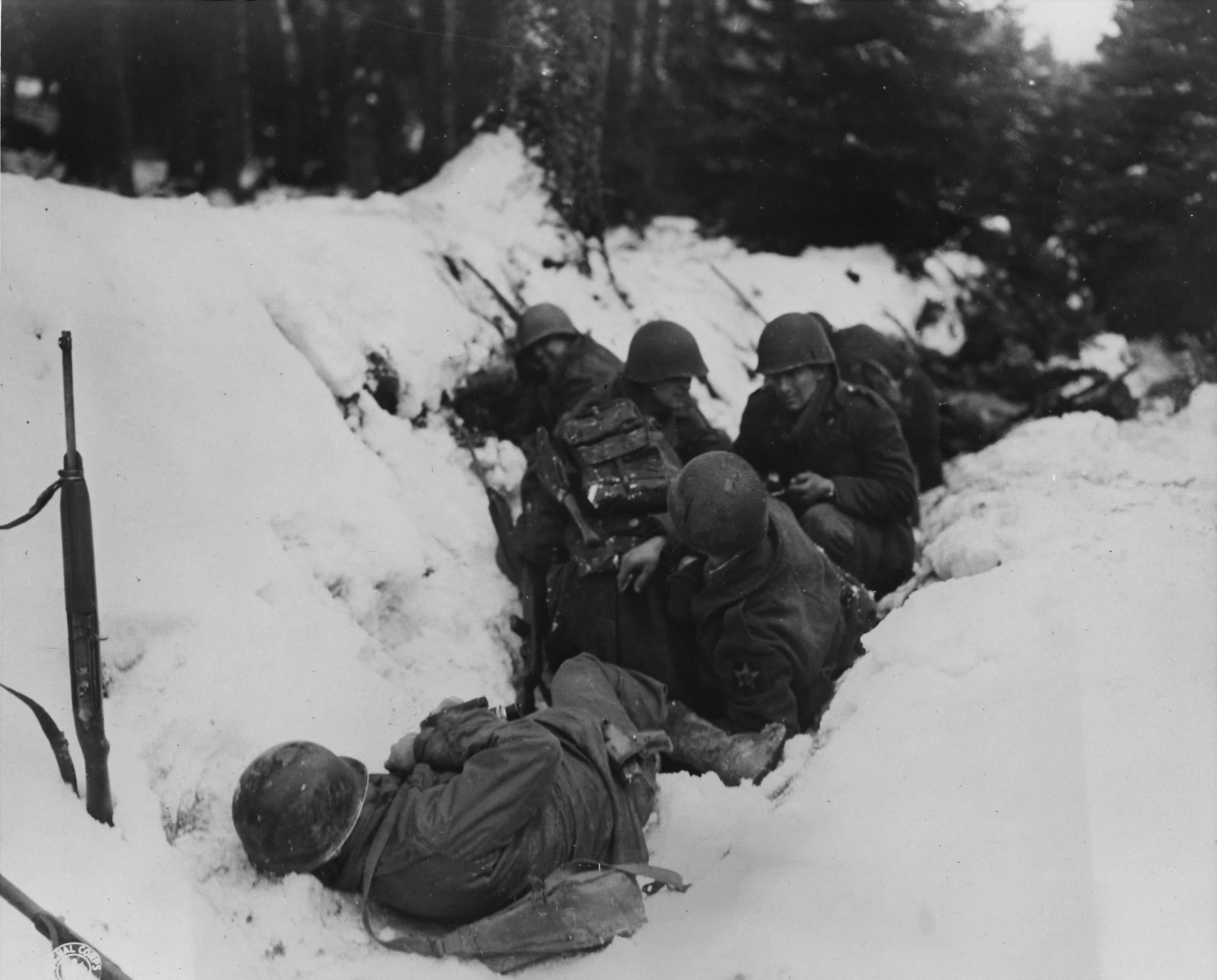
Americans in a snowy trench in the Ardennes in early December of 1944
As 1944 came to a close the situation in Germany was growing desperate. The compounding losses on the Eastern Front that had been locked in since Kursk in 1943 had finally arrived at the Reich’s pre-war frontier, and combined with the reopening of the Western Front had seen the loss of almost all of occupied Europe in the span of six months. Small victories won on the East Prussian border and the larger one in Holland had slowed the oncoming disaster, but not halted it, and now the Fuhrer was preparing an audacious new plan to reverse his nation’s fortunes and salvage the situation at the eleventh hour.
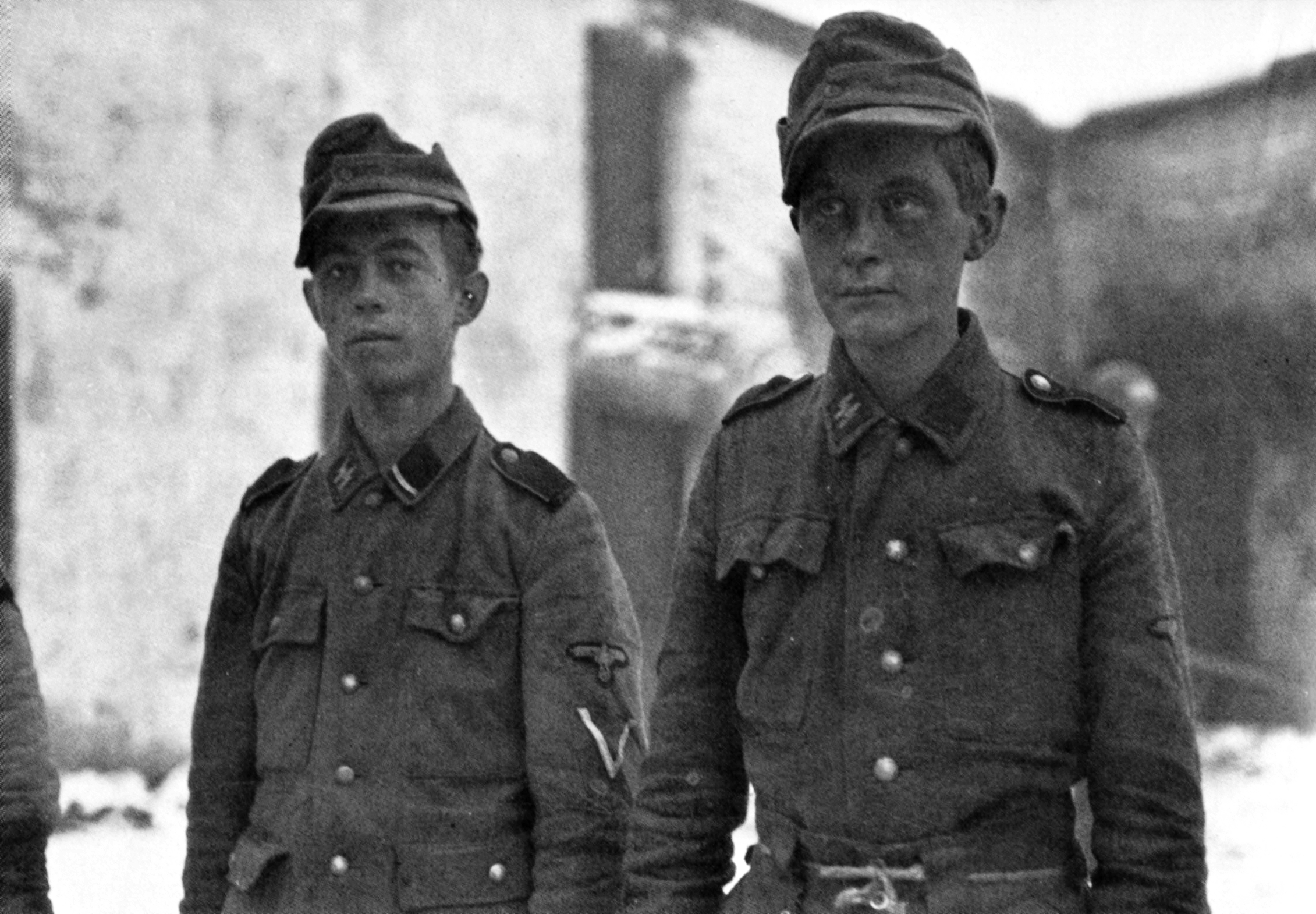
Two very young SS panzergrenadiers on the Western Front in late 1944
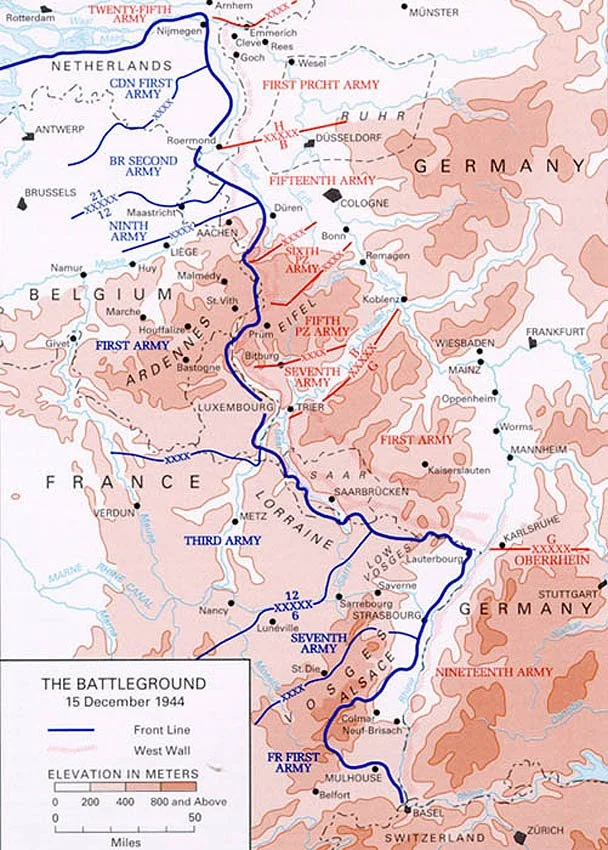
Operation Wacht am Rhein (“Watch on the Rhine”, the name of a patriotic song selected in part to provide the appearance of a plan of defense along that river) was drafted with an aim to punch through the weaker American lines in the Ardennes Forest in Belgium, retracing in part the route used by the Wehrmacht to overrun France in 1940. This move was to be accomplished by four field armies, with an end goal of retaking the port of Antwerp and dividing the Allied armies.
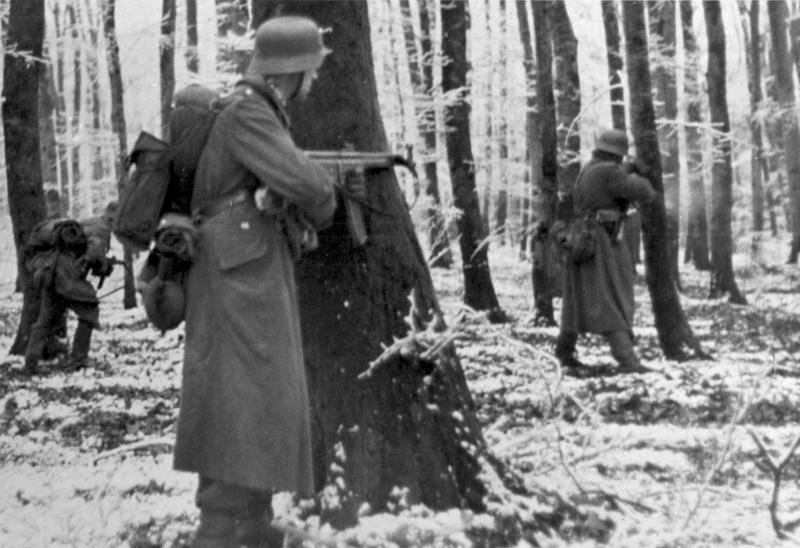
German soldiers in a forest in Luxembourg
Four field armies were made available, constituting most of what remained of the Germans’ strategic reserves, with large panzer formations forming the spearheads. The odds against the Germans were steep at this phase of the war; critical shortages of fuel meant that the panzers would need to secure Allied stocks as they advanced, while the near destruction of the Luftwaffe meant that poor weather was a mandate to negate Allied aerial reconnaissance and strikes at the vulnerable panzer columns. In order to conceal the buildup of forces, the Germans observed strict radio silence, and transmitted most critical orders via courier and over secured telephone lines, a luxury provided by operating within their home territory as opposed to occupied enemy lands.
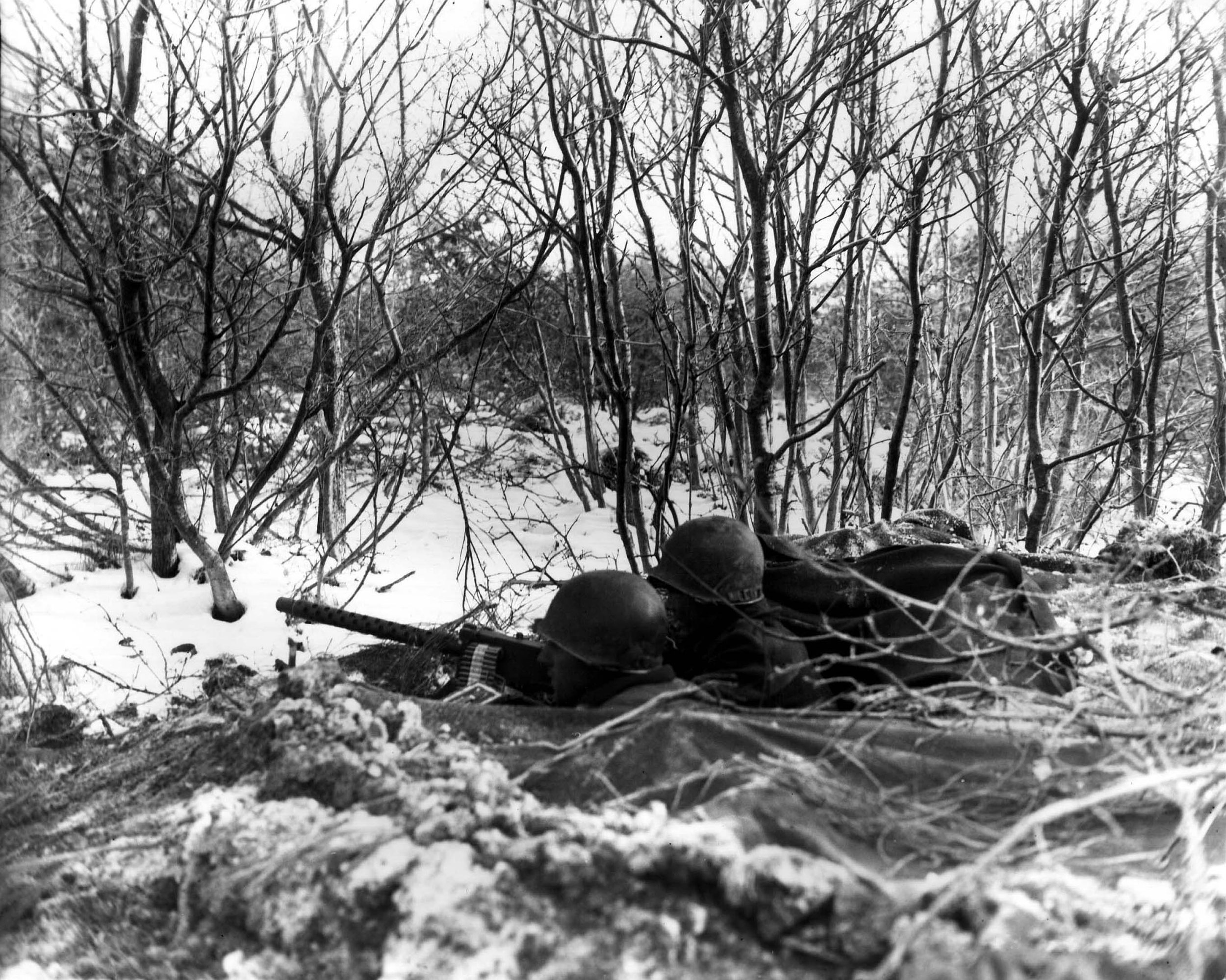
An American MG nest along the lines in the Ardennes
For the Allied forces, they had been slowed by the defenses of the Siegfried Line as well as the stretched supply lines from their dash across France in the summer. Most reserves had been expended in the abortive Market Garden operation, and the men themselves were exhausted after months of hard fighting. The Ardennes sector, considered low risk, was being used chiefly as a rest area for the American armies, confident in the defensive advantages of the terrain and the perceived weakness of the German forces in the area.
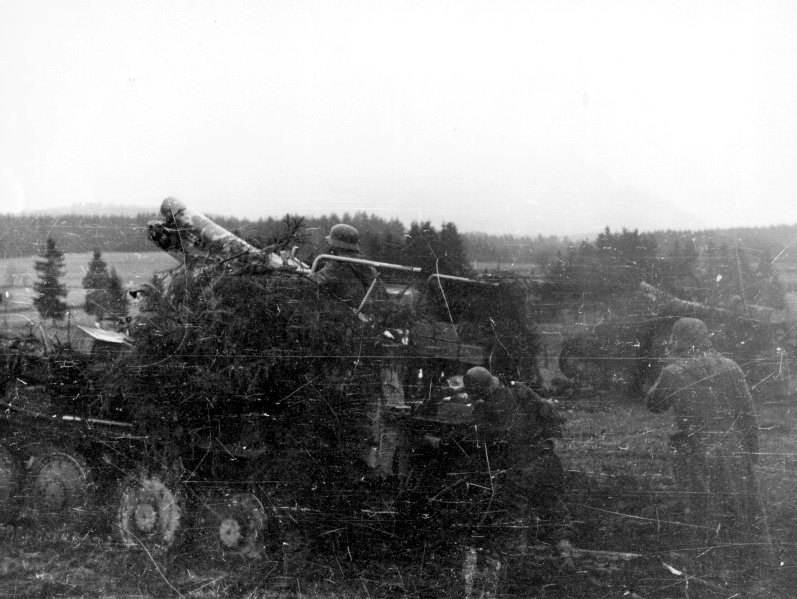
German self propelled howitzers in action on the opening day of the offensive
The German offensive was opened on 16 December of 1944, with a large bombardment along an eighty mile long section of the front in the Ardennes sector. After an hour and ahalf, the German columns jumped off into a worsening blizzard, with the conditions grounding the Allies’ air power even as it hampered the attackers on slippery roads with poor visibility. The first phase objectives were the small Belgian towns of St. Vith and Bastogne, major crossroads in the dense Ardennes forest.
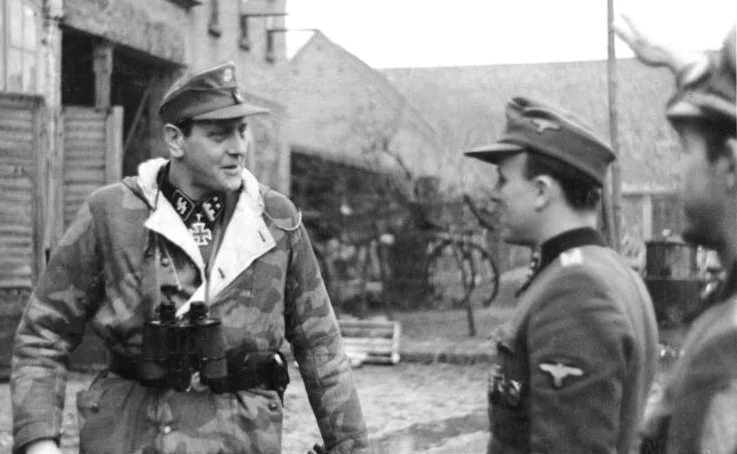
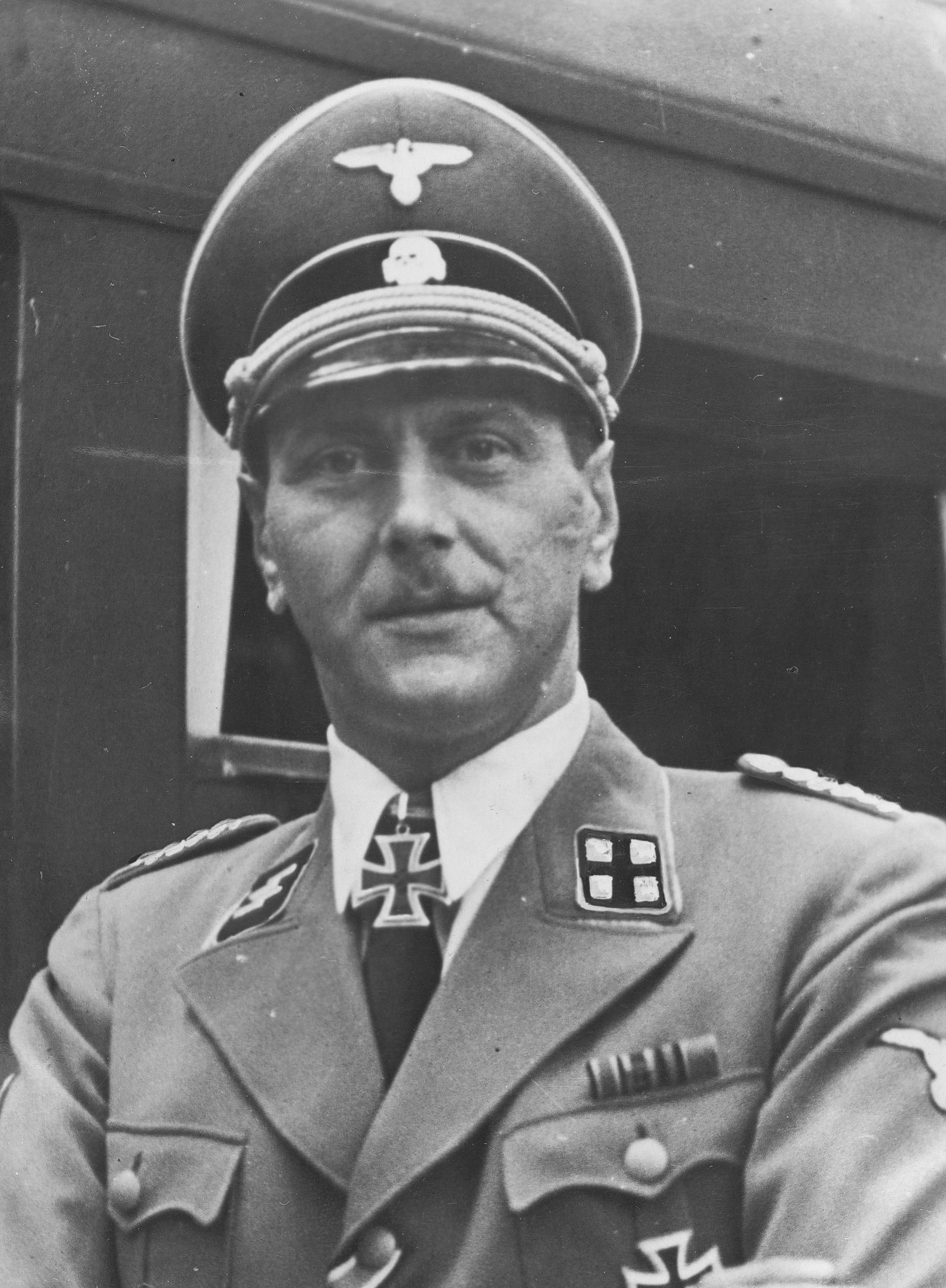
Otto Skorzeny with SS special forces
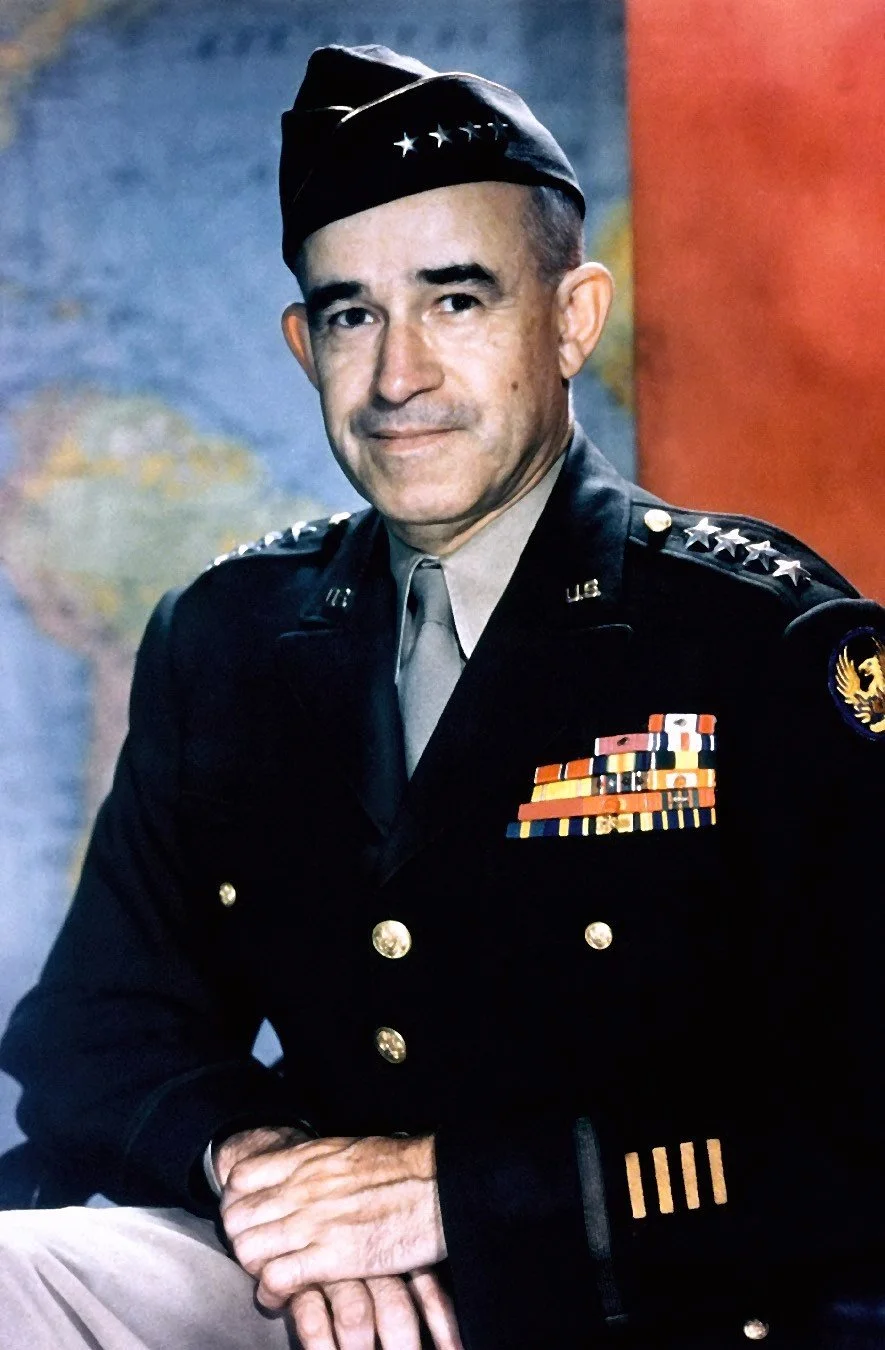
Preceding them, SS commandos under the leadership of Otto Skorzeny, fresh from the coup in Hungary and leader of the raid that liberated Mussolini in 1943, had begun to infiltrate the American lines along the entire sector. Designated Operation Griffin (Unternehmen Greif), this saw Germans wearing American uniforms and driving American jeeps enter the lines, recruited from the ranks of German soldiers able to speak English, especially with American accents. This request had only produced a few dozen fully viable recruits for the special Panzer Brigade 150, as well as a lack of captured equipment, which was made up for in part by disguising panther tanks as American tank destroyers. Despite their small size, the unit sewed confusion throughout the American ranks as they switched road signs, delivered false orders, and marked non-existent minefields. The paranoia that resulted even led to General Omar Bradley being detained for questioning by an American patrol. Even General Eisenhower was effected, being placed under heightened security out of concerns that Skorzeny would attempt to abduct of assassinate the Supreme Allied Commander.
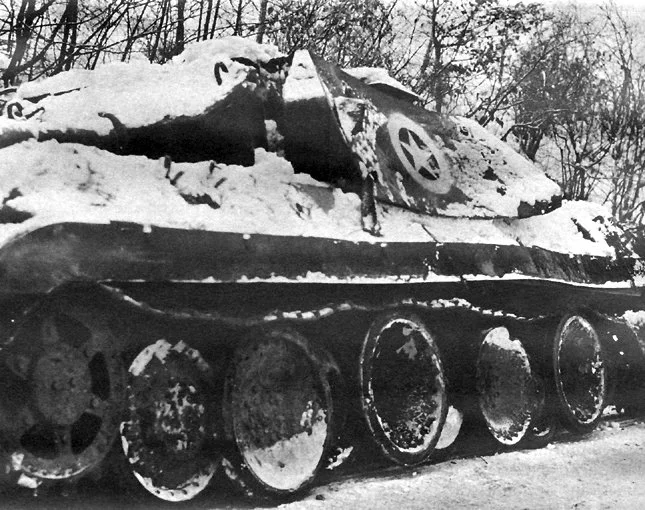
A knocked out Panther tank, disguised as an American tank destroyer
Despite its losses, the Luftwaffe also had a role to play in the offensive. On 17 December Operation Hawk (Unternehmen Stosser) was launched by Fallschirmjager of a hastily organized Kampfgruppe consisting of elements of various Luftwaffe paratrooper and field units, most of whom had never performed so much as a training jump before. The operation got off to a poor start, as delays in massing the required transports put the drop off by 24 hours, and the green pilots assembled were no better than the troopers in their holds, especially during a heavy snowstorm with near zero visibility. Many went off course and dropped their men over German territory well away from the front, and in the end only some 300 of the 1,200 men intended for the drop actually landed in the Ardennes (and survived the drop itself, with many inexperienced troopers being killed on impact with the ground or ripped from their parachutes by the storm). Without enough men or munitions to secure their objectives near Malmedy, the Fallschirmjager performed reconnaissance and dug in to wait for the arrival of the ground forces, and in the end had no significant role to play in the battle.
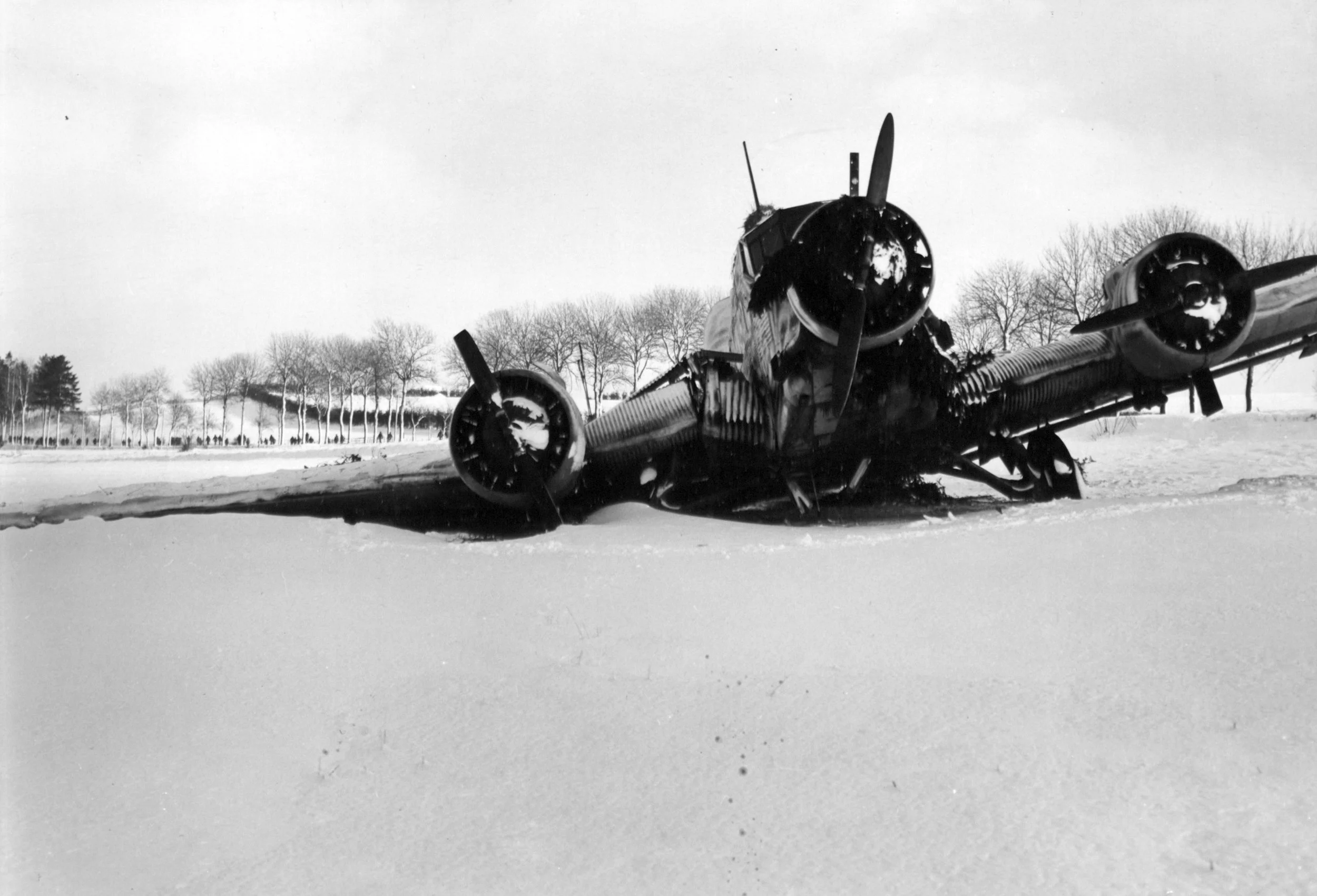
A JU52 transport plane crashed near St. Vith
For the main German assault, the three German armies struck at the American lines through the fog and smoke left by the opening bombardment, slamming into the dazed GIs in their frozen foxholes. On the southern flank, the German 7th Army engaged the US 4th and 28th Infantry Divisions as part of a drive to retake Luxembourg City and secure the flank of the main advance. The American units here, fresh from the hellish fighting for the Hurtgen Forest, found themselves in another desperate battle for survival, but their experience paid dividends. In a series of vicious small unit fights, the Americans pulled back slowly, holding the Germans for days along the Our River among other places, severely delaying the offensive timetable. Still organized, they were pushed backward, with many concentrating at the important crossroads town of Bastogne. This strong position, bypassed by the initial German assaults, would evolve into one of the most important sites in the battle to come.
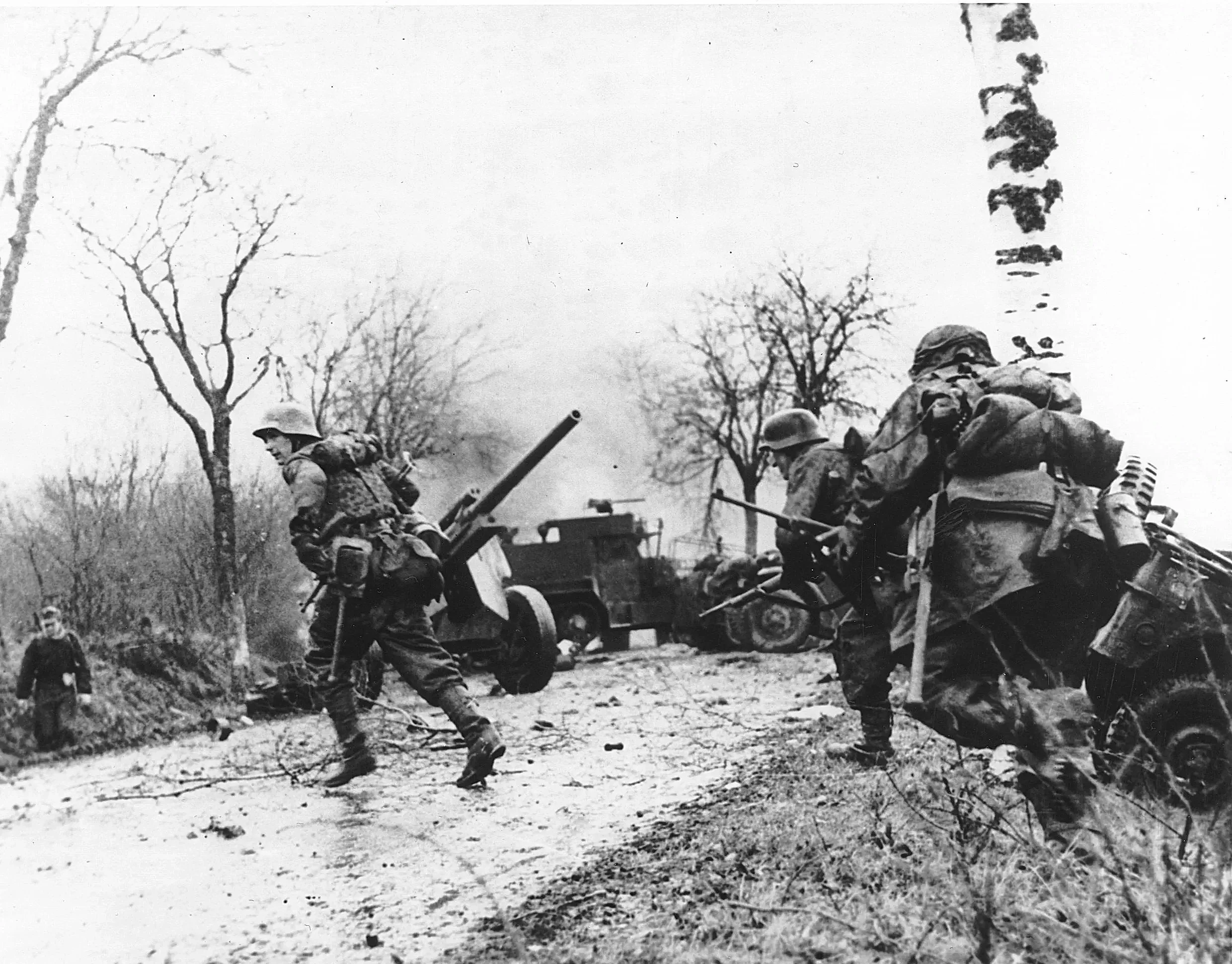
German soldiers cross a road strewn with wrecked German vehicles
In the center, the German 5th Panzer Army struck at the American lines held predominantly by the green 106th Infantry Division, which had only entered the line on 11 December. On the first day of the offensive two entire regiments of the 106th were enveloped by the Germans in the Schnee Eifel, and after three days of desperate fighting the Americans had exhausted their ammunition. The subsequent surrender of almost 9,000 American soldiers would represent the single largest defeat ever inflicted upon the United States by Germany.
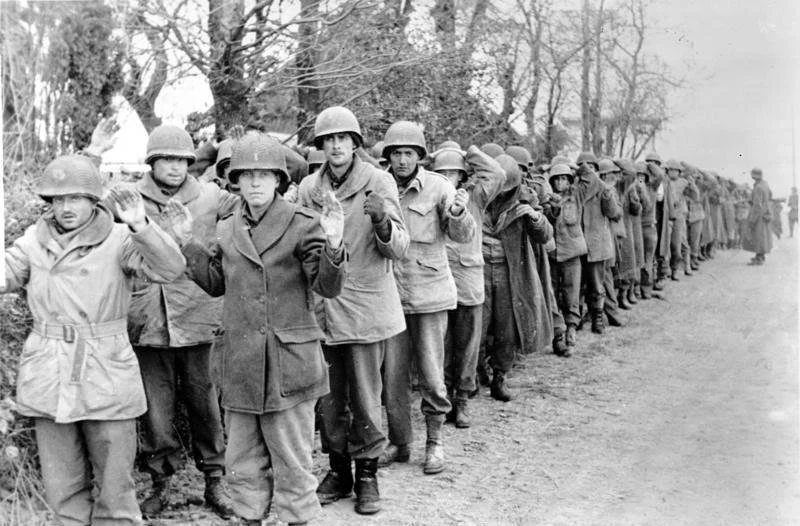
American prisoners under German guard
As the bulk of the 106th was fighting its battle, the Germans drove on the critical crossroads town of St. Vith, defended by the US 9th Armored Division along with elements of the US 28th Infantry Division and the remnants of the 106th that had avoided encirclement. The battle for St. Vith would consume a further five days as the Germans attempted to push through the narrow streets of the town, the Americans making a strategic withdrawal to prepared positions to the west on 21 December. These actions further disrupted the delicate German operations timetable in the Ardennes, with each hour lost pushing them one step closer to disaster.
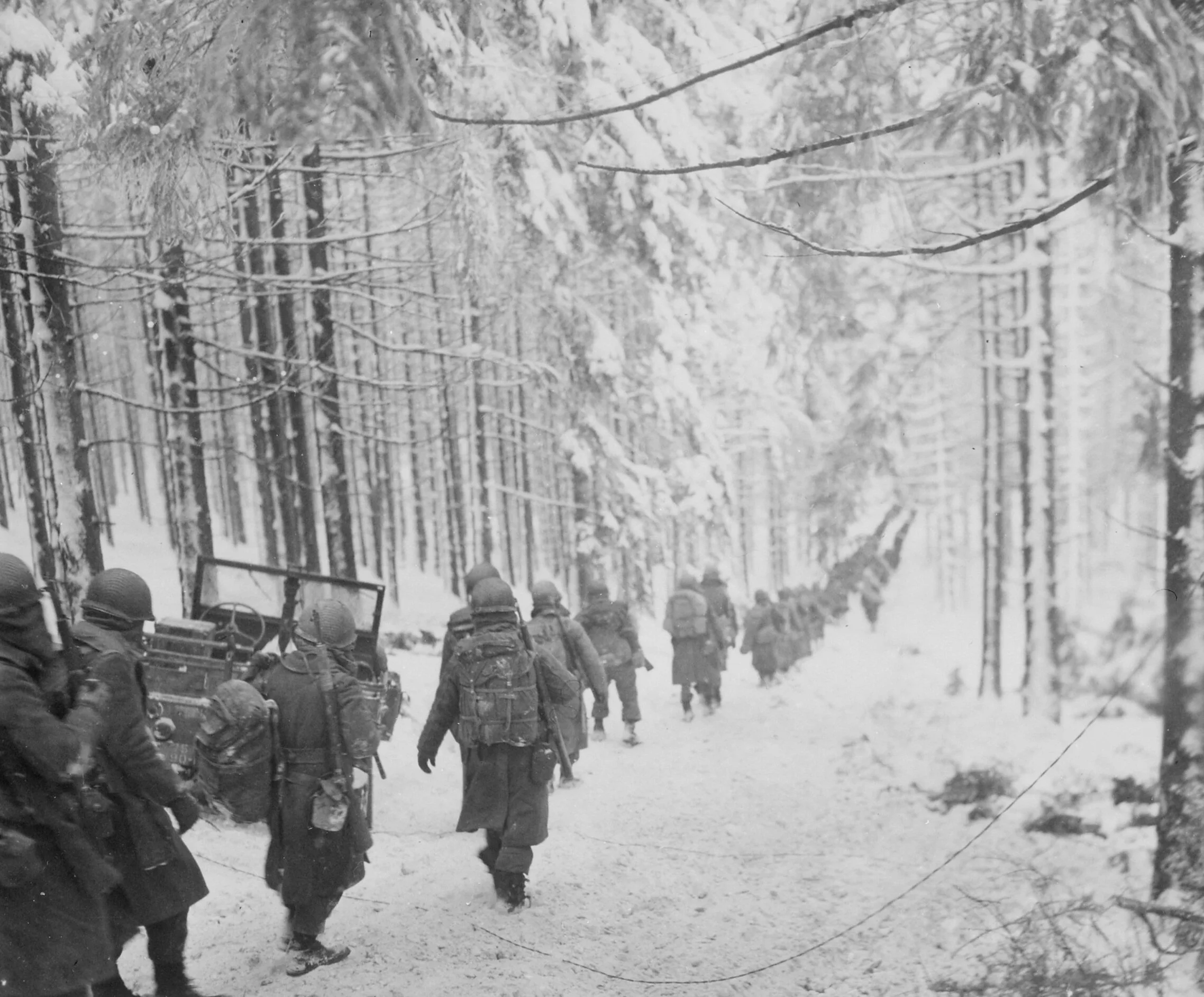
American troops move through the snow covered forest toward St. Vith
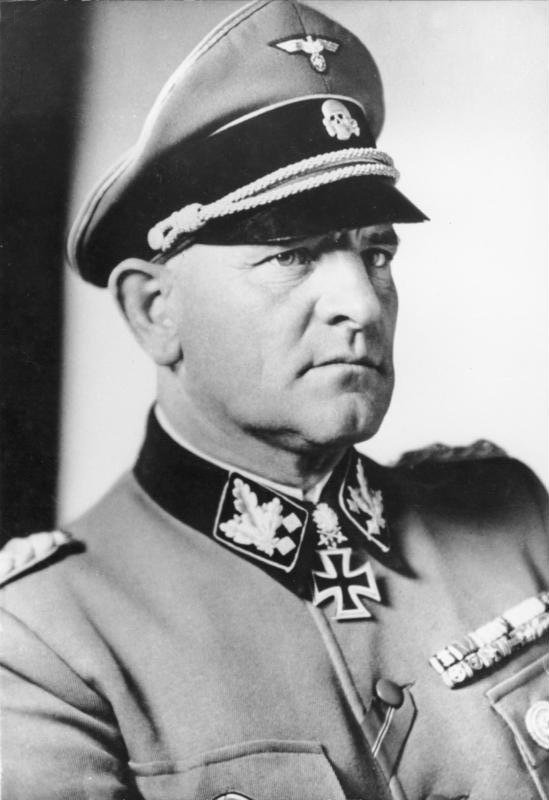
In the north, the main blow of the German offensive fell on the lines of the US 2nd and 99th Infantry Divisions. The German 6th Panzer Army was tasked with this critical sector, led by SS Oberstgruppenfuhrer Sepp Dietrich and containing some of the best units still available to the beleaguered Reich. By contrast, the 99th Division had only been in combat since early November, holding the contemptuous nickname “Battle Babies” from the veteran American units stationed nearby. The initial attack shattered the American line, but despite this the 99th managed to maintain cohesion, and pulled back to prepared positions along the Elsenborn Ridge. Thus entrenched, and joined by veterans of the 2nd Infantry Division, the Americans held a nearly unassailable position that commanded the Germans’ main axis of advance. For ten days, the Germans attempted to break the American line along the ridge, resorting to deploying their panzer reserves for frontal assaults, but all were stymied. The Germans elected instead to bypass the position, and on 26 December broke off their attacks. The timetable of the offensive, so sensitive to change, had been irretrievably lost.
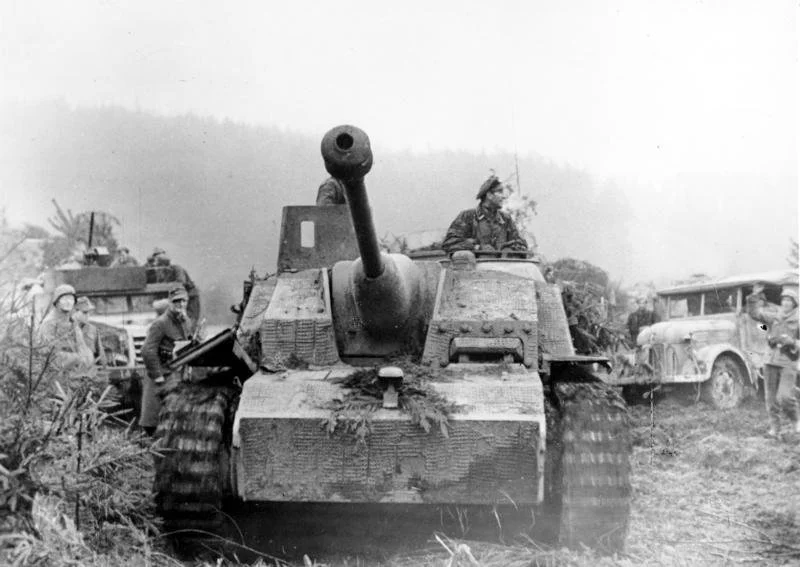
German armor moves forward along with captured American vehicles
As the German advance continued, the American forces pushed into the town of Bastogne soon found themselves isolated, with the 101st Airborne Division hurriedly brought forward into the village before it became enveloped. By 20 December, the Germans had closed the encirclement of the town and begun to lay siege, the American perimeter having been set up on a ring in the forests outside the village itself, manned by the paratroopers of the 101st along with elements of the 9th and 10th Armored Divisions forming a rapid reaction force. A platoon of tank destroyers was also available, plus two field artillery units with large caliber howitzers to augment their defensive firepower, along with various small remnant forces scattered by the initial German attacks.
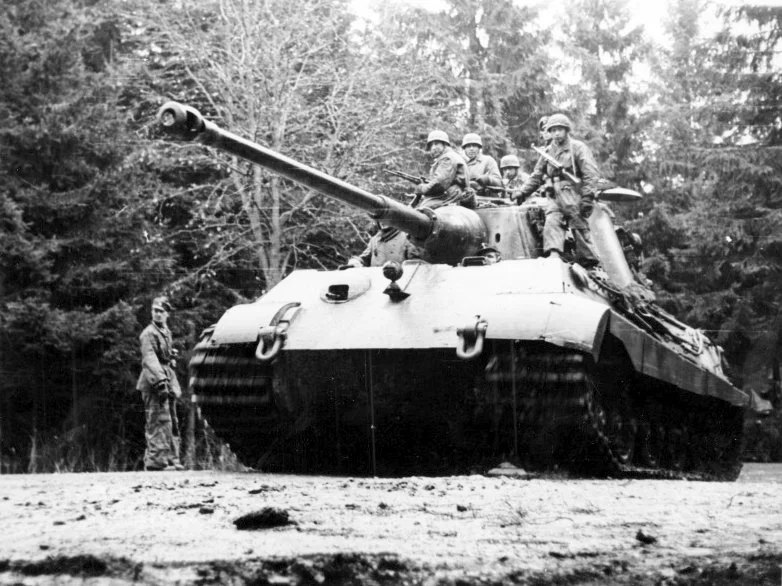
A German Tiger II tank with mounted infantry
As the siege began, poor weather allowed the Germans to operate without fear of air attacks as they pressed the Americans in Bastogne, and the same poor weather made it extremely difficult to air drop supplies to the defenders. Moved into the area rapidly from resting and refitting after the Market Garden fiasco, the 101st paratroopers (along with many of the other Americans in the Ardennes) had inadequate supplies of almost all types, including munitions and winter clothing. The situation in the frigid foxholes along the lines outside Bastogne was miserable for all involved, and on 22 December the Germans issued an ultimatum to the defenders of Bastogne to surrender or face annihilation. This elicited from the American commander a one word reply that would become famous:
“NUTS!”
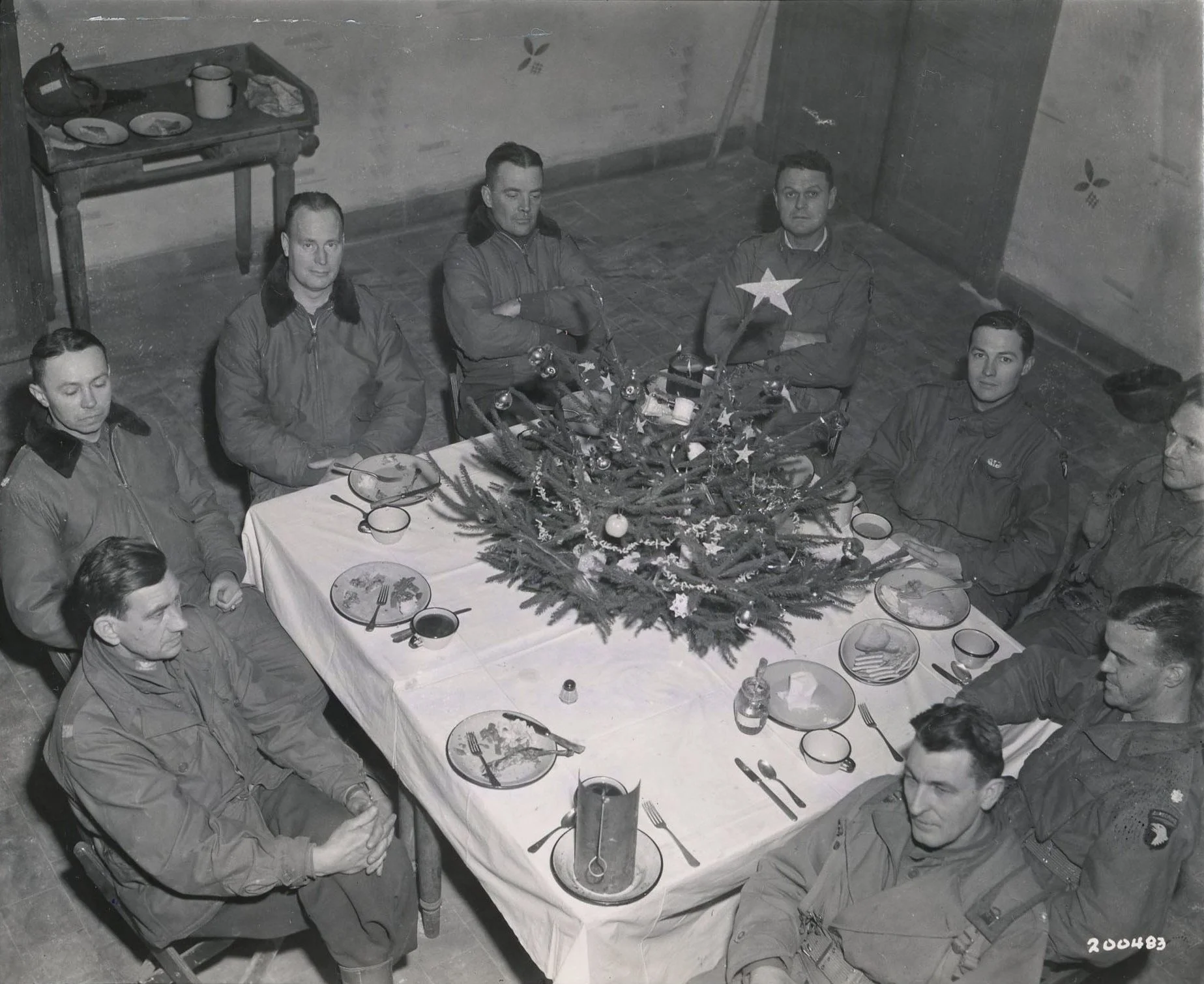
General McAuliffe and other officers of the 101st Airborne Division celebrate Christmas in Bastogne
The Americans in Bastogne dug in to hold against repeated German assaults over the following days, including raids by Luftwaffe bombers on Christmas Eve night. On Christmas Day the Germans launched a concerted assault on the town driving from the northwest, hoping to break the Americans and finally secure the strategic crossroads. Beginning the attack in the predawn hours German infantry supported by Panzer IV tanks managed to break through the perimeter and reached the edge of Bastogne, but as they approached they were caught in a murderous crossfire of small arms fire that decimated their attached infantry. Bazooka fire mixed with American tank destroyers likewise pummeled the panzers, inflicting heavy losses, and by the mid afternoon the Germans ceased their attacks. The next day American tanks from the 4th Armored Division broke through the German lines southwest of Bastogne and linked up with the defenders, lifting the siege, although fighting would continue around the town for some time to follow.
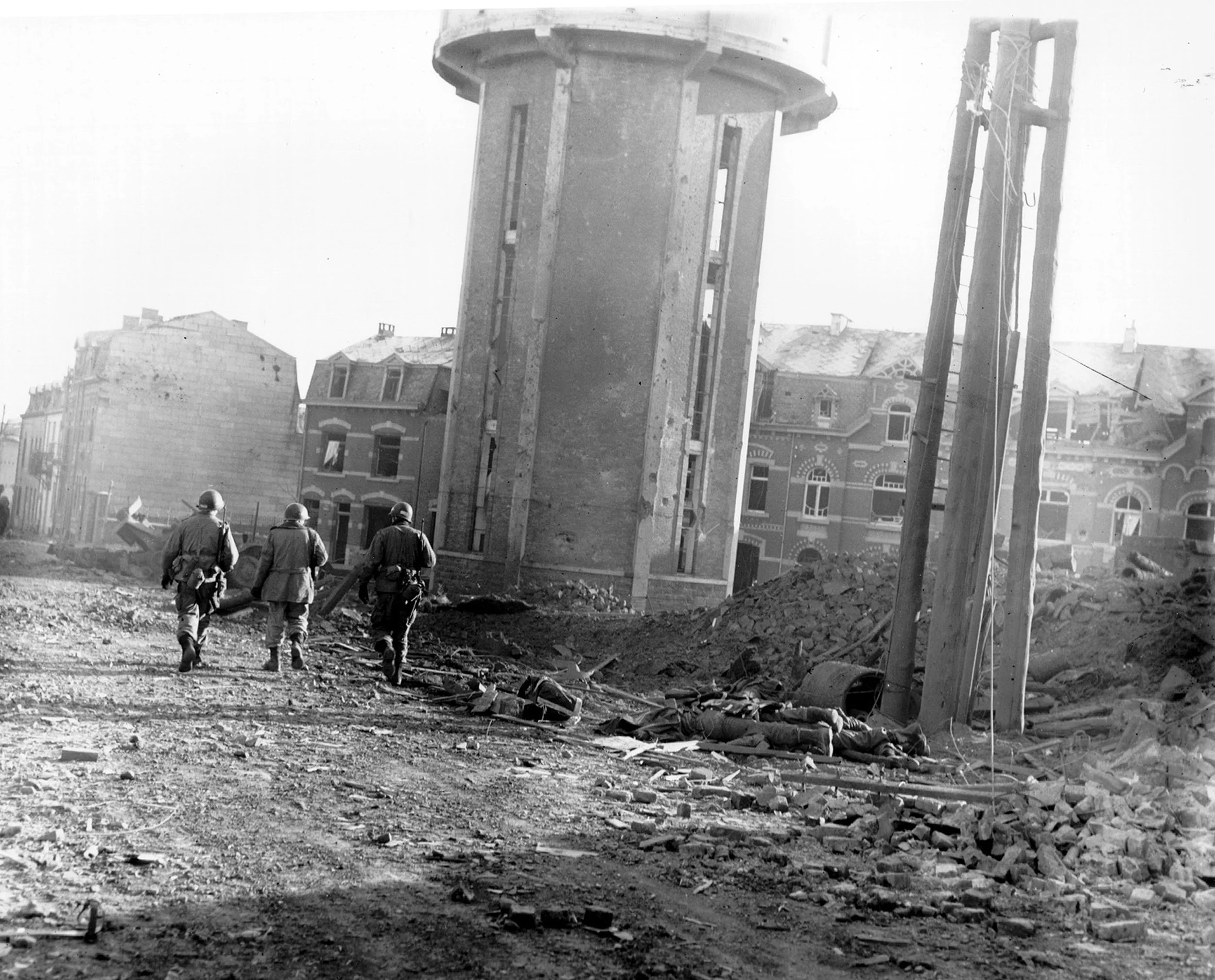
101st Airborne paratroopers on the blasted streets of Bastogne
By this time Operation Wacht am Rhein was beginning to collapse. The clearing weather that allowed the Luftwaffe to strike at Bastogne on Christmas had likewise allowed American fighter bombers to begin savaging panzers whenever they ventured into the open in daylight, and the Americans had been successful in destroying supply dumps critical to fuel the German advance. The offensive was effectively halted by 28 December, with American reinforcements flooding the region and British forces moved to counter any further breakthrough into Belgium.
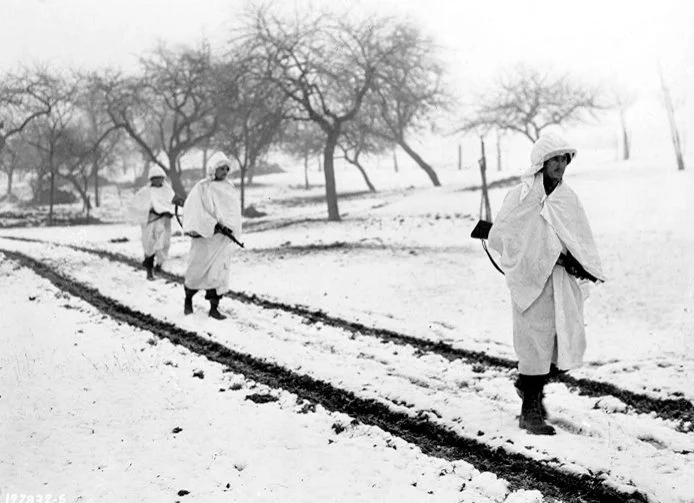
American soldiers patrol in the Ardennes, clad in capes made of bedsheets as snow camouflage
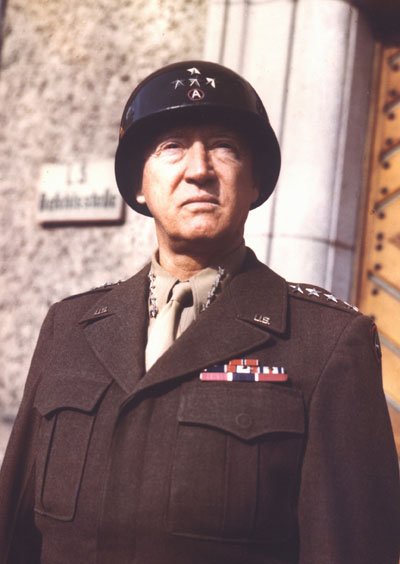
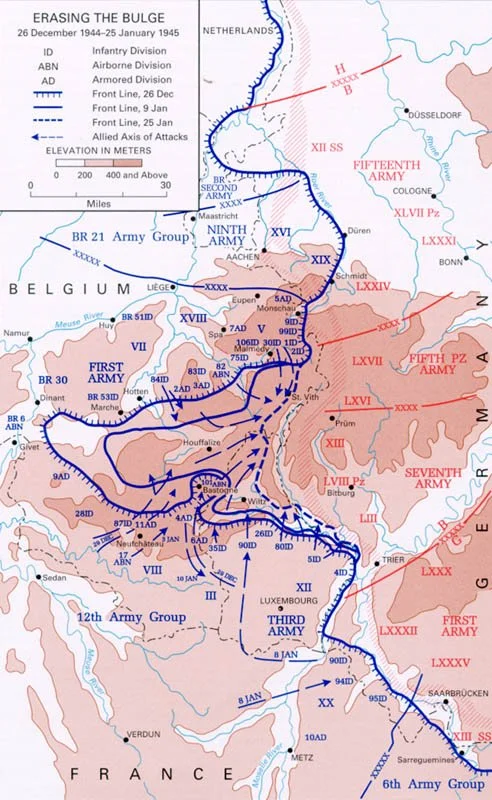
With the New Year came an Allied counteroffensive intended to reduce the “Bulge” (the large salient in the line created by the German offensive, so named by the American press). Intending to be a link up between Patton’s US Third Army coming from the south and Bradley’s US First Army (under Montgomery’s British 21st Army Group) in the north, this led to further ferocious fighting, especialy in the south around Bastogne. Despite the desperate fighting, however, the German drive was spent by the end of the first week of January, and OKW was forced to admit defeat. Orders were issued for a fighting withdrawal to prevent the German forces in the salient being cut off as had happened the previous summer around Falaise, and by February the Germans had been pushed back to their starting positions.
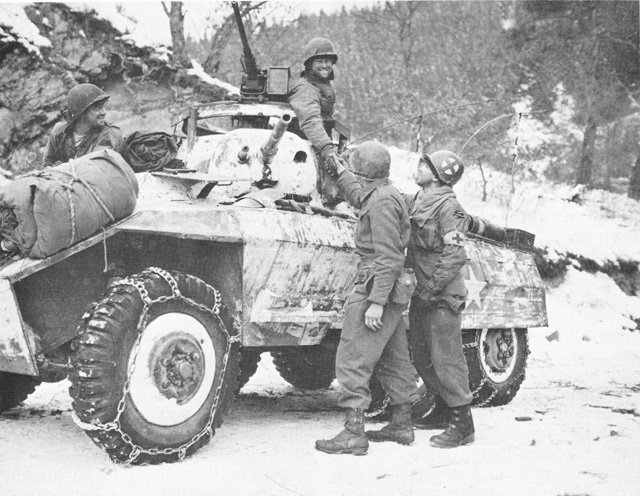
The US 1st and 3rd Armies link up as the “Bulge” is closed
The advance would lead to revelations as well regarding the brutality of the desperate Nazi regime in these waning months of the war. On the second day of the offensive, 17 December, the lead units of the SS Kampfgruppe Peiper had been stalled by stiff American resistance, and keeping in mind the orders from Hitler himself to “show no inhibitions”, a terrible fate awaited some of the prisoners in German custody. In numerous cases, POWs were summarily executed by passing German troops and SS officers, sometimes after being processed as standard POWs and gunned down in formation, others they were simply shot as they approached under white flags.
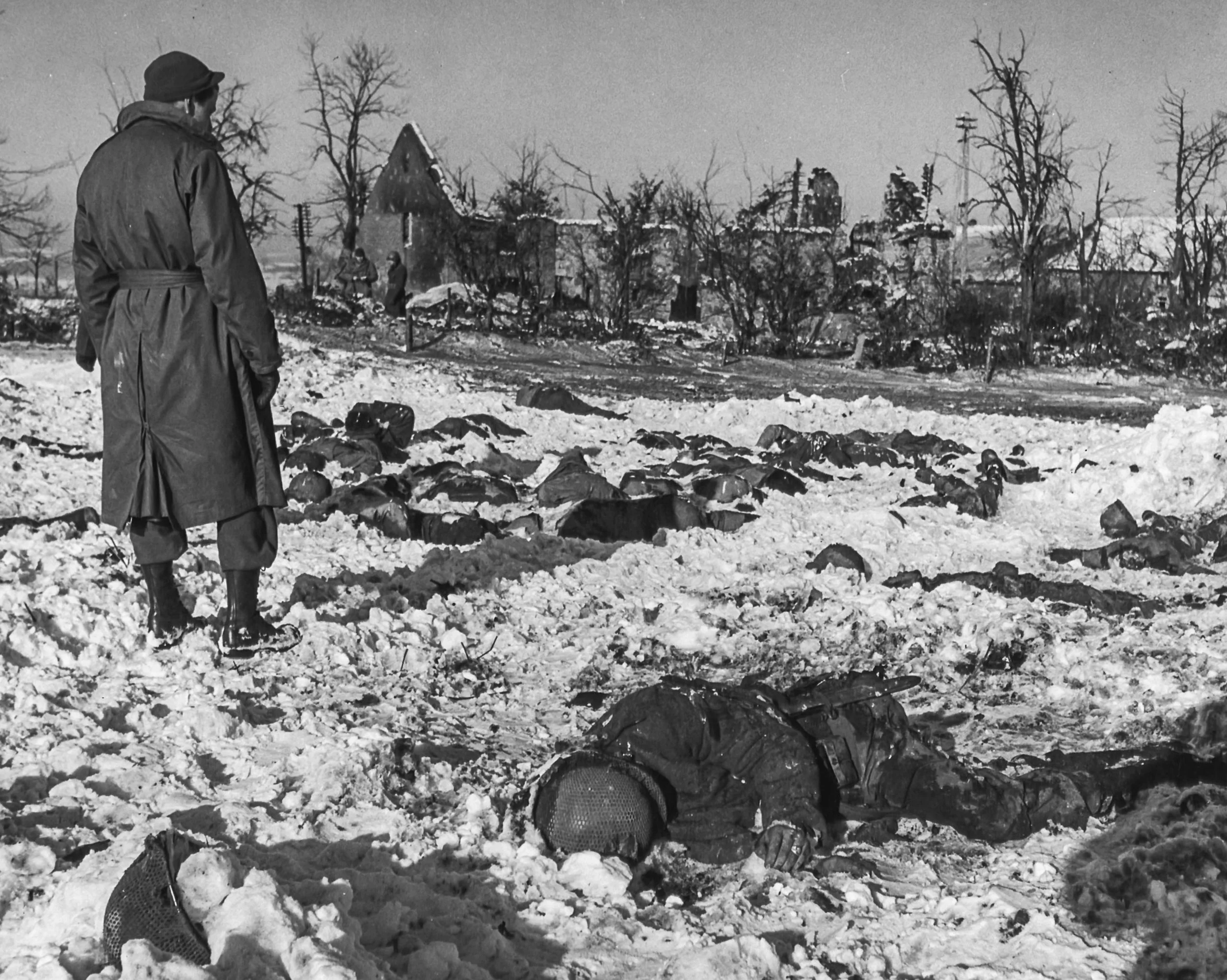
In the most infamous episode, Peiper’s SS troops herded 120 American prisoners taken after ambushing a convoy into a field at a crossroads near Malmedy and opened a murderous crossfire with small arms and machine guns. Some of the men attempted to take shelter in a nearby building, but the Germans set fire to it, shooting those who escaped. Afterward, SS men moved through the snowy fields and shot those who showed signs of life, and in the end the death toll would be listed as 86. The scattered survivors conveyed the horrifying tale to their comrades, leading to a terrible resolve taking hold of the American soldiers in the area. Unofficial American reprisals against German prisoners of both Wehrmacht and SS POWs took place as the “Bulge” was closed, and the discovery of the field of frozen corpses at Malmedy in January of 1945 led to documentation for planned post-war trials of the perpetrators.
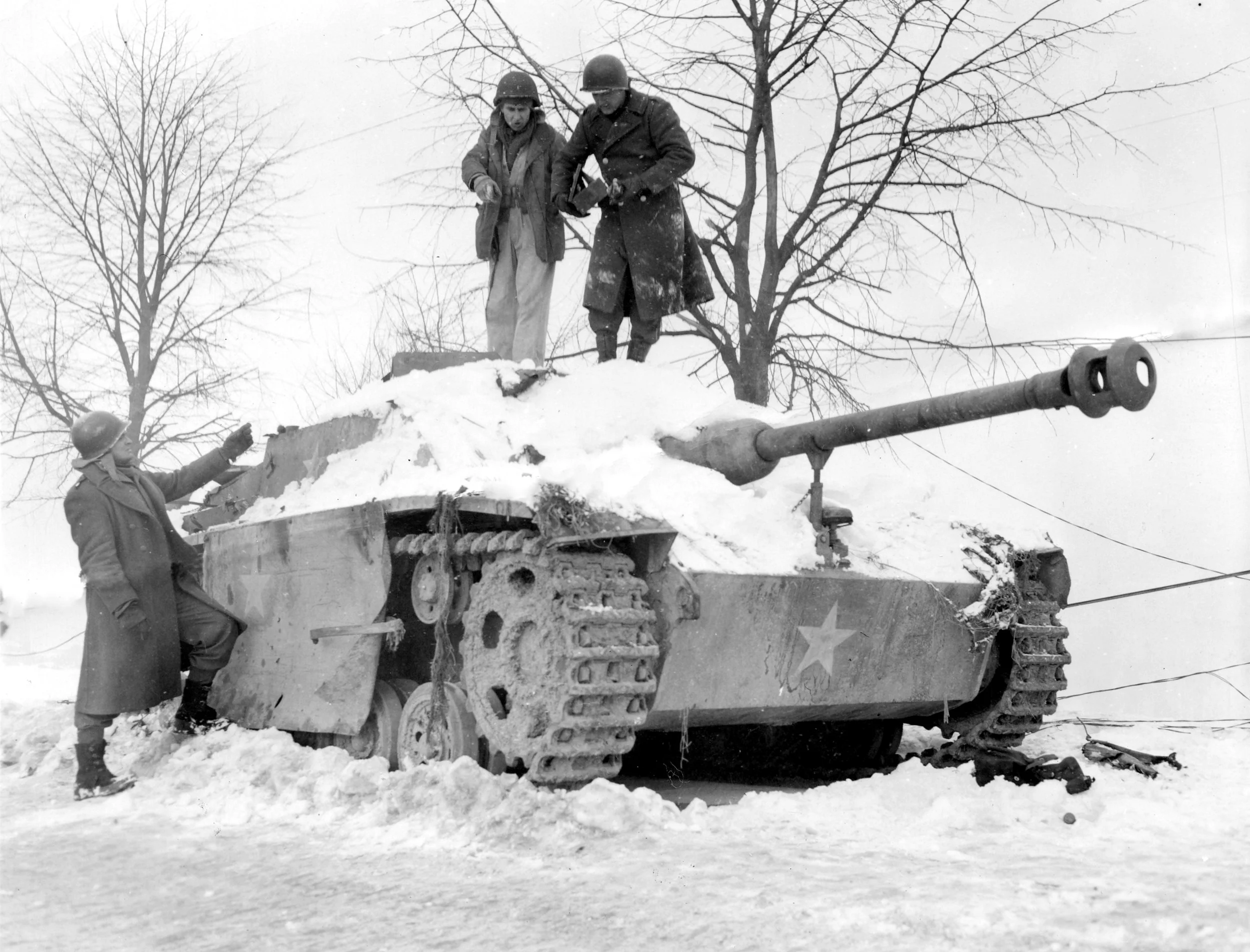
American soldiers inspect a knocked out STUG assault gun, bearing a US star
The offensive in the Ardennes represented the last serious effort the German military had in it to turn the disastrous situation around. After years of terrible fighting, this campaign had consumed most of what remained of the Nazis’ military strength. The war was not yet over, but never again would the Wehrmacht be capable of a large scale offensive.
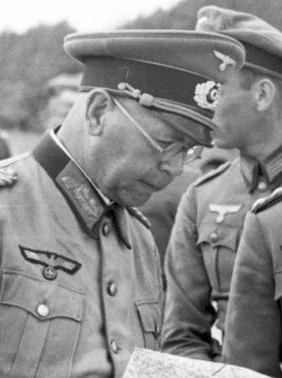
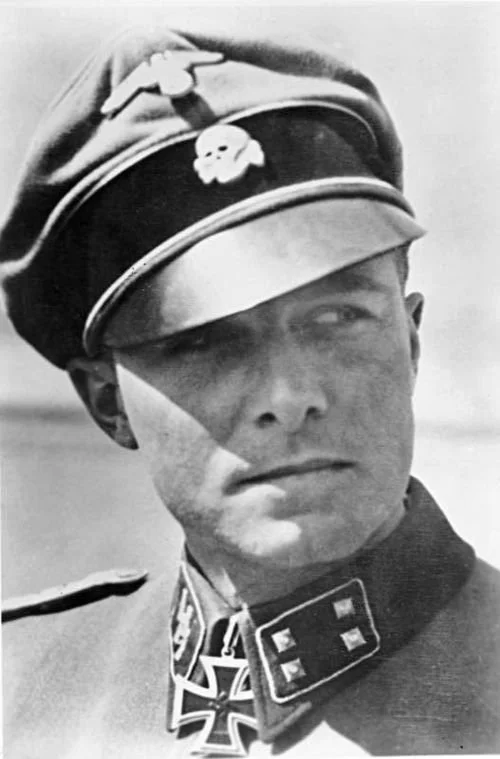
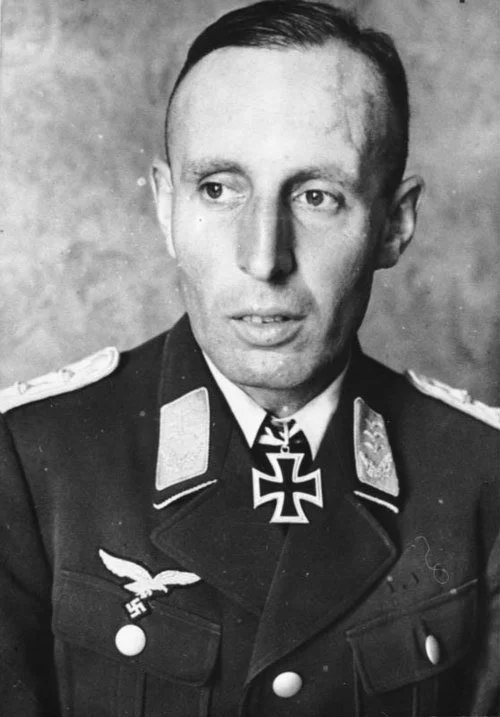
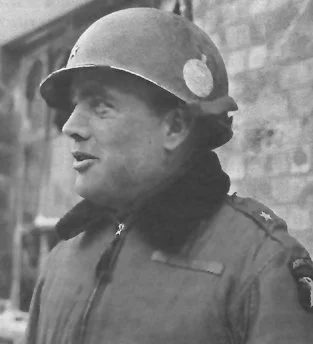
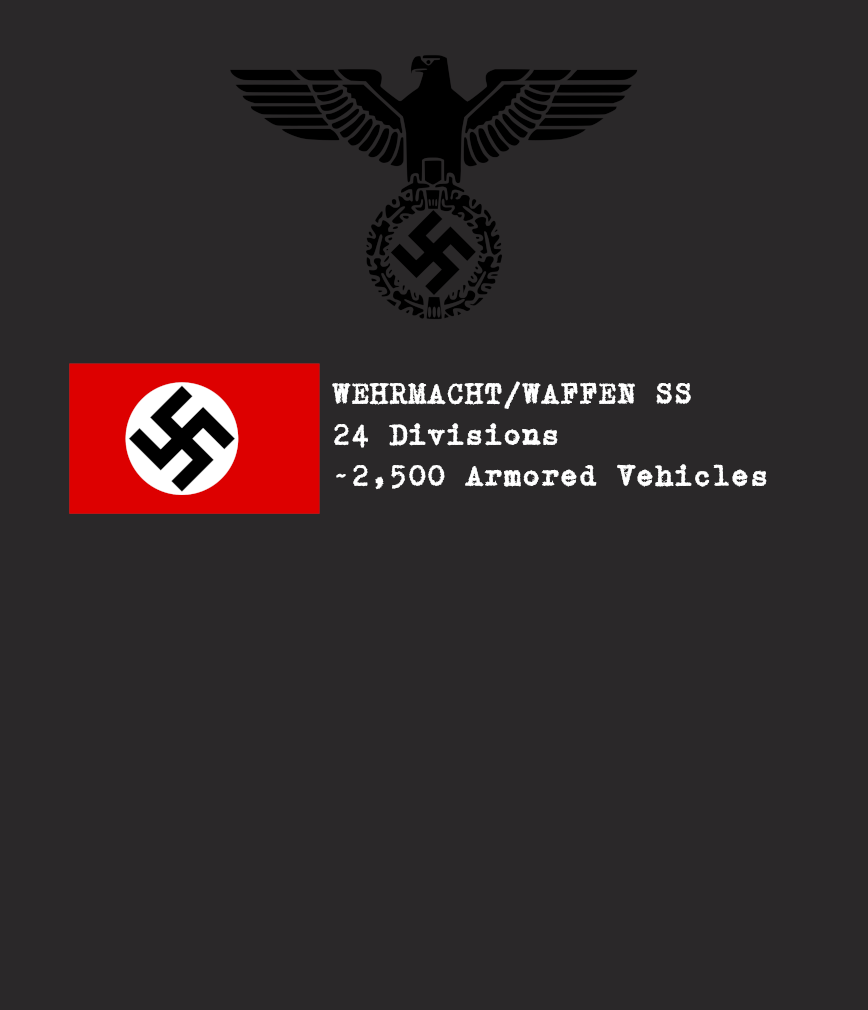
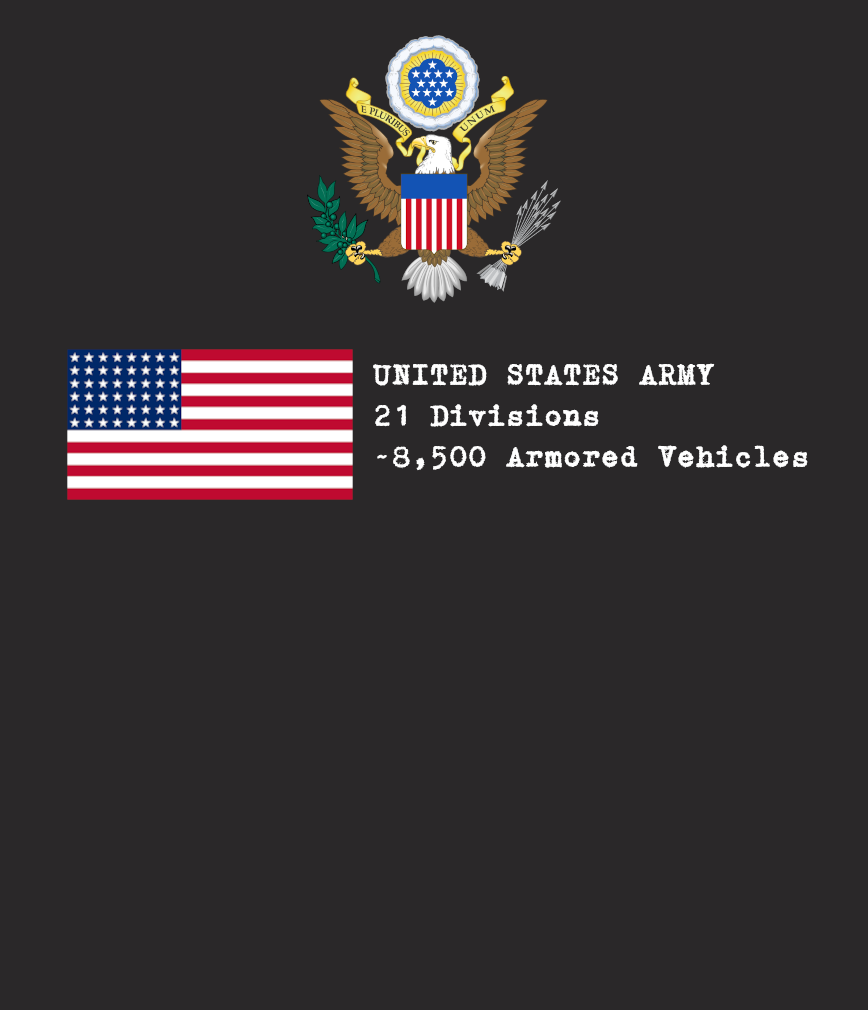
The Commanders